
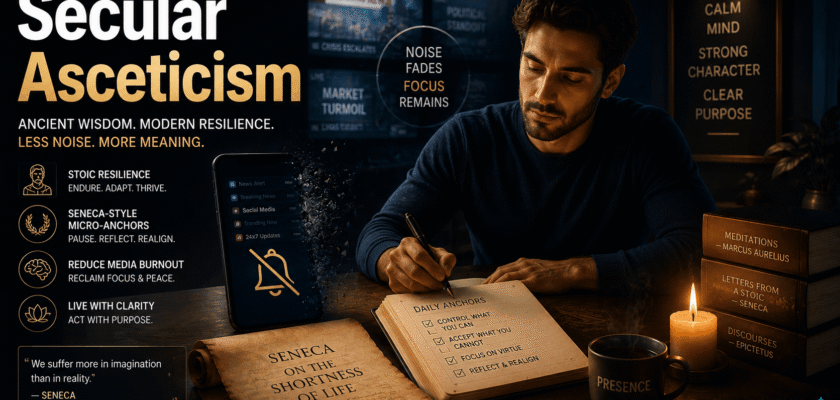
Secular Asceticism: A Calm Answer to Media Burnout
Secular asceticism is a practical way to reduce media burnout without leaving modern life. It means choosing limits on purpose. It also means protecting the mind from constant alerts, outrage loops and endless breaking-news feeds.
Many readers feel tired because media now moves faster than the nervous system can process. War updates, market shocks, crime clips, AI panic and political fights arrive all day. As a result, the mind stays alert even when there is no direct action to take.
Ancient Stoics faced a different world, yet their method still helps. Seneca often advised people to guard their time, test their desires and return to what they can control. Therefore, his ideas can be translated into a modern routine for news fatigue.
Secular asceticism does not mean ignoring the world. Instead, it means receiving the world with structure. You stay informed, but you stop letting every feed decide your mood.
| KEY TAKEAWAYSecular asceticism is not about fear or withdrawal. It is a daily discipline that limits noisy inputs so your attention can return to useful action, clear thinking and inner steadiness. |
Secular Asceticism and the High-Velocity Media Problem
High-velocity media creates pressure because it rewards speed, emotion and repetition. A person may read the same crisis from ten different angles, yet still feel less prepared.
The Reuters Institute has reported a long trend of falling news interest and rising news avoidance. It also notes that many people turn away from news because it feels negative, repetitive or exhausting.
Meanwhile, newer research on social media news exposure suggests that routine news feeds can affect stress, anxiety and mood. This does not mean all news is harmful. However, it does show why attention needs boundaries.
What Seneca Can Teach Without Religious Pressure
Seneca’s value for modern readers is simple. He teaches that peace begins with attention. If the mind is rented to every public noise, it becomes hard to choose a private direction.
Because this article uses a secular lens, readers do not need to follow any religion or spiritual system. The method is practical. You notice what controls you, reduce excess input and return to deliberate action.
That is why secular asceticism fits the modern media environment. It gives people a non-religious path to restraint, reflection and mental space.
The Four Seneca-Style Micro-Anchors
✓ Control anchor: Ask, “Can I act on this today?” If not, limit the loop.
✓ Time anchor: Check news during fixed windows, not every free minute.
✓ Body anchor: Relax the jaw, lower the shoulders and breathe before reacting.
✓ Value anchor: After reading, choose one useful action or close the feed.
| MICRO-ANCHOR BOXBefore opening a news app, pause for ten seconds. Decide what you need to know, how long you will spend and what action will follow. This small pause protects attention. |
A Simple Secular Asceticism Routine for News Fatigue
A good routine should be easy enough to repeat. If the rule is too strict, most people quit after two days. Therefore, start with small limits.
First, remove news alerts that do not require immediate action. Next, choose two daily news windows. Finally, end each window with a calming reset, such as walking, stretching or writing one line in a notebook.
This routine works because it changes the default setting. You are no longer pulled by every alert. Instead, you choose when to meet the world.
The 3-Window Method
✓ Morning: Read one reliable summary for ten minutes.
✓ Afternoon: Check only if work or safety requires it.
✓ Evening: Avoid crisis scrolling in the final hour before sleep.
Why Less News Can Create Better Awareness
Reading less does not always mean knowing less. Often, it means seeing more clearly. When a person avoids repeated clips and low-quality commentary, the important facts become easier to notice.
Moreover, slower news habits can reduce emotional overreaction. A person can wait for verified details instead of reacting to every rumor.
Better awareness is not created by constant exposure. It is created by reliable sources, calm timing and useful context.
How to Build a Stoic Media Diet
✓ Choose two or three trusted sources instead of ten noisy feeds.
✓ Read explainers more often than live outrage threads.
✓ Turn off non-essential push alerts.
✓ Keep social media news away from bedtime.
✓ Use bookmarks for thoughtful reading, not doomscrolling.
✓ After every news session, write one line: “What can I control now?”
✓ Replace one scrolling block with walking, prayer, meditation or quiet reading.
Signs You Need Stronger Boundaries
⚠ Your mood changes quickly after opening a news app.
⚠ You keep checking updates even after learning the main facts.
⚠ You feel guilty when you rest from the feed.
⚠ You read crisis content late at night.
⚠ You argue mentally with posts long after closing the app.
⚠ You know many details but feel less able to act.
Secular Asceticism for Solopreneurs and Creators
Solopreneurs, writers and creators face a special challenge. They need trends, but they also need calm focus. Constant media exposure can feel like work, even when it is only avoidance.
A secular ascetic approach helps separate research from noise. For example, a creator can collect ideas during one fixed block, save useful links and then close the feed before writing.
Consequently, the mind receives enough market awareness without becoming trapped in daily panic.
A 7-Day Media Burnout Reset
✓ Day 1: Turn off non-essential news notifications.
✓ Day 2: Choose two news windows and follow them.
✓ Day 3: Remove one app from the home screen.
✓ Day 4: Replace one doomscrolling block with a walk.
✓ Day 5: Read one long-form explainer instead of ten short posts.
✓ Day 6: Write one control list after reading the news.
✓ Day 7: Review which limits improved your mood and sleep.
What Secular Asceticism Is Not
Secular asceticism is not denial. It does not ask people to pretend that war, climate stress, politics or financial pressure are fake.
It is also not privilege-based indifference. In many cases, informed citizens should care and act.
However, caring is different from constant exposure. A person can donate, vote, help, prepare, call family or learn deeply without refreshing the same frightening feed all day.
Organic Search Summary for Readers
Secular asceticism helps people build a calmer relationship with high-speed media. It uses limits, reflection and attention discipline to reduce news fatigue.
Seneca’s old ideas become practical when they are turned into small anchors. Control, time, body and value can guide each media session.
Most importantly, the goal is not to know nothing. The goal is to know enough, act wisely and keep the mind steady.
Conclusion
Secular asceticism offers a clean path through modern media burnout. It keeps the useful part of news while reducing the emotional overload that comes from constant exposure.
Seneca’s blueprint still works because human attention has limits. When those limits are ignored, the mind becomes tired, reactive and scattered.
By using small anchors, fixed news windows and simple reflection, readers can stay informed without surrendering their peace to every alert.
Frequently Asked Questions
Q. What is secular asceticism?
Secular asceticism is the practice of using voluntary limits without a religious requirement. It helps protect time, attention and energy.
Q. How does secular asceticism reduce media burnout?
It limits repeated exposure, reduces alert-driven checking and helps the mind return to what can be controlled.
Q. Is Stoicism a religion?
No. Stoicism is a philosophy. Many people use it in a secular way for discipline, resilience and calm decision-making.
Q. Should I stop reading the news completely?
Not necessarily. The healthier goal is structured news use, reliable sources and fewer repeated emotional loops.
Q. What is one simple Seneca-style habit?
Before checking news, ask: “What do I need, how long will I spend and what action can I take?”


