
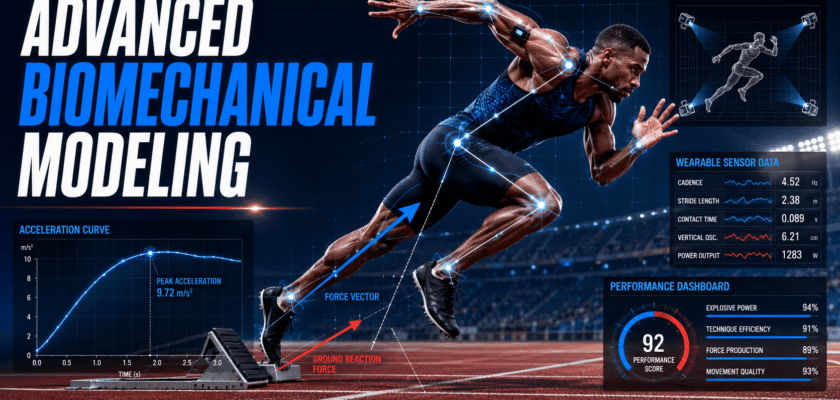
Advanced Biomechanical Modeling: Why Sprint Starts Are Being Re-measured
Advanced biomechanical modeling is changing the way coaches read the first steps of a sprint. Earlier, many teams judged the start by eye, stopwatch splits and simple video angles. Now, high-definition spatial trackers can capture body position, step timing, block push, trunk angle and acceleration patterns with much more detail.
The sprint start is important because the first push and the first few steps shape the entire acceleration phase. Small changes in force direction, shin angle or contact timing can affect how quickly an athlete builds speed.
A 2026 study on field-based sprint kinematics examined markerless motion capture against OptoJump measures for contact time, flight time, step time, step length, step frequency and step velocity. This shows why coaches are moving toward more accessible tracking tools for sprint analysis.
Therefore, the new performance question is not only, “Who reacted fastest?” It is, “How did the athlete create acceleration after the gun?”
| KEY TAKEAWAYAdvanced sprint analytics turns the start into measurable phases: set position, block push, first flight, first ground contact, step rhythm and early acceleration. |
Advanced Biomechanical Modeling and High-Definition Spatial Trackers
High-definition spatial trackers can use cameras, wearable inertial sensors, force plates, pressure insoles or markerless computer vision. Each system captures a different part of the sprint-start story.
Markerless systems are attractive because they reduce the need for reflective markers and lab-only setups. However, they still need validation, good camera angles and careful interpretation.
World Athletics says its innovation and research approach places testing and analysis at the heart of its development work. That mindset is now reaching coaching environments where technology must be useful on the track, not only in the lab.
What Coaches Can Measure in a Sprint Start
✓ Reaction time after the start signal.
✓ Horizontal block force and force direction.
✓ Hip projection over the first steps.
✓ Trunk angle during push-off and early acceleration.
✓ Shin angle at first contact.
✓ Contact time and flight time during the first steps.
✓ Step length and step frequency balance.
✓ Left-right asymmetry during block exit.
Why the First Three Steps Matter
The first three steps are not just a beginning. They decide how efficiently force becomes forward speed.
If the athlete pops up too early, the body may lose horizontal drive. If the athlete stays too low for too long, step rhythm can suffer. If contact time becomes too long, acceleration may flatten.
Advanced biomechanical modeling helps coaches see these details frame by frame. Instead of saying “drive harder,” the coach can say which joint angle, timing pattern or force direction needs attention.
| COACHING LENSThe best model does not replace the coach. It gives the coach better evidence, cleaner feedback and fewer guesses during high-speed movement review. |
Spatial Trackers vs Traditional Video Review
Traditional video review is useful, especially when a coach understands sprint mechanics. However, normal video can miss small timing differences and joint-position changes.
Spatial trackers can add structured metrics. For example, they can estimate step velocity, contact time, body angles and acceleration curves. This helps coaches compare sessions without relying only on memory.
Still, technology is not perfect. A 2025 comparison of markerless and marker-based sprint capture found promise but also variability in some high-speed joint measures. This means coaches should treat data as guidance, not as an automatic truth.
The Role of Wearable Sensors and Machine Learning
Wearable sensors are also becoming more useful. A 2026 biomechanics paper described a real-time multimodal lower-limb framework using wireless wearable sensors and machine learning to predict joint angles, ground reaction force and joint moments with low delay.
Although walking and sprint starts are different tasks, the direction of the technology is important. Sports systems are moving toward fast feedback, portable data capture and model-based movement prediction.
For sprint coaches, this can eventually support live or near-live feedback after starts. The athlete may see whether the last rep improved block force, contact timing or shin angle.
How Sprint Start Analytics Can Change Training
✓ Block spacing can be adjusted based on measured push-off position.
✓ Strength work can target weaknesses shown by force direction data.
✓ Technical cues can be tested with objective before-and-after numbers.
✓ Athletes can compare race-day starts with training starts.
✓ Coaches can reduce over-cueing by focusing on one metric at a time.
✓ Return-to-sprint plans can use asymmetry and load-tracking data.
What a Good Sprint-Start Model Should Avoid
⚠ Overloading the athlete with too many numbers after every rep.
⚠ Treating one session as final proof of a technical problem.
⚠ Comparing junior athletes directly with elite profiles without context.
⚠ Changing block setup without considering strength, mobility and comfort.
⚠ Ignoring warm-up, fatigue, footwear, track surface and weather.
⚠ Using unvalidated consumer metrics as competition-level evidence.
Practical Workflow for Track Coaches
A practical workflow should stay simple. First, record three to five starts under consistent conditions. Next, compare only a few metrics that match the training goal.
For example, one block may focus on reaction and block push. Another block may focus on first-step contact time. A third block may review trunk angle and step frequency.
After that, coaches should connect the numbers with video and athlete feeling. Data is most useful when it confirms what the coach can explain clearly.
Sprint Start Analytics Checklist
✓ Use the same camera or tracker position each session.
✓ Record the same warm-up status where possible.
✓ Compare starts from similar fatigue levels.
✓ Pick two or three key metrics, not twenty.
✓ Save clips and data together for later review.
✓ Translate data into one coaching cue before the next rep.
Why High-Definition Models May Help Injury Risk Management
Sprint starts place high demand on the ankle, knee, hip and trunk. A poor pattern may not cause injury immediately, but repeated overload can increase stress.
Biomechanical modeling can show asymmetry, unusual joint loading or poor force direction. This can guide strength and mobility work.
However, no model should be used to diagnose an injury by itself. Medical assessment remains necessary when pain, swelling or loss of performance appears.
What This Means for Indian Track Training Centers
Indian track programs can benefit from accessible sprint analytics if the tools are affordable and easy to use. Not every center needs a full laboratory setup.
A staged model may work better. Start with high-frame-rate video and basic timing gates. Then add wearable sensors or markerless motion capture for advanced athletes.
The real advantage will come when coaches learn how to use the data. Technology alone does not improve a start. Better feedback does.
Organic Search Summary for Athletes and Coaches
Advanced biomechanical modeling helps coaches understand sprint start acceleration in more detail. It combines video, spatial tracking, wearable sensors and force-related data.
High-definition trackers can measure reaction, step timing, body angle, force direction and early acceleration patterns. This can make coaching feedback more precise.
Still, the data must be validated and simple. The best systems help coaches make clearer decisions without overwhelming athletes.
Conclusion
Advanced biomechanical modeling is restructuring sprint start acceleration analytics. The start is no longer only a visual judgment. It is becoming a measurable sequence of force, angle, rhythm and timing.
High-definition spatial trackers, markerless motion capture and wearable sensors can help coaches identify what happens in the first explosive steps.
The winning approach will be balanced. Use the data, but keep coaching human. The best sprint start is not the one with the most numbers. It is the one where the athlete turns clean mechanics into fast acceleration.
Frequently Asked Questions
Q. What is advanced biomechanical modeling?
It is the use of motion, force and sensor data to model how the body moves during sport performance.
Q. How does it help sprint starts?
It can show block force, body angles, contact timing, step rhythm and early acceleration patterns.
Q. Are markerless trackers accurate enough?
They are improving, but coaches should use validated systems and compare data with video and expert review.
Q. Can this replace a coach?
No. It supports coaching decisions but does not replace technical judgment, athlete feel or training context.
Q. What should athletes track first?
Start with reaction time, first-step contact, trunk angle and step rhythm before adding more complex metrics.


