
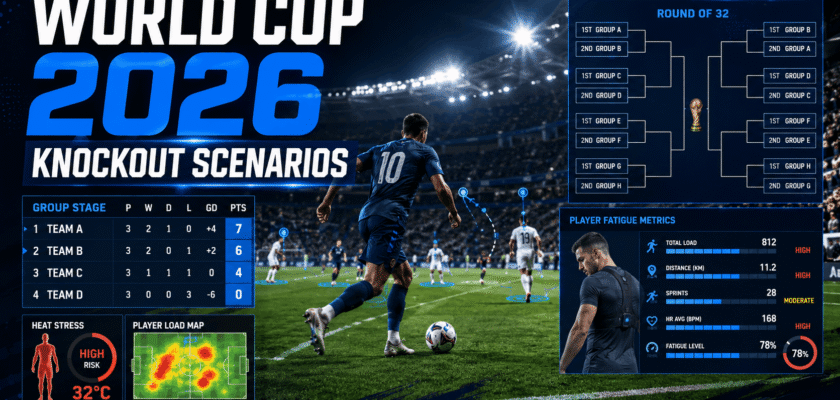
World Cup 2026 Knockout Scenarios: What Is Changing Now
World Cup 2026 knockout scenarios are now changing fast.
The group stage is near its final turn.
Therefore, every point now feels heavier.
Top teams still want clean group wins.
However, third-place teams also have a real path.
This new format keeps more teams alive.
It also makes every late goal more important.
The top two teams from each group advance.
Also, eight best third-place teams reach the Round of 32.
So, the final group games need careful reading.
| Quick Reader NoteThis is a live-style guide. Always check the final FIFA table before publishing updates. |
World Cup 2026 Knockout Scenarios and the Round of 32
The expanded format creates a bigger knockout board.
There are 12 groups of four teams.
So, 24 teams qualify by finishing first or second.
Then, eight third-place teams also qualify.
This makes the third-place table very important.
Points come first in that race.
Next, goal difference can decide the next team.
Then, goals scored can break close ties.
After that, fair play can matter too.
Why the Group Stage Climax Feels Different
Old World Cups had less third-place drama.
This format is wider and more open.
Therefore, a draw can still feel useful.
Also, a narrow loss may still keep hope alive.
That changes late-match choices.
Some coaches protect goal difference.
Others chase one more goal.
Meanwhile, card control also becomes important.
A red card can hurt both table position and team depth.
Teams Already Moving Toward the Knockouts
Recent reports show many teams already through.
Japan and Sweden advanced from Group F.
The Netherlands topped that group.
The United States also topped Group D.
Australia secured second place in Group D.
Paraguay stayed alive as a third-place contender.
However, the full bracket still needs final results.
So, readers should treat every preview as live.
Biometric Player Fatigue Metrics: What Fans Should Know
Biometric player fatigue metrics sound complex.
Yet the basic idea is simple.
Teams track player load during hard match cycles.
They may use GPS, optical data, heart-rate tools, or wellness scores.
FIFA also has standards for tracking systems.
These systems can use optical or wearable devices.
However, private team data is rarely public.
So, fans should avoid fake fatigue screenshots.
Only official or trusted data should guide claims.
Simple Fatigue Signals
✓ Short rest between matches.
✓ High travel distance across host cities.
✓ Long injury stoppages.
✓ Heavy sprint load in the last match.
✓ Heat stress and hydration breaks.
✓ Extra rotation before knockout games.
✓ Late substitutions for key players.
Heat, Travel, and Player Strain
Heat is now part of the tactical story.
Some 2026 matches have raised heat concerns.
Therefore, hydration breaks can change game flow.
They can also help coaches reset tactics.
Travel also matters in this large tournament.
Teams may cross long distances between games.
As a result, recovery planning becomes vital.
This is why player load is now a key preview angle.
Round of 32 Preview: What To Watch First
Round of 32 previews should start with rest days.
Then, check travel distance.
Next, review cards and injuries.
Also, compare group finish position.
A group winner may still face a risky third-place team.
A runner-up may get a cleaner matchup.
Therefore, the bracket can reward timing, not only talent.
Tactical Clues Before Knockout Matches
✓ Look for teams resting star players.
✓ Check if full-backs slowed late in games.
✓ Watch pressing intensity after minute 60.
✓ Track yellow-card risk before the knockout round.
✓ Notice teams that protect goal difference.
✓ Study set-piece quality under pressure.
✓ Review goalkeeper workload and save count.
Best Third-Place Race: Simple Guide
The best third-place table can confuse readers.
So, use one simple order.
First, count points.
Then, check goal difference.
Next, check goals scored.
After that, check fair play rules.
Finally, check the official table.
This process keeps the article clean and accurate.
Fantasy and Betting Caution
Knockout talk can create overconfidence.
However, football is still volatile.
A rested team may still lose.
A tired team may still defend well.
So, do not treat fatigue data as a result prediction.
Use it as one signal only.
Organic Search Summary
World Cup 2026 knockout scenarios are shaped by a wider format.
Top-two qualification is still the safest path.
However, third-place teams now have real hope.
Player strain data also matters more than before.
So, previews should include rest, heat, travel, cards, and rotation.
This gives readers a better Round of 32 view.
Conclusion
The World Cup 2026 group stage is built for drama.
Every late goal can change the Round of 32 map.
Meanwhile, fatigue data adds a second layer.
It shows why rest and travel can shape knockout football.
Still, the final table is the main source.
Therefore, fans should follow official updates before making claims.
Frequently Asked Questions
Q. How many teams reach the Round of 32?
Thirty-two teams reach the knockout stage.
Q. Who qualifies from each group?
The top two teams qualify from every group.
Q. Can third-place teams qualify?
Yes. The eight best third-place teams qualify too.
Q. Are biometric fatigue metrics public?
Usually no. Most team fatigue data stays private.
Q. What should fans check first?
Check points, goal difference, goals scored, and official tables.


