
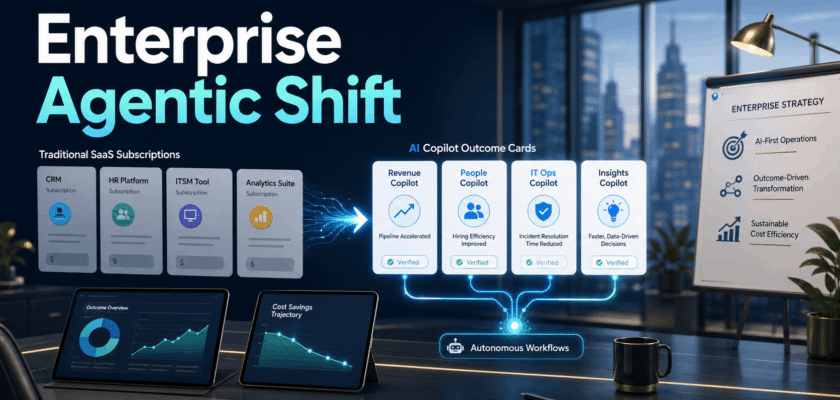
�� Enterprise software is entering a new buying cycle.
For years, companies paid for SaaS seats, dashboards, storage tiers, and feature bundles. That model made sense when software was mainly a place where people clicked buttons.
Now, agentic AI copilots are changing the math. These systems do not just display work. They draft emails, resolve support tickets, update CRM notes, prepare reports, review code, and trigger workflows.
That is why outcome based software pricing models 2026 are becoming a serious boardroom topic. Buyers want to pay for useful work, not unused access.
| Quick take: The enterprise agentic shift is not the end of SaaS. It is the start of a value-linked software model where AI copilots must prove measurable business output. |
�� Why Traditional SaaS Pricing Feels Heavy Now
Traditional SaaS pricing was built around access. A company paid per user, per month, even if many users logged in only a few times.
That created silent waste. Large teams often carried unused licenses, overlapping tools, and renewal contracts that were hard to justify.
Agentic AI makes that waste more visible. One trained copilot can complete tasks across many systems. So buyers now ask a simple question: why pay for every seat when only the outcome matters?
This pressure is pushing B2B tech firms toward enterprise generative AI deployment strategy plans that measure completed work, risk reduction, and time saved.
�� Agentic AI Is More Like a Worker Than a Feature
A basic chatbot answers questions. An agentic AI copilot takes action.
It can read a ticket, check policy, write a reply, update a record, and escalate the case if needed. In sales, it can prepare account summaries and follow-up drafts. In finance, it can flag unusual entries for review.
This changes the pricing debate. If the copilot works like a digital teammate, a flat access fee may feel outdated.
That is why outcome based software pricing models 2026 focus on completed tasks, resolved cases, accepted drafts, qualified leads, clean audit logs, or reduced processing time.
�� SaaS Subscription vs Outcome-Based AI Copilot
The shift is easier to understand through a simple comparison.
| Model | How It Charges | Main Buyer Question |
| Traditional SaaS | Per seat, per month, or per feature bundle | How many users need access? |
| Usage-based AI | Per token, request, message, or credit unit | How much compute will we consume? |
| Outcome-based AI | Per resolved ticket, approved workflow, saved hour, or verified business result | What value did the copilot actually deliver? |
| Hybrid AI SaaS | Base platform fee plus usage and outcome layers | Can cost scale with both control and results? |
✅ Why Buyers Like Outcome-Based Software Pricing Models 2026
Enterprise buyers are under pressure to cut software overhead. At the same time, they are being asked to adopt AI quickly.
Outcome-based pricing looks attractive because it links spend to visible value.
- Support teams can pay around resolved tickets or lower handle time.
- Sales teams can measure qualified meetings, clean CRM updates, or faster proposal drafts.
- Finance teams can track reconciled entries, risk alerts, or audit-ready reports.
- Engineering teams can connect spend to accepted code suggestions, merged pull requests, or faster documentation cycles.
This model helps CFOs compare AI spend with business impact. It also forces vendors to prove that their copilots are not just shiny add-ons.
⚠️ The Hard Part: Defining a Real Outcome
Outcome pricing sounds clean. However, it can become messy fast.
A resolved support ticket may not mean a happy customer. A generated sales email may not mean revenue. A code suggestion may not mean production value.
So every contract needs strict definitions. Buyers and vendors must agree on what counts, how it is measured, and who owns the risk when business conditions change.
This is where many enterprise generative AI deployment strategy plans fail. They chase automation first and measurement later.
A better plan starts with metrics. Then it adds AI workflows. Finally, it connects billing to verified results.
�� How B2B Tech Firms Can Reduce Corporate Software Overheads
B2B tech firms can use the agentic shift to simplify their stacks.
First, they should map duplicate tools. Many companies pay for several apps that manage similar tasks. AI copilots can sit across these apps and reduce manual switching.
Next, teams should identify high-volume workflows. Support triage, invoice checks, sales research, meeting notes, and compliance review are strong starting points.
Then, leaders should pilot one outcome at a time. For example, they can measure ticket resolution speed before expanding into customer success automation.
Finally, finance teams should review cost per result, not cost per user. This makes AI spending easier to defend during renewal cycles.
�� Governance Still Matters
Agentic copilots need guardrails. They can touch customer data, internal files, financial records, and sales pipelines.
That means strong permissions, audit logs, data retention rules, and human approval steps are not optional.
The best AI copilots will not only complete work. They will also show evidence of work. That evidence will matter for compliance teams, legal teams, and enterprise buyers.
This is why the strongest SaaS platforms may not disappear. Many will become orchestration layers for AI agents. They will manage access, workflow control, audit trails, and business context.
�� The New Enterprise Deployment Playbook
The safest enterprise generative AI deployment strategy should move in stages.
Stage one is observation. Teams measure where time and money are currently wasted.
Stage two is assisted work. Copilots draft, summarize, and recommend, while humans approve the final step.
Stage three is controlled automation. Agents complete repeatable tasks inside fixed rules.
Stage four is outcome billing. Once the result is measurable, the pricing model can shift from access to verified output.
This gradual approach lowers risk. It also protects the company from paying premium AI costs before the return is clear.
�� What This Means for SaaS Vendors
SaaS vendors now face a tough choice.
They can keep selling seats and risk buyer pushback. Or they can redesign pricing around value, usage, and outcomes.
The winning vendors will likely use hybrid pricing. A base fee can cover platform reliability, permissions, and support. Usage credits can cover compute. Outcome fees can reward measurable business results.
This protects vendor margins while giving customers a cleaner value story.
�� Conclusion
The enterprise agentic shift is not hype anymore. It is changing how companies judge software value.
Traditional SaaS subscriptions charged for access. Agentic AI copilots push buyers to demand proof of completed work.
That is why outcome based software pricing models 2026 matter so much. They help enterprises reduce corporate software overheads, control AI spend, and connect automation to real business results.
For B2B tech firms, the message is clear. Do not buy AI because it looks advanced. Buy it when it can prove a useful outcome.


