
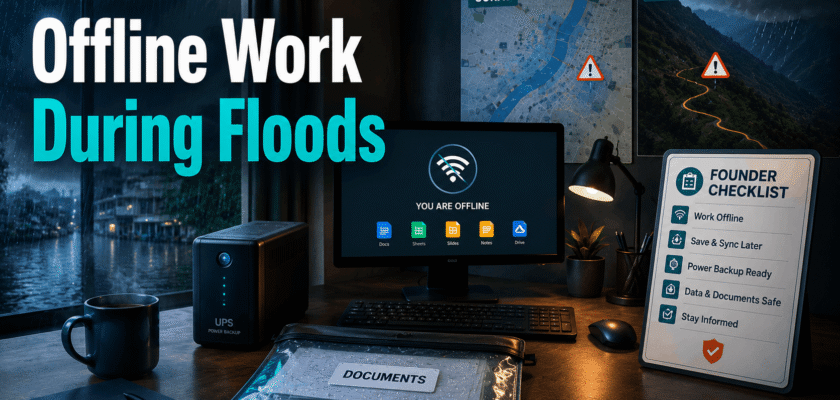
| ⚠️ Publish-Safe Fact Note Surat saw severe flooding after intense July monsoon rain. Himachal Pradesh also faced flash floods, landslides, blocked roads, and bridge damage. However, alerts change quickly. Readers should always check IMD, local police, district administration, and disaster management updates before travel or field work. |
How to build off grid asynchronous workspaces is now a real lifestyle skill for solo founders. The Surat and Himachal flood red alert cycle showed how fast travel, internet, power, and team coordination can break during extreme monsoon weather.
For many small teams, the problem is not only rain. It is also lost commute time, unstable broadband, broken schedules, and panic switching between apps.
Therefore, solo founders need a calm setup. It should work even when roads are flooded, calls fail, and cloud apps load slowly.
Why Flood Red Alerts Change Modern Work
Flood red alerts change work because they make every normal system fragile. A metro, highway, bridge, delivery rider, office lift, or broadband line can fail together.
Surat flooding reports showed how heavy rain can hit roads, homes, markets, and power safety at once. Meanwhile, Himachal reports showed how flash floods can cut off villages and damage bridges in hilly terrain.
So, the modern founder cannot depend only on cloud-first work. They also need local-first work. This means files, tasks, notes, and core tools must stay usable without the internet.
| ✅ Key Takeaway A monsoon-ready founder setup is not a luxury desk trend. It is a continuity system. It protects writing, invoices, client notes, content plans, passwords, and daily decisions when the weather turns unstable. |
How to Build Off Grid Asynchronous Workspaces
How to build off grid asynchronous workspaces starts with one rule. Your main work should not stop because one app, one network, or one meeting fails.
This is why solo founders are moving toward offline desktop architectures. They keep one stable computer, one local file system, one power backup, and one simple daily workflow.
In this model, the internet becomes a sync layer. It is not the whole workplace.
The Offline Desktop Architecture
An offline desktop architecture is a simple work system. It lets you draft, plan, edit, review, and package work without live internet.
The goal is not to reject cloud tools. Instead, the goal is to keep your core work alive until the network returns.
| Workspace Layer | Offline Setup |
| Writing Layer | Use offline docs for blogs, emails, scripts, invoices, and client drafts. |
| Knowledge Layer | Keep local notes, checklists, templates, SOPs, and emergency contact files. |
| Content Layer | Store images, thumbnails, captions, briefs, and upload-ready folders locally. |
| Task Layer | Maintain one offline daily task board or simple text-based work queue. |
| Sync Layer | Upload, send, or cloud-sync only when the internet becomes stable again. |
Power, Files, and Network Safety
Power backup comes first. A laptop alone is not enough if you also need a router, phone, hard drive, and light.
Use a UPS or small inverter for the router and desktop. Keep a charged power bank for the phone. Also, keep your main work folder available on the device itself.
File safety also matters. Use clear folders like Today, Client Work, Finance, Content, Upload Later, and Emergency. This reduces confusion when your mind is already stressed.
✅ Keep one local copy of active client files.
✅ Keep one external backup in a waterproof pouch.
✅ Keep one cloud sync folder for later upload.
✅ Export important notes as PDF or plain text.
✅ Save passwords in a trusted offline-capable password manager.
Single-Window Workstation Rules
During bad weather, app switching creates stress. So, a single-window workstation can help.
Keep only one active work window open. Then keep one notes window and one emergency alert source. Avoid social feeds unless they are needed for verified local updates.
| ✅ Single-Window Rule One task. One file. One local folder. One alert source. One upload queue for later. |
This routine lowers decision fatigue. It also keeps the founder focused when outside conditions are noisy.
Minimalist Productivity Routines For Bad Weather
Minimalist productivity routines for bad weather should be boring, repeatable, and offline-friendly.
Start with a three-block day. First, finish one urgent client task. Next, prepare one upload-ready asset. Finally, review money, safety, and communication needs.
This keeps the day useful even when meetings fail.
✅ Use a 90-minute offline focus block in the morning.
✅ Batch messages only when the network returns.
✅ Keep meetings optional during red alert days.
✅ Record short video or voice updates offline.
✅ Share work summaries instead of forcing live calls.
Why Asynchronous Work Helps Solo Founders
Asynchronous work helps because it removes the pressure to respond instantly. During floods, instant work is often unsafe and unrealistic.
A founder may need to check family safety, protect documents, move equipment, or wait for water levels to fall. In that moment, clear written updates are better than rushed calls.
Clients also benefit. They receive a status note, a delivery window, and the next action. Therefore, trust stays intact even when operations slow down.
Safety Boundaries During Flood Alerts
Work should never beat safety during flood alerts. Do not travel only to collect a laptop, camera, or hard drive. Do not cross waterlogged roads for a meeting.
Also, do not plug devices into wet sockets. Move electronics above floor level. Keep chargers away from damp walls and flooded corners.
If the local administration asks people to avoid travel, treat that as the work policy for the day. A missed meeting can be rescheduled. A safety mistake cannot always be reversed.
| �� Do Not Do This Do not drive through floodwater for work. Do not depend on one cloud app only. Do not keep all passwords online-only. Do not leave backups near the floor. Do not force staff, freelancers, or vendors to travel during alerts. |
Offline Founder Kit
✅ Laptop or desktop with key apps already installed.
✅ UPS, inverter, or power bank support.
✅ Local work folder with active projects.
✅ External SSD or pen drive in a waterproof pouch.
✅ Printed emergency contacts and key passwords recovery notes.
✅ Notebook, pen, torch, medicines, dry snacks, and drinking water.
This kit is not only for disasters. It also helps during internet cuts, power issues, travel shutdowns, and sudden family emergencies.
Conclusion: Build Before The Next Alert
How to build off grid asynchronous workspaces is no longer only a productivity trend. It is a monsoon survival system for solo founders, creators, consultants, and small business owners.
Surat and Himachal show one clear lesson. Extreme weather can disturb roads, power, internet, and calm thinking at the same time.So, build the offline setup before the next alert. Keep your files local, your tools simple, your power backup ready, and your workday asynchronous.


