


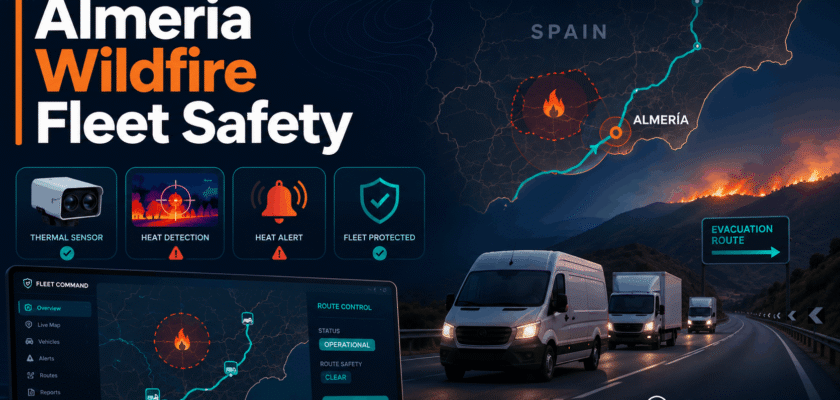
Almeria forest fire vehicle evacuations 2026 have exposed a painful safety gap for drivers, fleet owners, and emergency planners.
The wildfire near Los Gallardos and Bédar in Spain showed how fast heat, wind, blocked roads, and panic can turn vehicles into dangerous escape spaces.
This is not only a travel tragedy. It is also an automobile safety lesson.
For commercial fleets, the message is clear. Route redirection, thermal sensor checks, and driver instructions must work before flames reach the road.
| ⚠️ Publisher Safety NoteThis article does not claim that a sensor can stop a wildfire. It explains how fleets can reduce risk through heat monitoring, live route decisions, driver training, and official evacuation compliance. |
Why Almeria Forest Fire Vehicle Evacuations 2026 Matter
Reports from Spain say the fast-moving Almeria wildfire left several people dead or missing after roads and escape paths became unsafe.
Some victims were found in vehicles or after leaving vehicles on routes that were not advised by authorities.
That detail matters for fleet managers. In a wildfire, a road that looks open on a map can become blocked within minutes.
Therefore, commercial route planning must include fire risk, wind direction, road closure signals, and safe waiting zones.
The Vehicle Risk No Fleet Should Ignore
Extreme heat does not damage every vehicle in the same way.
Still, heat can raise stress on tyres, brakes, batteries, cooling systems, engine bays, and cargo compartments.
A loaded van stuck in smoke and heat has less margin than an empty car on an open road.
So the safety question is simple. Can the driver see heat warnings early enough to stop, reroute, or wait?
Safety Audits for Vehicle Thermal Sensors
A thermal sensor audit should begin before the fire season.
Fleet teams should check engine coolant alerts, tyre-pressure systems, brake temperature trends, battery temperature logs, and cabin air quality alerts.
Electric delivery vehicles need extra attention. Battery thermal management must be clean, logged, and checked after long uphill routes.
Diesel and petrol fleets also need checks. Overheated brakes, low coolant, and old tyres can become serious hazards during emergency detours.
Commercial Fleet Route Redirection Systems
Commercial fleet route redirection systems should not depend only on the fastest route.
They should also score routes by fire proximity, road width, fuel availability, turning space, phone coverage, and official evacuation notices.
A safe route is not always the shortest route.
In high-risk heat zones, dispatch teams should keep a backup route ready before the driver starts the trip.
Driver Instructions Must Be Simple
Drivers need very clear instructions in wildfire zones.
First, follow official evacuation or shelter-in-place orders.
Second, do not leave an advised route just because another road looks empty.
Third, call dispatch before entering smoke-heavy roads, dry riverbeds, narrow tracks, or mountain shortcuts.
Finally, stop risky deliveries when emergency services restrict movement. Goods can wait. Lives cannot.
What Fleet Owners Should Add This Week
Fleet owners should add a short heat-risk checklist for every driver working in exposed areas.
The checklist should include fuel or charge level, tyre condition, coolant level, emergency water, first-aid kit, offline maps, and emergency contacts.
Dispatch teams should also mark vehicle assembly points near towns, petrol stations, and open safe zones.
Most importantly, drivers should know who has the final authority to cancel a delivery.
Automotive Safety Protocols Under Extreme Heat
Automotive safety protocols under extreme heat must combine vehicle data with human judgement.
A dashboard alert is useful. But it is not enough if the driver feels pressure to complete the route.
Managers should create a no-penalty stop rule for heat, smoke, road closure, or emergency siren conditions.
That rule can save lives and protect the fleet from bigger losses.
Fleet Safety Checklist for Wildfire Routes
| Safety Area | What To Check | Why It Matters |
| Thermal sensors | Coolant, battery, brake and tyre alerts | Early warnings reduce roadside failure. |
| Route planning | Official fire alerts and backup roads | A blocked road can trap vehicles. |
| Driver policy | No-penalty stop and reroute rule | Safety must beat delivery pressure. |
| Cargo checks | Heat-sensitive food, medicines or batteries | Extreme heat can damage goods. |
| Communication | Offline maps and emergency contacts | Phone networks may become weak. |
| ✅ Natural Keyword CoveragePrimary: Almeria forest fire vehicle evacuations 2026Secondary: commercial fleet route redirection systemsSecondary: automotive safety protocols under extreme heatRelated: vehicle thermal sensors, wildfire routing, emergency fleet safety, extreme heat mobility |
FAQs
Can thermal sensors prevent wildfire vehicle accidents?
No. Thermal sensors cannot stop a wildfire. However, they can warn fleets about vehicle stress before a risky route becomes worse.
Should drivers evacuate by car during a wildfire?
Drivers should follow official local orders. Some incidents require evacuation. Others may require sheltering in place until a safe route is confirmed.
What should commercial fleets do first?
They should create heat-risk routes, verify driver contacts, audit vehicle sensors, and stop delivery pressure during active emergency alerts.
Why is this important for India too?
India also faces extreme heat, forest fires, floods, and blocked roads. Fleet teams need the same live-routing mindset during climate events.
Featured Image Prompt – Exact 1200 x 675 px
| ��️ Image PromptCreate a premium SEO-friendly automobile blog featured image in exact 1200 x 675 pixels for Single Click Blog. Clearly include only the short title text ‘Almeria Wildfire Fleet Safety’ in a bold, clean, readable style. Show a cinematic commercial fleet route-control dashboard, heat-alert vehicle thermal sensor icons, a safe evacuation road map near Almeria, and a subtle wildfire glow in the distance. Keep the layout premium, minimal, high-CTR, and copyright-free. Use deep navy, safety orange, white, teal, soft gray, and muted red alert accents. No real emergency logos. No gore. No burned bodies. No infographic clutter. No extra stats. No large paragraphs. Add ‘Single Click Blog’ small at the bottom-right corner. Keep all important text safely inside the frame. |
Image alt text: Almeria forest fire vehicle evacuations 2026 with commercial fleet route redirection systems and vehicle thermal sensor safety dashboard.
Conclusion: Fleet Safety Must Move Before the Fire
Almeria forest fire vehicle evacuations 2026 are a warning for every fleet that operates in heat, hills, forests, or remote roads.
The biggest lesson is not fear. The lesson is preparation.
Commercial fleet route redirection systems, vehicle thermal sensors, and clear driver rules can reduce confusion when every minute matters.
For fleet owners, the next safety upgrade should not wait for the next emergency.


