

Skill based tech hiring platforms 2026 are changing how students prove job readiness. A degree still matters, but it is no longer the only door into many tech roles.
Large employers now want proof that a candidate can build, test, secure, document, and ship. So, recruiters are looking beyond college names and into verified skill evidence.
This shift is not anti-university. Instead, it is anti-guesswork. Companies want faster hiring, cleaner screening, and stronger proof of real ability.
| �� Quick Take: The new hiring signal is simple: show verified work, not only a degree label. This is why cryptographic skill passports are becoming important for future engineering graduate placements. |
�� Why Degree-First Hiring Is Losing Its Grip
For years, a university degree worked as a shortcut for trust. It told employers that a candidate had passed structured learning.
However, tech roles are changing faster than many course structures. AI, cybersecurity, cloud, data engineering, and product automation now update every few months.
As a result, employers need proof that a student can solve current problems. A transcript alone does not show that clearly.
Therefore, companies are testing skill-first hiring systems. These systems check work samples, coding tasks, security labs, AI workflows, and verified project records.
�� What Is a Cryptographic Skill Passport?
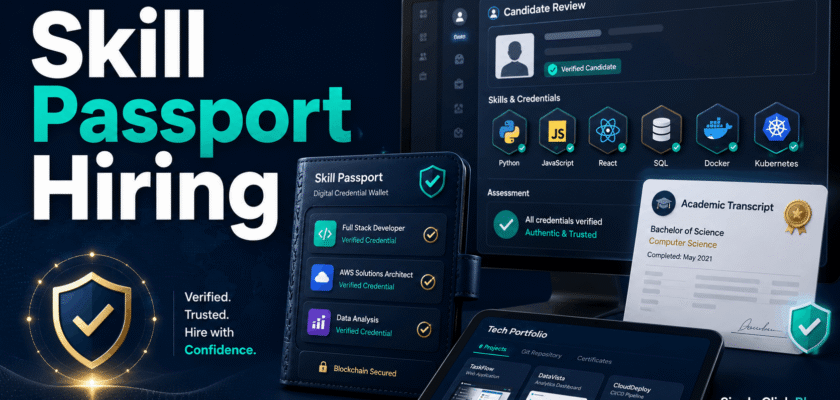
A cryptographic skill passport is a digital record of verified abilities. It can include badges, project proof, assessments, internship evidence, and employer-backed references.
The word cryptographic matters because the record can be signed and checked. In simple words, it becomes harder to fake or edit after issue.
This is different from a normal resume. A resume says what a candidate claims. A verified credential helps prove who issued the skill record and whether it has changed.
That is why cryptographic education credential verification is becoming useful for hiring teams that screen thousands of applicants.
✅ How The New Hiring Filter Works
The hiring filter is moving from “Where did you study?” to “What can you prove?”
In this model, a student may upload a verified project badge, a secure assessment score, a Git portfolio, and a practical AI workflow demo.
The recruiter can then check whether the skill proof came from a trusted issuer. This can reduce manual background checks and fake-certificate risk.
It also helps strong students from smaller colleges. If their work is verified, they can compete with candidates from better-known campuses.
�� Degree-First Hiring vs Skill Passport Hiring
| Hiring Area | Old Degree-First Filter | New Skill Passport Filter |
| Screening | College name, degree title, marks | Verified skills, project proof, live tasks |
| Trust signal | Brand of institute | Issuer-signed digital credential |
| Tech proof | Course list and certificates | Git work, labs, tests, secure badges |
| Student advantage | Best-known campuses win first | Strong verified work can stand out |
| Risk | Fake claims can pass early filters | Tamper-checkable records reduce doubt |
�� Why Fortune 500 Recruiters Care About This
Big companies hire across countries, teams, and vendor networks. So, they need a repeatable way to compare talent.
A skill passport can give them cleaner signals. It can show whether a candidate passed a cloud lab, completed a security task, or shipped a real automation workflow.
Also, hiring managers want role-ready people. They do not want to spend months verifying basic claims after the offer stage.
So, the future of engineering graduate placements may depend on proof portfolios as much as placement drives.
�� Why AI Is Speeding Up This Shift
AI has changed entry-level work. Basic code generation, test writing, research, and documentation can now be assisted by AI tools.
Because of this, companies are asking a sharper question: can the student guide AI, check its errors, secure the output, and explain the system?
This is why AI literacy, cybersecurity awareness, and product thinking are becoming stronger hiring signals.
A degree may show learning history. A verified AI project can show current execution.
�� What Students Should Build in 2026
Students should not wait for a company to trust a plain resume. They should create a proof stack early.
Start with three clean projects. Then add one AI workflow, one cloud deployment, and one security or data-quality check.
Next, collect verifiable badges from trusted platforms. Also, keep public documentation simple and readable.
Finally, make every project explain a business problem. Recruiters value outcomes, not only tools.
�� What Colleges Must Change Now
Colleges should not treat digital credentials as extra decoration. They should treat them as career infrastructure.
A modern placement cell can issue verified project records, internship proof, capstone badges, and skill transcripts.
This helps students, but it also protects college reputation. Employers can see cleaner proof and faster verification.
Therefore, universities that build trusted skill records may become stronger placement partners.
⚠️ The Risk: Skills-First Hiring Can Still Become Hype
This shift has one big risk. Many companies may talk about skills-first hiring but still use old filters in practice.
Also, not every role can ignore degrees. Regulated roles, research-heavy roles, and deep engineering positions may still need formal education.
So, students should not drop degrees blindly. A better strategy is to combine a degree with verified skill proof.
That combination gives the strongest signal: structured learning plus real execution.
✅ Conclusion
The future of tech hiring is not degree versus skill. It is degree plus proof.
Skill based tech hiring platforms 2026 will reward students who can show verified work, practical judgment, and updated technical ability.
For students, the message is clear. Build projects, verify skills, document outcomes, and make your learning easy to trust.
For colleges, the message is even clearer. The next placement war will be won by institutions that can turn learning into trusted digital evidence.


