
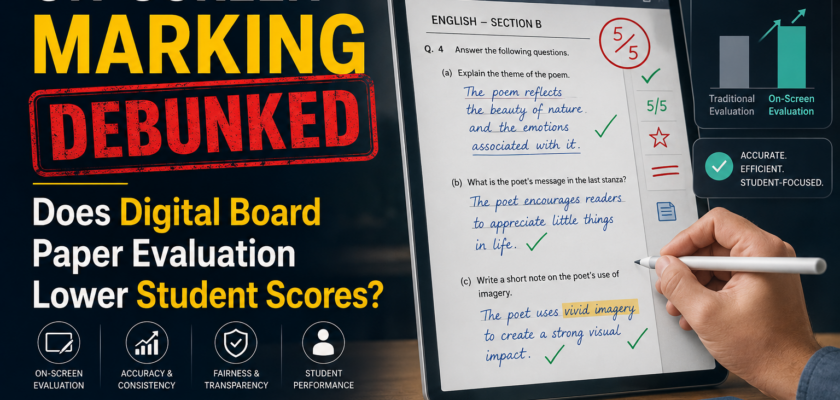
On-Screen Marking Debunked: Does Digital Board Paper Evaluation Lower Student Scores?
The release of the CBSE Class 12 Board Results has triggered an unprecedented wave of anxiety across India. Following the declaration of scores, social media platforms have been flooded with complaints from parents, teachers, and students alleging unexpectedly low marks—particularly in Physics, Chemistry, Biology, and Mathematics. Many have even pointed out a puzzling anomaly: students who cleared highly competitive exams like JEE Main have supposedly failed or scored dismal marks in their corresponding board papers.
The primary target of this backlash is the newly reintroduced On-Screen Marking System 2026 (OSM). With the overall pass percentage dropping by 3.19% to a seven-year low of 85.20%, a polarizing question is being asked: Does digital evaluation inherently penalize students, or is something else causing the dip?
Let’s separate internet panic from structural reality.
1. What is the On-Screen Marking System 2026?
This year, instead of manually distributing physical answer sheets to checking centers, the board executed its largest digital assessment exercise to date. Under the On-Screen Marking System 2026, approximately 98.6 lakh answer books for Class 12 were securely scanned, uploaded, and evaluated on computer screens by trained examiners.
The Promised Advantages:
- Zero Calculation Errors: The software automatically totals individual question marks, completely eliminating traditional manual adding errors.
- Step-Wise Compliance: The interface forces evaluators to check papers strictly against the official, expert-vetted marking scheme, page by page.
- Confidentiality: Scripts are completely blinded, ensuring high security and reducing bias.
2. The Student Fear: The Legend of the “Invisible Diagram”
The core anxiety among students is that digital scanning ruins the legibility of handwritten work. Rumors claim that light pencil sketches, fine geometric lines, and complex chemical structures get blurred during high-speed scanning, leading to zero marks.
The Debunking Fact:
Both the Ministry of Education (MoE) and the board have stepped forward to address this head-on. Officials revealed that multiple quality-control layers were integrated into the workflow.
If a scanned sheet was flagged with legibility issues due to faint ink, it was pulled from the digital queue. In fact, more than 13,000 answer sheets were explicitly isolated and evaluated manually to ensure no student was unfairly penalized. Evaluators were also instructed to acknowledge alternative correct methodology outside of the strict key.
3. Strategic Matrix: Manual Checking vs. On-Screen Marking System 2026
| Operational Parameter | Conventional Manual Checking | On-Screen Marking System 2026 |
| Tabulation & Totalling | High human error (Unchecked pages) | Automated (Zero calculation errors) |
| Marking Uniformity | Subjective / Variable based on center | Strictly locked to step-by-step criteria |
| Faint Paper Protocol | Handled natively by eye | Flagged by QC; 13k+ checked manually |
| Result Speed | Slower due to physical logistics | Significantly accelerated processing |
| Grievance Redressal | Opaque / High correction fee | Highly transparent / Price slashed to ₹100 |
4. If the System is Foolproof, Why the Drop in Scores?
If the On-Screen Marking System 2026 isn’t systematically failing students, what explains the drop in the pass percentage? Evaluators and school principals have pointed to two distinct factors:
- The Strictness of Digital Locking: In manual checking, an exhausted examiner might glance at a long paragraph and award a generic 3 out of 5 marks. In OSM, the examiner cannot move forward without assigning marks to individual sub-steps. If a student wrote a long story but missed the core technical keywords required by the step-wise scheme, the digital script registers an objective zero. It exposes lack of conceptual depth.
- Speed vs. Training: While some Delhi teachers confirmed the system reduces calculation slip-ups, certain administrators argued that the digital rollout was hurried, leaving some elderly examiners struggling with screen fatigue.
5. The Emergency Relief: ₹100 Re-evaluation
To lower the post-result anxiety and prove complete transparency, the Ministry of Education has executed an unprecedented move. They have radically slashed the fees for answer sheet verification and rechecking:
- Viewing Answer Sheets: Slashed to ₹100 (Down from ₹700).
- Verification of Marks: Slashed to ₹100 (Down from ₹500).
- Rechecking Fee: Only ₹25 per question.
- The Refund Clause: If a student’s marks increase during this re-evaluation process, the application fee will be entirely refunded.
The application portal opened on May 19, giving students a direct tool to view their scanned papers independently and verify the digital marks.
Conclusion
The On-Screen Marking System 2026 is not a “score killer”—it is simply an unforgiving mirror. It has automated away the calculation blunders of the old manual system, but it has also stripped away the casual leniency of human grading.
While Controller of Examinations Sanyam Bhardwaj openly admitted that minor errors are statistically possible when processing 1.25 crore scripts, the board’s transparent, low-cost rechecking window ensures that any genuine glitch will be immediately corrected. If you feel your score doesn’t match your effort, skip the social media panic, log onto the portal, and let the verified data speak for itself.


