
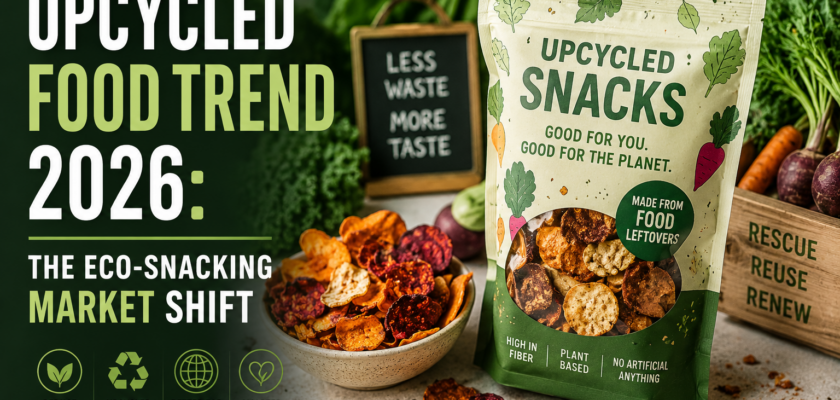
Upcycled Ingredients: How Food Brands are Turning Organic Waste into High-Protein Snacks.
The underlying roadmap directing global food processing is undergoing a rapid, structural transformation. For decades, industrial food production lines operated under a highly linear, high-waste manufacturing model. Processing plants routinely discarded tons of nutrient-rich organic side-streams—such as spent brewer’s grains, fruit pulps, and oilseed cakes—straight into regional landfills. This traditional approach successfully minimized immediate ingredient sortation costs, but it created massive environmental challenges while wasting premium raw nutritional value.
Fortunately, modern culinary engineering is executing a sharp pivot toward sustainable resource circularity.
We have officially entered a new era marked by the rapid global expansion of the upcycled food trend 2026 matrix.
Driven by a growing consumer demand for environmental responsibility and clean labels, food brands are transforming agricultural byproducts into elite ingredients.
By upcycling forgotten organic side-streams, developers are driving a massive expansion in the sustainable protein snacking market. This profound shift is permanently changing the trajectory of eco-friendly culinary commercial innovations across the consumer food space. Consequently, major snack brands are successfully cutting production waste, proving that true nutritional progress requires transforming overlooked resources into delicious, sustainable fuel.
1. The Upcycled Advantage: Extracting Premium Nutrition from Food Waste
The primary technological catalyst accelerating this food processing revolution centers on extracting high-density macronutrients from everyday manufacturing byproducts. Standard agricultural production methods often treat raw processing leftovers as simple industrial waste lines.
In contrast, next-generation upcycling frameworks treat these overlooked side-streams as highly valuable sources of clean protein and dietary fiber.
                    [ The Linear Food Waste Loop ]
     (Crop Processing ──► Rich Byproducts Discarded ──► Heavy Methane Landfill Waste)
                                     │
                                     ▼
                [ The 2026 Upcycled Nutrition Shield ]
     (Nutrient Extractions ──► Fortified Snack Flour ──► Zero-Waste Protein Food)
These highly optimized upcycled networks offer immense advantages to modern food distribution systems:
- Rescuing Spent Grains: Upcycling systems convert barley pulp left over from beverage brewing into high-fiber, low-glycemic flour bases.
- Reclaiming Fruit Nutrients: Processing plants dehydrate discarded fruit peels and seeds into fiber-rich powder additions for breakfast snacks.
- Maximizing Land Efficiency: Consequently, food brands double the nutritional output of existing crops without clearing an acre of fresh farmland.
2. Re-Engineering the Pantry: Transforming Spent Byproducts into Consumer Snacks
The rapid expansion of these sustainable snacks relies on deploying advanced extrusion technologies that turn raw agricultural byproducts into delicious, store-ready foods.
  [ Harvest Side-Streams Collected ] ───► [ Clean Dehydration and Milling Applied ]
                                                       │
                                                       ▼
                                        [ High-Pressure Extrusion Line ]
                                  "Shapes Fiber-Rich Flour into Crispy Textures"
                                                       │
                                                       ▼
                                        [ Eco-Snack Product Launched ]
                                  "Delivers 15 Grams of Clean Plant Protein"
                                                       │
                                                       ▼
                                        [ Upcycled Food Certified Badge ]
                                  "Guarantees Authentic Environmental Security"
Snack manufacturers utilize highly automated processing equipment to craft everyday foods that easily match the taste and texture of traditional grain options.
- Eliminating Chemical Preservatives: These innovative snack formulations utilize natural preservation methods, completely avoiding artificial chemical additives.
- Optimizing Flavor Profiling: Advanced culinary blending masks bitter plant elements, ensuring upcycled protein bars taste identical to legacy options.
- Securing Public Trust: Furthermore, every single production batch carries an official Upcycled Certified seal, giving shoppers proof of its environmental benefits.
- The Consumer Transformation: Thus, shoppers enjoy high-quality nutrition while reducing environmental waste, showing that smart design builds healthier pantries.
3. Strategic Matrix: Linear Snack Processing vs. 2026 Upcycled Protein Frameworks
| Production Vector Axis | Traditional Linear Snack Processing | 2026 Upcycled Protein Frameworks |
| Ingredient Sourcing Base | Relies entirely on resource-heavy virgin crops | Reclaims nutrient-dense agricultural side-streams |
| Manufacturing Waste Output | High; throws away processing pulps and grains | Minimal; routes processing side-streams into foods |
| Carbon Footprint Impact | Elevated; driven by heavy crop shipping loops | Reduced; local processing slashes delivery lines |
| Label Certification Tier | Standard organic or basic non-GMO classifications | Upcycled Certified; verifies verified waste reductions |
| Risk Characterization | High vulnerability to climate-driven crop failures | Withdrawn Risk; tech-backed material efficiency |
4. Sustainable Scaling: Building Closed-Loop Supply Connections Across Food Networks
The final core trend reshaping consumer dietary dynamics focuses on establishing highly efficient ingredient connections between separate food and beverage networks. By linking different manufacturing sectors together, food engineers build an unshakeable foundation for structural business compounding.
  [ Beverage Plant Outputs Spent Grain ] ───► [ Direct In-Line Pipe Transit to Snack Plant ]
                                                            │
                                                            ▼
                                             [ Instant Automated Thermal Drying ]
                                       "Preserves Fresh Nutritional Assets Safely"
                                                            │
                                                            ▼
                                             [ Closed-Loop Snack Output Built ]
                                       "Erases Fuel Costs and Extends Storage Life"
Snack manufacturers install automated processing nodes right inside existing food processing facilities.
When a beverage facility completes a production run, the leftover grains travel through an attached pipeline straight to a drying station.
This smart setup completely eliminates the need for expensive trucking, lowering processing emissions while extending product storage life.
Thus, proactive supply management transforms manufacturing waste into a powerful tool for economic and ecological advancement. This structural alignment keeps food production networks completely safe and efficient, proving that true sustainability is won by building smart, zero-waste processing channels right where our food is made.


