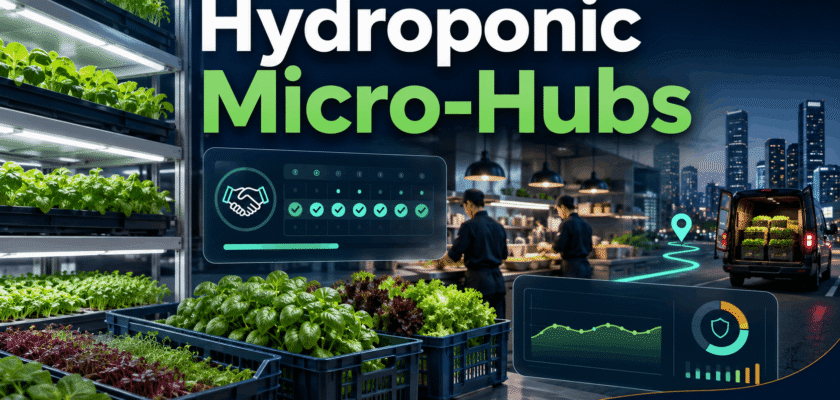
Commercial hydroponic supply chain agreements 2026 are giving urban cloud kitchens a new way to protect fresh-ingredient supply. Instead of buying every herb and leafy green from a changing wholesale market, a kitchen can reserve weekly output from a nearby controlled farm.
This model does not remove inflation. However, it can reduce sudden shortages, emergency buying, and spoilage. It also gives both partners a clearer production plan.
The timing matters. FAO reported that its global Food Price Index remained 1.7% above the previous year in June 2026. At the same time, commercial urban agriculture is expanding as cities look for shorter and more stable vegetable supply chains.
| �� Quick Takeaway✓ Hydroponic micro-hubs work best for high-value leafy greens, herbs, and microgreens.✓ The biggest saving may come from lower waste and stable quality, not the lowest price per kilogram.✓ A strong contract must cover volume, shelf life, safety, energy backup, and replacement rules.✓ Sustainability claims need measured water, energy, packaging, and delivery data. |
Commercial hydroponic supply chain agreements 2026: why kitchens are interested
Fresh produce is one of the hardest kitchen costs to control. Weather can reduce arrivals. Heat can shorten shelf life. Heavy rain can delay trucks. A sudden wholesale shortage can also force the kitchen to buy at a higher rate.
Cloud kitchens feel this pressure quickly because their menus depend on repeatable recipes. A basil bowl, salad, wrap, garnish, or healthy meal must look the same every day. If quality changes, ratings can fall.
A hydroponic partnership changes the planning cycle. The kitchen shares a crop forecast. The grower plans planting and harvest windows. Both sides then agree on a weekly delivery rhythm.
| �� Simple Supply Logic Weather shock → lower market arrivals → spot price rises → kitchen buys in panic → waste or menu cuts increase.Reserved crop plan → scheduled harvest → fixed quality standard → direct delivery → better cost visibility. |
What a hydroponic micro-hub actually means
A hydroponic micro-hub is a small or medium controlled growing unit placed inside or near a city. Plants grow in a water-based nutrient system instead of normal soil.
The hub may use a greenhouse, warehouse, rooftop, or modular room. Its purpose is not to grow every ingredient. It focuses on crops that benefit from short transport, frequent harvest, and stable quality.
USDA includes hydroponic, aeroponic, aquaponic, and vertical facilities within urban agriculture. Cornell also describes controlled environment agriculture as an intensive hydroponic system that manages crop conditions more closely.
Which ingredients fit the model best?
The best crops usually have high value, short harvest cycles, and high freshness sensitivity. FAO identifies leafy greens, herbs, and microgreens as preferred crops for high-tech commercial urban farming.
✓ Lettuce and salad leaves for bowls, wraps, and premium sides.
✓ Basil, mint, and selected herbs for sauces, beverages, and garnish.
✓ Microgreens for premium menus and high-value plating.
✓ Spinach and other tender greens where the farm has a proven crop system.
✓ Speciality greens that are hard to source with the same size and quality each day.
Staples such as wheat, rice, potato, and onion usually do not fit this model. Their value per square metre is too low for most indoor systems. Therefore, a micro-hub should solve a narrow supply problem, not replace the full produce market.
How the partnership can reduce cloud kitchen raw material costs
Reducing cloud kitchen raw material costs starts with usable yield. A cheaper crate is not useful when a large part is wilted, damaged, or rejected.
A nearby hydroponic supplier may deliver produce closer to harvest time. This can improve shelf life and reduce trimming loss. It can also lower the need for emergency purchases during a shortage.
✓ Stable pack size improves recipe costing and portion control.
✓ Planned harvests reduce last-minute buying at peak market prices.
✓ Shorter delivery routes can reduce handling damage and transit time.
✓ Direct supplier communication can speed replacement of a weak batch.
✓ Shared forecasts can prevent overproduction at the farm and overstocking at the kitchen.
Still, hydroponic produce may carry a higher unit price because of electricity, equipment, skilled labour, rent, and nutrient controls. The correct comparison is total usable cost, not invoice price alone.
| �� Cost Formula Box Usable ingredient cost = purchase price + delivery + rejection loss + trimming loss + spoilage + emergency buying.A premium crop can still save money when it cuts waste and keeps the menu available. |
Core terms every supply agreement should include
A verbal promise is not enough. The farm and kitchen need simple written rules. These rules protect the grower from sudden order cuts and protect the kitchen from weak supply.
| Agreement Area | What to Write Clearly |
| Crop and grade | Variety, leaf size, colour, flavour, pack weight, and acceptable defects. |
| Weekly volume | Minimum and maximum quantity with a forecast cut-off date. |
| Price model | Fixed rate, price corridor, or review formula linked to energy and input costs. |
| Delivery service | Days, time window, cold handling, reusable crate rules, and proof of delivery. |
| Shelf-life target | Minimum usable life remaining when produce reaches the kitchen. |
| Rejection rule | Photo proof, response time, replacement timeline, and credit-note process. |
| Food safety | Water tests, sanitation logs, worker hygiene, batch coding, and recall support. |
| Continuity plan | Power backup, equipment failure plan, secondary crop site, and shortage notice. |
| Data sharing | Yield, waste, energy, water, packaging, and on-time delivery metrics. |
| Exit clause | Notice period and a safe process for reducing reserved volume. |
Sustainable restaurant ingredient sourcing metrics
Sustainable restaurant ingredient sourcing metrics should be simple, comparable, and verified. A marketing claim such as “uses less water” is not enough on its own.
Hydroponic systems can use water and land efficiently. Yet fully indoor farms may need large amounts of electricity for lighting, cooling, and climate control. Cornell says energy management is central to successful controlled environment agriculture. FAO also warns that non-renewable power can weaken the environmental case.
| Metric | What It Shows |
| Usable yield | Percentage of delivered produce that enters a saleable dish. |
| Kitchen waste | Kilograms discarded per 100 kilograms received. |
| On-time-in-full | Share of orders delivered at the correct time and quantity. |
| Shelf life at receipt | Average safe, usable days remaining after delivery. |
| Water intensity | Litres used per kilogram of saleable crop, with method explained. |
| Energy intensity | Kilowatt-hours per kilogram, split by renewable and grid power. |
| Packaging loop | Share of crates or packs returned and reused. |
| Delivery distance | Kilometres travelled per delivery and load utilisation. |
| Rejected batch rate | Share of deliveries rejected for quality or safety reasons. |
The kitchen should review these numbers each month. It should also compare the hydroponic supplier with its previous market supplier using the same crop, same quality grade, and same period.
Food safety cannot be treated as automatic
Indoor farming can reduce some field exposure. However, it is not risk-free. FAO says seeds, water, growing media, equipment, and human handling can introduce contamination. Microbiological hazards such as Salmonella and E. coli can still be present.
✓ Test source water and nutrient water on a defined schedule.
✓ Keep clean and dirty zones separate inside the farm.
✓ Use batch codes that connect seeds, harvest date, pack date, and customer.
✓ Train staff on hand hygiene, equipment cleaning, and illness reporting.
✓ Create a recall test before the first commercial delivery.
✓ Agree who pays for testing, disposal, and replacement after a failed batch.
For a cloud kitchen, traceability matters because one contaminated ingredient may enter many dishes. Fast batch identification can limit the size of a recall.
The hidden risk: electricity and climate control
A crop contract can fail even when demand is strong. A power outage, cooling failure, pump problem, or lighting cost spike can reduce output.
That is why the kitchen should ask how the farm manages energy. A greenhouse that uses sunlight may have a different cost structure from a fully enclosed vertical farm. Neither model is automatically better in every city.
✓ Ask for backup power for pumps, cooling, and monitoring systems.
✓ Set a minimum warning period for crop shortfalls.
✓ Track energy cost changes before the price review date.
✓ Prefer efficient lighting and renewable power where the economics are proven.
✓ Keep a secondary supplier for critical menu ingredients.
A practical 90-day pilot for cloud kitchens
A kitchen should test the model before signing a long contract. A 90-day pilot can reveal real waste, quality, and service performance.
1. Choose two or three crops that have high weekly spend or high spoilage.
2. Record the current landed cost, usable yield, waste, and emergency-buy frequency for four weeks.
3. Reserve a limited weekly volume from one hydroponic micro-hub. Keep a backup supplier active.
4. Review quality, shelf life, delivery, food safety records, and customer response every week.
5. Scale only when the total usable cost and service reliability beat the old sourcing method.
| ✅ Pilot Success Rule Do not judge the partnership only by the first invoice.Judge it by usable yield, menu uptime, waste, emergency buying, and customer consistency over the full pilot. |
Mistakes cloud kitchens should avoid
⚠ Signing a long contract before testing crop quality in real dishes.
⚠ Assuming every indoor crop has a lower carbon footprint.
⚠ Comparing invoice price without measuring trimming and spoilage.
⚠ Depending on one farm without a power-failure backup plan.
⚠ Using vague words such as premium, clean, or pesticide-free without proof.
⚠ Ignoring batch traceability because the farm is nearby.
⚠ Ordering too many crop types before the hub proves stable output.


