
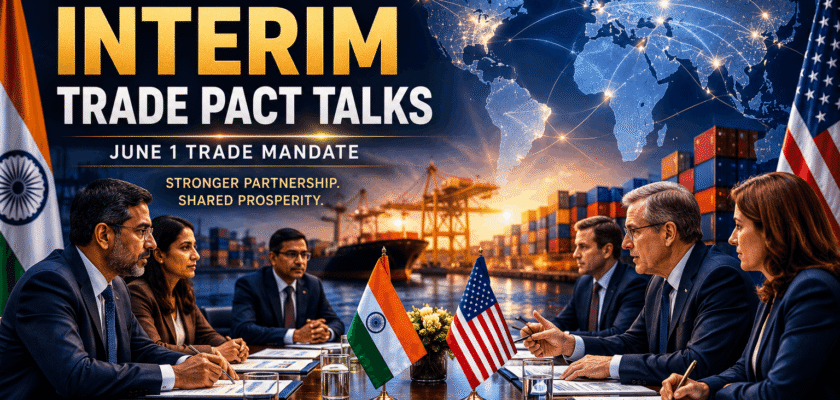
India-U.S. Interim Trade Pact Talks: Why June 1 Matters
India-U.S. interim trade pact talks are set to begin a fresh four-day round from June 1, 2026, in New Delhi. These talks matter because both countries want to finalise details of an interim trade agreement while continuing work on a wider Bilateral Trade Agreement.
This is not only a normal trade meeting. It may influence tariffs, market access, customs rules, investment flows, and economic security planning between two major economies.
Therefore, the June 1 trade mandate is being watched by exporters, importers, investors, policymakers, and global supply chain players.
Why India-U.S. Interim Trade Pact Talks Are Important
India-U.S. interim trade pact talks are important because India and the United States share a large and growing trade relationship. Both countries want stronger economic ties, but they also have sensitive sectors to protect.
The United States wants better access for its companies and exporters. India wants fair treatment for its products, services, workers, and domestic industries.
As a result, the interim pact may become a bridge. It can solve some urgent trade issues now while both sides continue negotiating the larger bilateral trade agreement.
What Is the June 1 Trade Mandate?
The June 1 trade mandate refers to the new round of discussions starting June 1, 2026, when U.S. negotiators are scheduled to visit India for four days.
Reports say the talks will focus on finalising details of the interim agreement and advancing the broader Bilateral Trade Agreement. Areas on the table include market access, non-tariff measures, customs and trade facilitation, investment promotion, and economic security alignment.
In simple words, both sides want a practical short-term deal before the bigger agreement becomes ready.
India-U.S. Interim Trade Pact Talks and Market Access
India-U.S. interim trade pact talks may focus strongly on market access. Market access means how easily goods and services from one country can enter the other country’s market.
For India, better market access can help exporters in sectors like textiles, pharma, engineering goods, gems, jewellery, food products, IT services, and other value-added categories.
For the U.S., market access may matter in areas like technology, agriculture, medical devices, energy, digital services, and high-value manufacturing.
However, both sides will likely protect sensitive sectors. That is why negotiations may be tough.
Tariffs: The Most Sensitive Part of the Talks
Tariffs are one of the most sensitive parts of any trade pact. A tariff is a tax on imported goods. Lower tariffs can make products cheaper and trade easier. However, they can also create pressure on domestic producers.
The 2026 talks are happening in the context of changing U.S. tariff policy. Reports say both countries are trying to recalibrate the proposed pact to reflect recent changes in the U.S. tariff regime.
Therefore, tariff balance will be important. India will want export benefits, but it may avoid sudden pressure on local industries.
Non-Tariff Measures: The Hidden Trade Barrier
Non-tariff measures are rules that can affect trade without directly using import taxes. These can include quality standards, certification rules, testing requirements, labelling rules, customs checks, and technical regulations.
Sometimes these rules protect safety and quality. However, they can also slow down trade if they become too complex.
India and the U.S. may discuss ways to make these rules clearer and easier. This can help exporters avoid delays and reduce compliance costs.
For small businesses, this part may matter more than headline tariff cuts.
Customs and Trade Facilitation: Why It Matters
Customs and trade facilitation can make trade faster. If paperwork, clearance, inspection, and compliance become smoother, companies save time and money.
This is important for sectors that depend on quick movement of goods.
Better customs systems can help:
- Exporters
- Importers
- Logistics companies
- E-commerce firms
- MSMEs
- Pharma companies
- Food exporters
- Electronics suppliers
- Auto component makers
- Retail supply chains
So, even small customs improvements can create a big business impact.
Investment Promotion: What Both Sides May Want
Investment promotion is another important area in the India-U.S. interim trade pact talks. Both countries want companies to invest more across manufacturing, technology, clean energy, semiconductors, defence, supply chains, and digital infrastructure.
India wants more foreign investment that creates jobs, exports, and technology transfer. The U.S. wants stable rules, easier approvals, and better protection for investors.
If the interim pact improves investor confidence, it may support more long-term business partnerships.
However, investment rules need clarity and trust.
Economic Security Alignment: The Bigger Strategy
Economic security alignment means both countries may coordinate on supply chains, critical technologies, strategic sectors, and risk reduction.
This has become more important after global supply chain shocks, geopolitical tensions, and rising competition in technology.
India and the U.S. may look at areas like:
- Critical minerals
- Semiconductors
- Defence supply chains
- Clean energy technology
- Pharma supply security
- Digital infrastructure
- AI and data systems
- Maritime trade routes
- Cybersecurity
- Strategic manufacturing
This shows that the pact is not only about trade. It is also about geopolitical positioning.
Why the Interim Pact May Come Before a Full BTA
A full Bilateral Trade Agreement can take a long time. It needs detailed talks on many sectors, rules, protections, and legal commitments.
An interim pact is faster. It can handle urgent issues first and create momentum.
This approach helps both sides show progress without waiting for the full agreement. It can also test political trust and business response.
Therefore, the interim pact may work like a first step toward a bigger economic partnership.
What India May Want From the Pact
India may want better access for its exports, smoother compliance rules, stronger services access, and more investment support.
India may focus on:
- Lower trade barriers
- Easier market access
- Support for MSME exporters
- Better customs process
- Recognition of standards
- Investment in manufacturing
- Technology cooperation
- Protection for sensitive sectors
- Services and skilled worker interests
- Stable tariff treatment
India will likely push for a balanced deal that helps exports without hurting domestic industries.
What the U.S. May Want From the Pact
The United States may want better access for its companies, more predictable trade rules, and stronger alignment on strategic economic issues.
The U.S. may focus on:
- Market access for American products
- Digital trade rules
- Agriculture and food access
- Medical device rules
- Technology trade
- Tariff concerns
- Investment protections
- Customs improvements
- Intellectual property issues
- Supply chain cooperation
However, U.S. demands may face negotiation if they affect India’s sensitive sectors.
Why Farmers and Small Industries Will Watch Closely
Trade agreements can create both opportunity and fear. Farmers and small industries often worry that cheaper imports may hurt local producers.
That is why India will likely move carefully in sensitive areas like agriculture, dairy, food products, and small manufacturing.
At the same time, better export access can help Indian producers sell more in the U.S. market.
Therefore, the final pact must balance consumer benefit, export growth, and domestic protection.
What Exporters Should Watch
Indian exporters should watch the talks carefully because even small changes can affect business planning.
Exporters should track:
- Tariff changes
- Product eligibility
- Rules of origin
- Customs procedures
- Certification rules
- Quality standards
- Documentation needs
- Sector-specific benefits
- Logistics timelines
- Compliance cost
If the pact reduces trade friction, exporters may get new opportunities.
What Importers Should Watch
Importers should also watch the talks because tariff and customs changes can affect pricing.
A better trade framework may reduce delays and make supply chains smoother. However, some sectors may still face restrictions or safeguard rules.
Importers should track:
- Duty changes
- Product categories
- Compliance rules
- Customs process
- Documentation
- Port clearance
- Quality norms
- Supplier contracts
- Currency movement
- Consumer demand
This helps businesses avoid sudden surprises.
India-U.S. Interim Trade Pact Talks and Global Politics
India-U.S. interim trade pact talks also have a global politics angle. Trade is now connected with strategy, technology, security, and supply chain independence.
Both countries want to reduce overdependence on risky supply routes. They also want stronger cooperation in high-value sectors.
As a result, the talks may support wider geopolitical goals, not just import-export numbers.
This is why global investors are watching the June 1 round closely.
Possible Benefits of the Interim Pact
If the interim pact moves forward, it may bring several benefits.
Possible benefits include:
- Better trade predictability
- Faster customs clearance
- Improved export access
- Stronger investment confidence
- Reduced trade friction
- More supply chain cooperation
- Better business planning
- Stronger India-U.S. economic ties
- Support for strategic sectors
- Momentum for full BTA talks
However, the final impact will depend on the actual text of the agreement.
Possible Challenges in the Talks
The talks may also face challenges. Trade agreements are never simple because every sector has different interests.
Possible challenges include:
- Tariff disagreements
- Agriculture concerns
- Digital trade rules
- Market access disputes
- Non-tariff barriers
- Domestic industry pressure
- Political messaging
- U.S. tariff policy changes
- Data and technology rules
- Enforcement details
So, both sides may need careful compromise.
What to Expect After June 1
After June 1, the four-day meeting may produce clearer signals. Both governments may share whether they have reached common ground on key interim pact details.
However, even if progress happens, final announcement may need legal review, political approval, and technical drafting.
So, businesses should watch official statements instead of relying only on rumours.
The most important signals will be:
- Whether both sides call the talks productive
- Whether interim pact text is near final
- Whether tariff issues are resolved
- Whether market access language is clear
- Whether a full BTA timeline is mentioned
These points will show how serious the progress is.
Final Verdict
India-U.S. interim trade pact talks from June 1, 2026, may become an important moment for bilateral trade. The proposed interim agreement can help both countries handle urgent trade issues while preparing for a broader Bilateral Trade Agreement.
The talks may cover market access, tariffs, non-tariff measures, customs facilitation, investment promotion, and economic security alignment. For exporters, importers, investors, and policymakers, these areas can shape future business planning.
In simple words, this is more than a trade meeting. It is a test of how India and the United States want to build economic trust in a more uncertain global order.


