
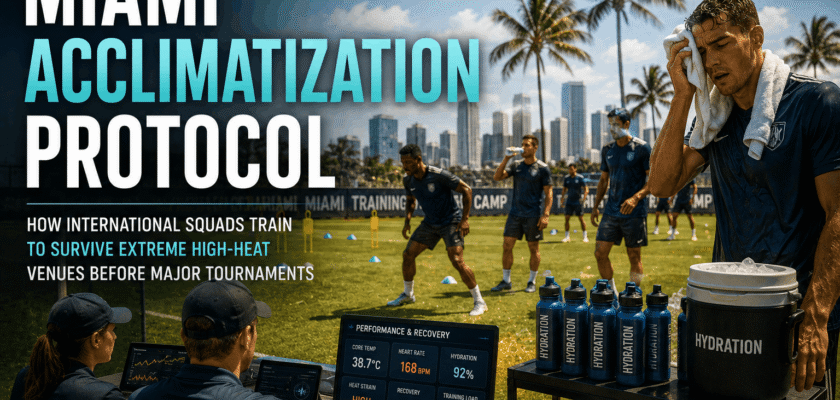
Miami Acclimatization Protocol: Why Heat Training Is Now Essential
Miami acclimatization protocol is becoming a major pre-tournament travel and performance strategy because international squads are preparing for extreme high-heat venues. Big tournaments are no longer only about tactics, fitness, and team selection. Weather, humidity, travel fatigue, hydration, recovery, and training timing can also decide performance.
For the 2026 World Cup, heat and humidity across North America have become serious planning factors. England’s national team has started a 10-day training camp in the Miami/Florida heat to help players adapt before tournament matches. Reuters reported that Thomas Tuchel called heat an obstacle to overcome, not an excuse.
Therefore, the Miami acclimatization protocol is not just a sports science idea. It is also a travel management plan for squads moving into hot and humid tournament zones.
Why Miami Acclimatization Protocol Matters in 2026
Miami acclimatization protocol matters because several tournament venues can expose players to high temperatures, humidity, and heat stress. The 2026 World Cup is spread across the United States, Canada, and Mexico, making travel and climate adaptation more complex than a single-country event.
FIFA has finalised the 2026 team base camp training site footprint, adding 25 communities beyond the 16 host cities. These include warm-weather locations such as Palm Beach Gardens and Tampa in the United States.
This shows that base camp location is now part of tournament strategy. Teams must think about heat, travel time, recovery quality, training fields, medical support, and match location movement.
What Is the Miami Acclimatization Protocol?
The Miami acclimatization protocol is a practical system that helps players adapt to hot and humid conditions before major matches. It includes heat exposure, hydration planning, cooling methods, adjusted training loads, nutrition, sleep recovery, and travel timing.
A strong protocol usually includes:
- Gradual heat exposure
- Training at controlled times
- Hydration before, during, and after sessions
- Electrolyte planning
- Cooling towels and ice vests
- Recovery monitoring
- Sleep protection
- Medical checks
- Sweat-rate tracking
- Match-day heat strategy
The goal is simple: help players perform safely and strongly when heat becomes a real opponent.
Heat Is Not Just Weather, It Is a Performance Factor
Heat is not just uncomfortable weather. It changes how the body works during sport. When the body gets too hot, the heart works harder, sweat loss rises, decision-making can slow, and fatigue can arrive earlier.
In football, heat can affect:
- Sprint repeatability
- Pressing intensity
- Passing sharpness
- Recovery between runs
- Concentration
- Muscle cramps
- Hydration balance
- Tactical discipline
- Substitution timing
- Injury risk
So, teams that ignore heat may lose energy before the final whistle.
Miami Heat and Humidity: Why It Is Different
Miami-style heat is challenging because humidity makes cooling harder. In dry heat, sweat evaporates more easily. In humid heat, sweat stays on the skin longer, and the body struggles to cool itself.
This can make players feel heavy even if the temperature does not look extreme on paper.
Reports from England’s camp described players training in around 32°C Miami heat as part of World Cup preparation.
That kind of environment is useful for adaptation, but it must be managed carefully.
Why International Squads Choose Hot-Weather Camps
International squads choose hot-weather camps because players need time to adjust before competition. Arriving directly from cooler climates into hot venues can increase fatigue and reduce performance.
A hot-weather camp gives teams time to:
- Build heat tolerance
- Test hydration plans
- Adjust training times
- Monitor individual responses
- Practice cooling breaks
- Plan match-day routines
- Improve recovery habits
- Build squad cohesion
- Reduce shock on arrival
- Prepare mentally for discomfort
This is why Miami and Florida-style environments are useful before high-heat tournaments.
Scientific Basis of Heat Acclimatization
Heat acclimatization works through repeated exercise in hot conditions. The body slowly becomes better at handling heat stress.
A major consensus statement on training and competing in heat says heat acclimatization should involve repeated exercise-heat exposures over 1–2 weeks.
Possible adaptations include:
- Earlier sweating
- Better sweat efficiency
- Lower heart strain
- Improved plasma volume
- Better thermal comfort
- Lower perceived effort
- Improved endurance in heat
- Better hydration awareness
These changes help athletes tolerate heat more safely.
How Long Does Heat Acclimatization Take?
Heat acclimatization does not happen instantly. Some benefits can begin within a few days, but stronger adaptation usually needs repeated exposure.
A sports performance guide for World Cup heat preparation notes that at least five days in hot base camps can deliver some adaptation, while recovery and fluid intake must be closely monitored.
For elite squads, a 7–10 day camp can be useful because it gives time to train, monitor, adjust, and recover before matches.
However, coaches must balance adaptation with freshness. Too much heat stress can reduce training quality.
Daily Heat Exposure: Why Timing Matters
Daily heat exposure must be planned carefully. The goal is not to exhaust players. The goal is to create controlled adaptation.
Gatorade Sports Science Institute guidance says optimal heat acclimatization generally needs about 90 minutes of daily heat exposure with aerobic exercise, with gradual increases in intensity or duration.
For football squads, this may look like:
- Warm-up in heat
- Tactical drills at moderate intensity
- Controlled conditioning blocks
- Hydration breaks
- Cooling after training
- Recovery monitoring
- Lower-load sessions after heavy days
The process should be progressive, not brutal.
Why Cooling Strategies Are Important
Cooling strategies help players reduce heat stress before, during, and after training. Reuters reported that England developed cooling strategies with help from Team GB and global specialists.
Cooling tools can include:
- Ice vests
- Cold towels
- Ice slush drinks
- Shade tents
- Fans
- Cold-water immersion
- Cooling stations
- Hydration breaks
- Pre-cooling before sessions
- Post-training cooling
These methods can protect performance and reduce risk.
Hydration Is the Core of the Protocol
Hydration is central to the Miami acclimatization protocol. In hot and humid venues, sweat loss can be high. If players lose too much fluid, performance drops and heat illness risk rises.
Teams usually track:
- Body weight before and after sessions
- Sweat rate
- Urine colour
- Electrolyte loss
- Cramp history
- Heat symptoms
- Training load
- Recovery score
- Thirst patterns
- Individual hydration plan
Each player sweats differently. So, one hydration plan cannot fit everyone.
Electrolytes Matter More Than Plain Water
Plain water is important, but electrolytes matter when sweat loss is heavy. Players lose sodium and other minerals through sweat. If they replace only water and ignore electrolytes, they may still feel weak or cramp-prone.
A practical plan may include:
- Sodium-containing drinks
- Pre-session hydration
- During-session electrolytes
- Post-session rehydration
- Salt-aware meals
- Individual sweat testing
- Avoiding overhydration
- Monitoring body weight changes
Medical and nutrition teams must guide this. Players should not randomly overuse electrolyte products.
Recovery After Heat Training
Recovery after heat training is just as important as the training itself. Heat acclimatization creates stress on the body. If recovery is poor, players may become tired, slow, or injury-prone.
Recovery should include:
- Cooling down properly
- Replacing fluids
- Eating enough carbohydrates
- Getting protein after training
- Sleeping well
- Reducing unnecessary travel
- Monitoring HRV or wellness scores
- Checking muscle soreness
- Managing media duties
- Using massage or physiotherapy when needed
A smart team does not only train hard. It recovers hard.
Why Match Scheduling Still Matters
Heat acclimatization helps, but match scheduling still matters. A team can prepare well and still face difficult conditions if kickoff time is hot.
A recent extreme-heat analysis argued that evening games reduce heat risk but do not eliminate it. It noted that late afternoon and early evening matches in Miami and Kansas City can still carry high wet-bulb globe temperature risk in typical or hotter-than-average summer conditions.
So, tournament organisers, teams, broadcasters, and medical staff all have a role.
Preparation helps. But heat-safe scheduling also matters.
Wet-Bulb Globe Temperature: The Better Heat Measure
Normal temperature does not tell the full story. Sports teams often use wet-bulb globe temperature, or WBGT. It considers heat, humidity, wind, and solar radiation.
WBGT gives a better idea of heat stress risk during outdoor sport.
A venue may look manageable by air temperature, but high humidity and direct sun can make it dangerous.
Teams should monitor:
- Air temperature
- Humidity
- Sun exposure
- Wind speed
- WBGT
- Pitch surface temperature
- Hydration response
- Player symptoms
This gives a more complete risk picture.
Miami Acclimatization Protocol and Travel Planning
Miami acclimatization protocol also includes travel planning. Long flights, time-zone changes, airport delays, hotel sleep quality, and bus transfers can all affect recovery.
Teams must manage:
- Arrival timing
- Jet lag
- Hotel temperature
- Meal timing
- Training field access
- Travel distance to stadium
- Recovery room setup
- Medical equipment
- Hydration logistics
- Security and privacy
Travel is not separate from performance. It is part of performance.
Why Base Camps Are Strategic Assets
Base camps are strategic assets because players spend most of their tournament time there. A good base camp helps training, recovery, privacy, nutrition, medical support, and team culture.
FIFA’s 2026 base camp footprint includes multiple communities outside host cities, giving teams more options for training environments and logistics.
A strong base camp should offer:
- Quality pitch
- Recovery facilities
- Gym access
- Medical rooms
- Privacy
- Good food
- Climate control
- Easy transport
- Security
- Media management
The wrong base camp can create hidden stress.
Heat Training and Tactical Style
Heat can affect tactical style. A team that presses aggressively for 90 minutes in cool weather may need adjustments in hot venues.
Coaches may need to manage:
- Pressing triggers
- Rest defence
- Possession control
- Substitution timing
- Tempo changes
- Hydration breaks
- Player rotation
- Midfield energy
- Full-back runs
- Late-game fatigue
A smart coach designs tactics for the climate, not only the opponent.
Why Substitutions Become More Important
Substitutions become more important in high heat because fatigue rises faster. Fresh legs can protect intensity and reduce injury risk.
Coaches may use substitutes to:
- Restore pressing
- Protect tired players
- Add pace late
- Control midfield
- Reduce cramp risk
- Manage yellow cards
- Protect star players
- Change tempo
- Support defensive structure
- Attack tired opponents
In hot matches, squad depth becomes a travel-health advantage.
Nutrition Before High-Heat Matches
Nutrition must support heat performance. Players need enough carbohydrates for energy and enough fluids for cooling.
Pre-match nutrition may focus on:
- Easy-to-digest carbohydrates
- Moderate protein
- Low stomach heaviness
- Adequate sodium
- Good hydration
- Avoiding unfamiliar foods
- Avoiding very spicy heavy meals before matches
- Meal timing
- Individual tolerance
- Recovery snacks
Food choices during travel must be simple, safe, and repeatable.
Sleep Protection in Hot Venues
Sleep is critical during heat adaptation. If players do not sleep well, recovery falls.
Teams should manage:
- Cool hotel rooms
- Consistent sleep schedule
- Reduced late media events
- Light exposure control
- Jet lag planning
- Quiet rooms
- Sleep monitoring
- Recovery naps when needed
- Caffeine timing
- Pre-sleep cooling
A player cannot adapt properly if sleep is broken every night.
Medical Monitoring During Heat Camps
Medical monitoring helps detect problems early. Heat illness can escalate quickly, so teams must track symptoms carefully.
Warning signs include:
- Dizziness
- Confusion
- Heavy fatigue
- Nausea
- Headache
- Chills in heat
- Unusual cramps
- Very high heart rate
- Poor coordination
- Collapse risk
The CDC notes that heat-related illness in athletes can be prevented when coaches and athletes are properly educated about heat safety.
Education is part of protection.
Fans Also Need Heat Preparation
This topic is not only for players. Fans travelling to hot venues also need preparation.
Fans should:
- Drink water regularly
- Use sunscreen
- Wear light clothing
- Avoid standing in direct sun too long
- Know stadium water rules
- Plan transport early
- Eat light before matches
- Watch for dizziness
- Help children and elderly fans
- Follow local heat advisories
Sports tourism in hot cities needs safety planning.
Miami and Other High-Heat Venues
Miami is one of the key high-heat concern areas. PreventionWeb reported that extreme June-July heat is currently most common at stadiums in Miami, Mexico City, Houston, and Guadalajara, with each averaging at least 10 extremely hot June-July days per year over the past decade.
This does not mean every match will be unsafe. It means preparation must be serious.
Teams and fans should expect hot conditions and plan accordingly.
Why Training in Heat Can Build Mental Toughness
Heat training can build mental toughness because players learn to stay calm when conditions feel uncomfortable. However, coaches must not confuse toughness with unsafe overload.
Good mental preparation includes:
- Accepting discomfort
- Practicing hydration habits
- Learning cooling routines
- Managing frustration
- Staying tactically disciplined
- Communicating fatigue early
- Trusting medical staff
- Avoiding ego-driven overtraining
- Respecting body signals
- Focusing under pressure
The best teams are tough and smart.
Common Mistakes Teams Should Avoid
Teams should avoid common heat-preparation mistakes.
Avoid:
- Arriving too late
- Training too hard too soon
- Ignoring humidity
- Using one hydration plan for all players
- Skipping electrolytes
- Poor sleep planning
- Overloading players during adaptation
- Ignoring WBGT
- Underestimating travel fatigue
- Treating heat as an excuse instead of a factor
Heat preparation should be scientific, not emotional.
What a 10-Day Miami Acclimatization Camp May Look Like
A 10-day Miami acclimatization camp may follow a gradual structure.
Days 1–2
Light training, travel recovery, hydration checks, medical screening.
Days 3–5
Moderate heat exposure, tactical drills, sweat-rate tracking, controlled conditioning.
Days 6–7
Match-like intensity blocks, cooling strategy testing, recovery monitoring.
Days 8–9
Reduced load, sharper tactical work, set-piece practice, sleep protection.
Day 10
Final tune-up, travel planning, hydration and match-day routine review.
This is a sample structure. Elite teams customise it player by player.
Why Individual Plans Matter
Individual plans matter because players respond differently to heat. A goalkeeper, centre-back, winger, and midfielder do not have the same running load. Older players and younger players may also adapt differently.
Teams should personalise:
- Fluid intake
- Electrolyte needs
- Training load
- Recovery time
- Cooling methods
- Sleep support
- Nutrition
- Medical monitoring
- Substitution planning
- Return-to-play decisions
This makes the protocol safer and more effective.
Technology Used in Heat Preparation
Modern squads use technology to track heat stress and recovery.
Tools may include:
- GPS trackers
- Heart-rate monitors
- Core temperature sensors
- Sweat testing
- Hydration testing
- HRV tracking
- Sleep trackers
- WBGT meters
- Cooling stations
- Recovery dashboards
Data helps coaches know when to push and when to protect.
How Travel Companies Can Use This Trend
Travel companies can also learn from high-heat sports planning. Fans travelling to Miami, Houston, Mexico City, or similar venues may need heat-safe packages.
Tour operators can offer:
- Early transport planning
- Shaded waiting areas
- Hydration guidance
- Flexible sightseeing timing
- Hotel cooling checks
- Stadium entry guidance
- Medical support information
- Weather alerts
- Light meal planning
- Heat-safe family itineraries
Sports tourism must now include heat management.
What Tournament Organisers Should Improve
Tournament organisers should treat heat as a core operational risk.
They should improve:
- Cooling breaks
- Shade access
- Water availability
- Medical staffing
- Fan cooling zones
- Heat alerts
- Training pitch standards
- Fixture timing
- Transport queues
- Emergency response plans
ESPN reported that FIFA plans three-minute hydration breaks midway through each half at the 2026 World Cup, regardless of weather conditions.
That is a useful step, but wider heat planning still matters.
Final Verdict
Miami acclimatization protocol is becoming essential because international squads must prepare for extreme high-heat venues before major tournaments. Heat, humidity, travel fatigue, hydration, sleep, and recovery can all affect performance.
England’s Miami/Florida heat camp shows how serious top teams are becoming about climate preparation. With help from Team GB and global specialists, cooling strategies and acclimatization planning are now part of the tournament playbook.
In simple words, modern football preparation is not only about the ball. It is also about the body’s ability to survive and perform in heat.
The squads that manage heat better may have a real advantage when matches move into hot, humid, high-pressure venues.


