
Kuwait Airport Attack: Why the Gulf Is on High Alert
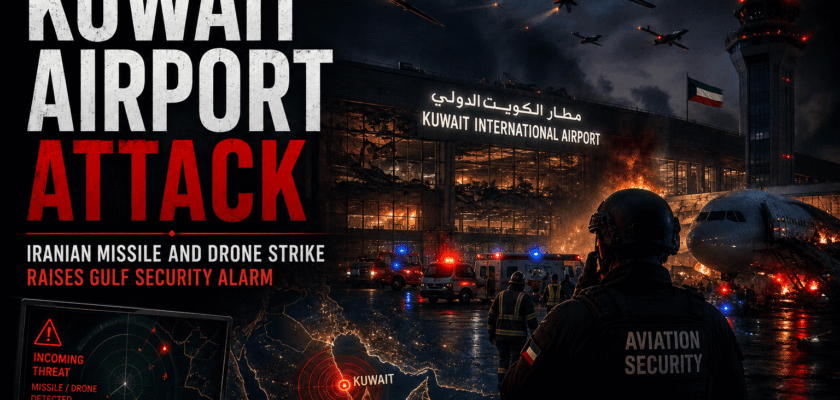
Kuwait airport attack has become a major global politics story after Iranian missiles and drones struck Kuwait International Airport and other targets during a sharp escalation in the Gulf. The incident reportedly caused one death, multiple injuries, damage to airport infrastructure, and temporary flight disruption.
This is not only an airport security issue. It is a regional crisis signal. Kuwait is a key Gulf state, a major energy-linked economy, and a U.S. ally. Any direct strike on its civilian infrastructure can raise tension across the Gulf, affect aviation routes, increase oil-market fear, and complicate diplomacy.
Therefore, the Kuwait airport attack shows how quickly the Iran conflict can spread from military pressure to civilian disruption.
Why Kuwait Airport Attack Matters in 2026
Kuwait airport attack matters because airports are critical civilian infrastructure. When an airport is hit, the impact spreads beyond one building. Flights divert, passengers panic, airlines reassess risk, governments activate emergency plans, and regional security forces go on alert.
Reuters reported that an Iranian missile and drone attack hit Kuwait, damaged Kuwait International Airport, killed one person, and injured several others. Terminal 1 suffered significant damage, while flights were temporarily diverted before limited operations resumed through Terminal 4 after safety checks.
This makes the event one of the most serious Gulf escalations of June 2026.
What Happened at Kuwait International Airport?
The attack struck Kuwait International Airport early on June 3, 2026. Reports said the airport’s Terminal 1 building suffered serious damage, flights were suspended or diverted, and emergency response teams were activated.
Reuters reported that Kuwait experienced an Iranian missile and drone attack targeting civilian infrastructure, including Kuwait International Airport and unspecified diplomatic missions. It also reported that one person was killed and several were injured.
Other regional reports said Kuwait activated airport emergency procedures and halted flights after the strike. The incident quickly became a major aviation and security story.
In simple words, the attack turned Kuwait’s main airport into a frontline symbol of Gulf instability.
Kuwait Airport Attack and the “30 Missiles and Drones” Claim
The original claim says Iran launched 30 ballistic missiles and drones targeting Kuwait Airport. However, verified reports available right now do not clearly confirm the exact number as 30.
Reuters confirmed drone and missile attacks on Kuwait and airport damage, but the publicly available reports do not support the exact “30” figure.
So, responsible reporting should say:
- Iran launched missile and drone attacks.
- Kuwait airport was hit.
- One death and multiple injuries were reported.
- Flights were disrupted.
- The exact number of missiles and drones remains unclear in verified reports.
This keeps the blog accurate and safe for Google News-style credibility.
Why Iran Targeting Kuwait Is a Major Escalation
Iran targeting Kuwait is a major escalation because Kuwait had not been the main battlefield in the earlier phases of the conflict. The attack suggests that Gulf states hosting or supporting U.S. interests may face rising risk.
Reuters reported that Iran also targeted other Gulf states and that missiles aimed at Bahrain were intercepted by U.S. and Bahraini forces. It also said some drones aimed at U.S. forces in Kuwait failed to hit their targets.
This creates a larger regional security concern.
The message is clear: Gulf states can no longer treat the conflict as distant.
Kuwait Airport Attack and Civilian Infrastructure Risk
Kuwait airport attack highlights the danger of strikes on civilian infrastructure. Airports carry families, workers, tourists, diplomats, medical travellers, cargo, and business passengers. They are not ordinary military sites.
When civilian infrastructure is hit, the risk includes:
- Passenger casualties
- Flight cancellations
- Emergency evacuations
- Cargo disruption
- Airline insurance pressure
- Diplomatic backlash
- Travel advisories
- Economic loss
- Public fear
- Regional escalation
This is why airport attacks attract global concern.
Even limited damage can create major psychological impact.
Impact on Flights and Passengers
The attack disrupted flight operations. Reuters reported that flights were temporarily diverted and Kuwait Airways later resumed operations from Terminal 4 after safety assessments.
For passengers, this kind of crisis can create immediate problems.
They may face:
- Delayed departures
- Diverted arrivals
- Cancelled connections
- Long airport waiting
- Security checks
- Confusion over baggage
- Emergency instructions
- Hotel booking issues
- Visa timing problems
- Family communication stress
Travelers should follow airline and airport official updates during such events.
Why Airlines React Quickly to Gulf Escalation
Airlines react quickly because Gulf airspace is one of the world’s most important aviation corridors. Many flights between Asia, Europe, Africa, and the Middle East pass through or near the Gulf region.
A missile or drone threat can force airlines to change routes.
This may lead to:
- Longer flight paths
- Higher fuel cost
- Delays
- More crew planning
- Insurance concerns
- Passenger rescheduling
- Cargo delay
- Emergency diversions
- Ticket price pressure
- Airline advisory updates
So, one airport attack can affect wider aviation planning.
Kuwait Airport Attack and Oil Market Anxiety
The Kuwait airport attack also affects oil market sentiment. The Gulf is central to global energy supply, and any military escalation near energy routes can raise oil-price fears.
Reuters reported that the broader Gulf flare-up contributed to oil prices rising nearly 2%, as conflict risks and stalled diplomacy increased market anxiety.
Oil traders watch Gulf events closely because even a perceived risk to shipping lanes, airports, ports, or energy infrastructure can affect prices.
This is why a security event can quickly become an economic event.
Why Strait of Hormuz Matters
The Strait of Hormuz is one of the world’s most important oil chokepoints. Any conflict near this area creates concern for energy markets.
The Kuwait attack happened during a wider Gulf flare-up involving Iran, the U.S., and regional targets. Reuters reported U.S. strikes near the Strait of Hormuz and Iranian attacks on Kuwait and Bahrain.
If shipping routes become unsafe, global oil and gas supply fears can rise.
That can affect:
- Fuel prices
- Airline cost
- Import bills
- Inflation
- Stock markets
- Currency pressure
- Shipping insurance
- Energy security planning
- Consumer prices
- Government policy
This is why Gulf security affects the whole world.
U.S. Response After the Kuwait Attack
The U.S. response became another major part of the story. Reuters reported that U.S. forces launched retaliatory strikes on Iran’s Qeshm Island and intercepted several incoming Iranian missiles and drones.
This shows that the attack did not remain a Kuwait-Iran issue only. It became part of the wider U.S.-Iran military confrontation.
When the U.S. responds militarily, escalation risk rises.
Each strike can create a new cycle of retaliation.
Bahrain and Wider Gulf Alert
The situation also affected Bahrain. Reuters reported that missiles targeting Bahrain were intercepted by U.S. and Bahraini forces.
This matters because Bahrain hosts important U.S. military assets and sits close to the Gulf’s strategic routes.
If multiple Gulf states become targets, the crisis can shift from isolated retaliation to regional confrontation.
Gulf countries may now increase:
- Air defence readiness
- Airport security
- Military coordination
- Public warning systems
- Diplomatic engagement
- Civil emergency planning
- Cybersecurity monitoring
- Energy infrastructure protection
- Port security
- Border surveillance
The region is entering a more dangerous phase.
Kuwait Airport Attack and Indian Citizens
The Kuwait airport attack is also important for India because many Indian citizens live and work in Kuwait. Indian media reported that an Indian national was killed in the attack. Times of India reported that the victim in the Kuwait airport drone attack was an Indian national.
This makes the event directly relevant for Indian families and workers in the Gulf.
India has deep people-to-people links with Kuwait through:
- Migrant workers
- Nurses
- Engineers
- Business staff
- Domestic workers
- Construction workers
- Airline passengers
- Medical travellers
- Students
- Families
Any Gulf security crisis can affect Indian citizens quickly.
What Indian Travellers Should Do
Indian travellers heading to Kuwait or transiting through the Gulf should stay alert and follow official instructions.
They should:
- Check airline updates
- Track airport status
- Avoid rumours
- Keep passport and documents ready
- Inform family about travel changes
- Follow Indian embassy advisories
- Avoid unnecessary travel near high-alert zones
- Keep emergency contacts saved
- Check insurance coverage
- Reach airport only after confirming flight status
During crisis periods, official updates matter more than social media posts.
Why Diplomatic Missions May Be Concerned
Reuters reported that the Iranian attack targeted civilian infrastructure, including Kuwait airport and unspecified diplomatic missions.
This raises concern because diplomatic missions are protected spaces under international norms. Any attack near or against diplomatic facilities can create serious political consequences.
Governments may respond with:
- Strong condemnations
- Emergency meetings
- Security upgrades
- Travel advisories
- Evacuation planning
- Diplomatic protests
- United Nations statements
- Regional coordination
- Military readiness
- Sanctions pressure
Diplomatic targets can turn a conflict into a wider international crisis.
Why Kuwait’s Location Is Strategically Sensitive
Kuwait’s location makes it strategically important. It sits at the northern edge of the Gulf, near Iraq, Iran, Saudi Arabia, and key energy routes.
It also has close security ties with the United States.
Because of this, any attack on Kuwait carries multiple meanings:
- Pressure on U.S. allies
- Warning to Gulf states
- Regional deterrence message
- Energy-market shock
- Aviation security risk
- Diplomatic escalation
- Military coordination trigger
- Wider Gulf instability
This is why the Kuwait airport attack gained global attention quickly.
Iran’s Possible Strategic Message
Iran may be trying to send a strategic message by targeting Gulf-linked infrastructure and U.S.-aligned regional interests. The message could be that pressure on Iran will create costs for nearby U.S. partners.
However, targeting civilian infrastructure can backfire diplomatically.
It can:
- Increase international condemnation
- Strengthen U.S.-Gulf coordination
- Raise sanctions pressure
- Reduce diplomatic sympathy
- Increase military retaliation
- Damage regional trust
- Affect civilian lives
- Escalate beyond control
This is why such attacks are risky.
Why Ceasefire Talks Are Under Pressure
The Kuwait airport attack came while diplomacy was already struggling. Reuters reported that diplomatic efforts to end the war and reopen the crucial Strait of Hormuz route had stalled despite signs of possible talks.
When attacks continue during negotiations, trust falls.
Each side may accuse the other of bad faith. Military commanders may push for harder responses. Domestic political pressure may increase.
This makes peace talks harder.
A ceasefire needs not only signatures. It needs restraint on the ground.
Global Politics Impact
The Kuwait airport attack can affect global politics because Gulf stability matters to many countries. The U.S., India, China, Europe, Japan, and Gulf states all have energy, trade, and citizen safety interests in the region.
The crisis can influence:
- Oil prices
- Shipping security
- Airline routing
- Diplomatic alignments
- Military deployments
- Sanctions debate
- Emergency evacuation planning
- Stock market sentiment
- Inflation expectations
- Regional alliances
This is why the incident goes beyond Kuwait.
It is a global security event.
Why Airport Security Needs New Thinking
Airport security often focuses on passengers, baggage, and internal threats. But missile and drone risks require a different security layer.
Modern airport protection may need:
- Air defence coordination
- Drone detection systems
- Early warning alerts
- Hardened terminals
- Emergency evacuation routes
- Fire response readiness
- Backup power
- Flight diversion planning
- Passenger communication systems
- Crisis command centres
Airports near conflict zones must prepare for threats from the sky, not only threats inside the terminal.
Drone Warfare and Civilian Airports
Drone warfare has changed modern conflict. Drones are cheaper than many missiles, easier to launch in groups, and harder to detect if small or low-flying.
Civilian airports are vulnerable because they have large open areas, fuel systems, aircraft, terminals, radar equipment, and passenger crowds.
Drone risks include:
- Terminal damage
- Runway closure
- Aircraft damage
- Passenger injury
- Fuel fire risk
- Airspace shutdown
- Emergency diversions
- Panic
- Economic loss
- International pressure
This is why drone defence is becoming a priority.
Ballistic Missile Risk in the Gulf
Ballistic missile risk is more serious because missiles can travel fast and cause major damage. Patriot and other air defence systems can intercept some threats, but no system is perfect.
Missile defence depends on:
- Early detection
- Radar coverage
- Interceptor readiness
- Command speed
- Target identification
- Civil warning systems
- Military coordination
- Redundancy
- Training
- Maintenance
If multiple missiles and drones are launched together, defence becomes harder.
That is why combined attacks create high alert.
Why Civilian Casualties Change the Narrative
Civilian casualties change the narrative because they turn a strategic attack into a humanitarian crisis. One death can increase public anger, diplomatic pressure, and media attention.
Reuters reported one death in the Kuwait attack. Indian outlets reported that the person killed was an Indian national.
This human cost matters.
Behind every casualty is a family, a workplace, and a community.
Global politics should not ignore that human side.
How Kuwait May Respond
Kuwait may respond through military readiness, diplomacy, and civil security measures. It may also work closely with Gulf partners and the United States.
Possible responses include:
- Strengthening air defence
- Increasing airport security
- Diplomatic protest
- Emergency UN consultation
- Travel advisory updates
- Repairing airport infrastructure
- Supporting victims
- Reviewing aviation safety
- Coordinating with allies
- Monitoring further threats
Kuwait will likely want to show control without triggering uncontrolled escalation.
How Gulf States May Coordinate
Gulf states may increase coordination after the attack because similar threats can target multiple countries.
They may coordinate on:
- Air defence radar sharing
- Missile warning systems
- Drone detection
- Maritime security
- Airport protection
- Energy infrastructure security
- U.S. military coordination
- Civil emergency alerts
- Diplomatic messaging
- Crisis communication
Regional coordination can reduce vulnerability.
However, political differences among Gulf states can sometimes complicate unified response.
Risk to Medical and Business Travel
Kuwait is not only a transit point. It is also a work destination and business hub for many people. Any airport disruption can affect business travel, medical travel, family visits, labour movement, and cargo.
Travelers may face:
- Cancelled meetings
- Delayed employment travel
- Medical appointment disruption
- Family emergency travel delays
- Cargo shipment issues
- Insurance complications
- Visa expiry concerns
- Hotel rebooking
- Missed connections
- Higher ticket prices
This is why airport attacks have wide social and economic impact.
Media Responsibility During Gulf Escalation
Media responsibility matters during fast-moving conflict. Early reports may contain unconfirmed numbers or claims. The “30 missiles and drones” number in the title should be treated carefully unless confirmed by reliable official or major media sources.
Responsible reporting should:
- Separate confirmed facts from claims
- Avoid exaggerating casualty numbers
- Cite reliable sources
- Update articles as facts change
- Avoid panic language
- Protect victim dignity
- Verify airport status
- Avoid fake videos
- Explain context
- Mention uncertainty clearly
This helps readers trust the article.
What Readers Should Watch Next
Readers should watch the next 24 to 72 hours carefully.
Important updates include:
- Kuwait airport operational status
- Official casualty numbers
- Iran’s statement
- Kuwait’s response
- U.S. military response
- Bahrain security updates
- Oil price movement
- Flight advisories
- Indian embassy guidance
- UN or Gulf Cooperation Council statements
This story may evolve quickly.
A single new strike or diplomatic statement can change the situation.
Final Verdict
Kuwait airport attack marks a serious escalation in Gulf tensions. Iranian missile and drone strikes damaged Kuwait International Airport, caused casualties, disrupted flights, and triggered broader security concern across the region. Verified reports confirm the attack and airport damage, though the exact claim of 30 ballistic missiles and drones is not clearly confirmed by reliable reporting yet.
The incident matters because Kuwait is a key Gulf state, a U.S. ally, and home to a large expatriate population, including many Indians. It also matters because Gulf instability can affect oil prices, aviation routes, shipping security, and global diplomacy.
In simple words, the Kuwait airport attack is not only a local security incident. It is a warning that the Gulf conflict can quickly spill into civilian infrastructure, travel systems, and global markets.
The next step must be restraint, verified communication, passenger safety, and serious diplomatic effort before the crisis spreads further.


