
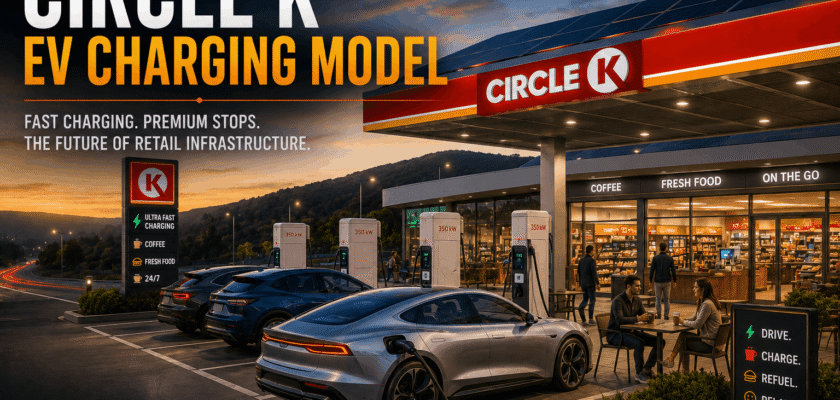
Circle K EV Charging Model: Why Retail Stops Are Becoming Power Hubs
Circle K EV charging model is changing how drivers think about fuel stations, convenience stores, and highway stops. Earlier, fuel stations were built for quick petrol or diesel refuelling. The driver stopped, filled the tank, paid, and left within minutes.
EV charging is different. Even fast charging takes more time than traditional refuelling. That extra time creates a new business opportunity. Instead of treating charging time as waiting time, Circle K is turning it into retail time.
Therefore, the Circle K EV charging model combines fast EV charging with food, drinks, clean restrooms, seating, lighting, safety, and convenience shopping. This is not only about charging cars. It is about redesigning the travel stop.
Why Circle K EV Charging Model Matters in 2026
Circle K EV charging model matters because public charging must feel easy, safe, and useful if more drivers are going to choose electric vehicles. A charger in an empty parking lot may solve the battery problem, but it does not solve the driver experience problem.
Circle K’s own charging page highlights convenience, fast charging, great locations, long hours, lit parking lots, amenities, clean restrooms, and food and beverages while the vehicle charges.
This matters because EV drivers often choose charging stops based on more than speed.
They want:
- Reliable fast chargers
- Safe locations
- Food and coffee
- Clean toilets
- Seating
- Lighting
- Easy payment
- Highway access
- App support
- A trusted brand
In simple words, charging success depends on both electricity and comfort.
What Is the Circle K EV Charging Model?
The Circle K EV charging model is a retail-integrated charging approach. It places fast EV chargers at convenience stops where customers can also buy food, coffee, snacks, groceries, and travel essentials.
The model has three layers:
Fast Charging
Drivers need quick and reliable power.
Convenience Retail
Drivers can use charging time to eat, shop, or rest.
Safe Stop Experience
Good lighting, clean restrooms, seating, and visible parking make the stop more comfortable.
This is why Circle K is not just installing chargers. It is turning retail sites into mobility hubs.
Circle K and IONNA: The 350-Site U.S. Expansion
Circle K and IONNA announced a major U.S. partnership in 2026. Reports say IONNA and Circle K plan to deploy more than 350 EV charging sites at Circle K locations across the United States, with 400 kW fast chargers expected in the rollout.
This is important because IONNA is backed by major automakers and aims to build a high-quality public charging network. Circle K brings retail locations, customer traffic, convenience-store experience, and highway presence.
Together, the partnership can solve two problems at once:
- EV drivers need better charging access.
- Retailers need new reasons for customers to stop.
That is why the deal is a strong signal for future retail infrastructure.
Why 400 kW Fast Chargers Matter
400 kW fast chargers matter because they can reduce charging time for vehicles that support high charging rates. Not every EV can use the full 400 kW, but high-power chargers help future-proof the site.
High-power charging can improve:
- Travel convenience
- Highway trip confidence
- Fleet charging speed
- Customer turnover
- Charger usefulness
- Long-distance EV adoption
- Premium charging experience
- Retail dwell-time balance
- Station competitiveness
- Future vehicle compatibility
A faster charger means drivers can stop for coffee, food, and rest without feeling trapped for too long.
This is where charging and retail work together.
Retail-Integrated Charging Nodes: The Core Trend
Retail-integrated charging nodes are locations where EV charging is combined with real customer amenities. These sites are not only technical charging points. They are consumer destinations.
A good retail-integrated charging node offers:
- Fast charging bays
- Convenience store
- Coffee and snacks
- Restrooms
- Seating area
- Safe lighting
- Clear parking design
- Contactless payment
- App-based charging
- Travel products
This model works because EV charging creates dwell time.
The customer stays longer, and the retailer gets more opportunity to sell.
Why Convenience Stores Are Perfect for EV Charging
Convenience stores are perfect for EV charging because they already sit where drivers stop. Many locations are near highways, urban routes, fuel stations, residential areas, and commuter corridors.
Convenience stores already understand:
- Driver behaviour
- Food and beverage sales
- Restroom importance
- Parking flow
- Roadside visibility
- Travel needs
- Quick purchases
- Loyalty programs
- Payment systems
- 24/7 operations
Adding EV charging turns existing real estate into a future mobility asset.
This is why fuel retailers are moving into charging faster.
Circle K’s EV-Only Convenience Site in Sweden
Circle K opened its first European EV charging-only location in Gårda near central Gothenburg, Sweden. The site includes 10 ultra-fast chargers and a 100-square-meter convenience store, making it the largest EV charging-only convenience location in Circle K’s global network.
This site is important because it removes petrol pumps completely.
It shows what a future EV travel stop may look like:
- No fuel pumps
- Ultra-fast charging bays
- Convenience retail
- Food and beverage options
- Urban accessibility
- EV-first layout
- Waiting-time monetization
- Cleaner mobility identity
This is a strong sign that charging hubs are becoming a standalone retail format.
Circle K’s Largest EV Charging Hub in Sweden
Circle K also opened a large EV charging hub in Järna, Sweden. The station includes a covered charging area with solar panels, benches at charging points, atmospheric lighting, clearly marked crosswalks, and a drive-through solution for faster and more convenient charging.
This shows that EV charging design is becoming more customer-focused.
The best stations are not just rows of chargers. They are designed around:
- Comfort
- Safety
- Weather protection
- Clear movement
- Lighting
- Resting space
- Solar integration
- Better traffic flow
- Customer feedback
- Premium experience
This is why the Circle K model matters for retail infrastructure.
Why EV Charging Stops Need Better Design
EV charging stops need better design because charging creates a different customer journey. Petrol drivers stay near the pump for a few minutes. EV drivers may spend 10 to 30 minutes, depending on the car, charger, and battery level.
During that time, customers notice everything.
They notice:
- Is the area safe?
- Is the charger working?
- Is the restroom clean?
- Is food available?
- Is there shade or cover?
- Is parking easy?
- Is payment simple?
- Is the station crowded?
- Is the lighting good?
- Is there a place to sit?
A poor experience can make drivers avoid the site next time.
Premium Convenience Stops: Why They Increase Revenue
Premium convenience stops can increase revenue because EV drivers spend more time on-site. If the store offers good coffee, snacks, meals, restrooms, and small shopping options, charging time becomes shopping time.
Revenue can come from:
- Coffee
- Snacks
- Fresh food
- Beverages
- Travel essentials
- Grocery items
- Loyalty programs
- Car wash
- App offers
- Fleet services
- Charging fees
This creates a new business model.
The charger brings the customer.
The store increases the basket size.
Why Clean Restrooms Are a Competitive Advantage
Clean restrooms may sound simple, but they are a major reason drivers choose one stop over another. Circle K highlights clean restrooms as part of its EV charging offer.
For EV drivers, clean restrooms matter because charging takes time.
A family on a road trip may choose the site with:
- Better toilet
- Safe parking
- Good food
- Bright lighting
- Seating
- Trusted brand
This means restroom quality can directly affect charging-site success.
Retail infrastructure is about small details that create repeat visits.
Safety and Lighting Matter for EV Drivers
Safety and lighting matter because EV charging often happens during evening, night, or early morning travel. A poorly lit charger in an isolated area can feel unsafe, especially for families, women travellers, and solo drivers.
Circle K positions its charging locations as safe because of long hours and lit parking lots.
A safe charging stop should have:
- Bright lighting
- Visible store staff
- CCTV
- Clear parking layout
- Emergency contact options
- Open restrooms
- Active retail traffic
- Easy exit routes
- No hidden corners
- Good signage
Safety is part of charging adoption.
Why Food and Beverage Are Central to EV Charging
Food and beverage are central because charging gives customers a natural reason to enter the store. Petrol drivers may not always buy something. EV drivers often have time.
Circle K says drivers can “refill your energy” with fresh food, beverages, and snacks while charging their car.
This is smart positioning.
The car charges outside.
The driver recharges inside.
This simple idea can turn charging stops into profitable retail moments.
App-Based Charging and Easy Payment
EV drivers want payment to be simple. Confusing apps, broken card readers, and failed authentication can ruin the experience.
Circle K promotes its Circle K Charge app and contactless payment options across charging services.
Good payment systems should offer:
- App-based start
- Contactless card payment
- Transparent pricing
- Session status
- Charger availability
- Digital receipt
- Loyalty integration
- Autocharge support
- Roaming compatibility
- Easy customer support
Charging must feel as simple as buying fuel.
Autocharge and Seamless EV Experience
Seamless charging is becoming more important. Kempower reported that Circle K and Kempower used an improved Autocharge feature at Circle K’s Gothenburg EV-only site. The feature can remember the vehicle, so future sessions can begin and be paid automatically after plugging in.
This matters because EV charging still feels complex for many new users.
Autocharge can reduce:
- App friction
- Card tapping
- Login problems
- Payment confusion
- Queue delays
- First-time user anxiety
The easier charging becomes, the faster mainstream adoption grows.
How Circle K Model Changes Retail Infrastructure
Circle K EV charging model changes retail infrastructure because the store is no longer only a fuel add-on. It becomes part of the energy transition.
Future retail sites may need:
- High-power grid connection
- Battery storage
- Solar canopy
- Charger maintenance teams
- EV parking design
- Longer customer dwell zones
- Better food service
- Clean restroom investment
- Digital payment systems
- Energy management software
This changes how retail locations are planned, valued, and upgraded.
Real estate with power capacity becomes more valuable.
Why Grid Capacity Is a Hidden Challenge
Grid capacity is a hidden challenge for fast charging. High-power chargers need strong electrical infrastructure. A site with many fast chargers may require transformer upgrades, grid connection work, battery buffers, or smart load management.
Retailers must think about:
- Local grid strength
- Peak demand charges
- Charger uptime
- Battery energy storage
- Solar support
- Utility approvals
- Future charger expansion
- Energy pricing
- Maintenance
- Power redundancy
A convenience store cannot become an EV hub only by installing chargers. It needs serious energy planning.
Battery Storage and Solar Can Support Charging Hubs
Battery storage and solar can help charging hubs manage energy better. Solar can generate some on-site power, while batteries can reduce peak load pressure and improve reliability.
Circle K’s Järna charging hub includes a covered charging area with solar panels, showing how station design can include renewable features.
Future EV retail hubs may use:
- Solar canopy
- Battery storage
- Smart charging
- Energy management software
- Load balancing
- Peak shaving
- Backup power
- Grid services
- Dynamic pricing
- Fleet scheduling
This makes EV charging infrastructure more advanced than traditional fuel retail.
Why Existing Fuel Stations Have an Advantage
Existing fuel stations have an advantage because they already have locations, traffic flow, retail staff, restrooms, signage, and customer trust. They also understand mobility behaviour.
This gives fuel retailers a head start.
They can use existing sites to offer:
- EV charging
- Convenience retail
- Car wash
- Food services
- Loyalty programs
- Fleet accounts
- Travel rest stops
- Fuel and charging together
- Hybrid customer base
- Future mobility services
During the transition period, sites may serve both fuel drivers and EV drivers.
This creates flexible revenue.
EV Charging and Customer Dwell Time
Customer dwell time is the time customers spend at the location. EV charging increases dwell time compared with fuel filling.
A longer dwell time can be good if the site is comfortable.
It can increase:
- Coffee sales
- Food purchases
- Restroom usage
- Basket size
- Loyalty engagement
- App usage
- Brand recall
- Repeat visits
- Travel stop preference
- Premium retail value
But if the site is uncomfortable, longer dwell time becomes frustration.
So, retail quality decides whether dwell time becomes revenue.
Why Highway Charging Needs Amenities
Highway charging needs amenities because long-distance EV drivers need rest, food, toilets, and confidence. A charger alone is not enough on a road trip.
A highway EV charging stop should include:
- Multiple working chargers
- Fast charging speed
- Food and drinks
- Clean restrooms
- Shade or cover
- Safety lighting
- Clear signage
- Easy entry and exit
- Seating
- Real-time availability
The Circle K model fits this need because convenience retail is already part of highway travel.
Why Urban Charging Needs a Different Layout
Urban charging has different needs. Drivers may charge while shopping, commuting, working, or taking a short break.
Urban EV charging sites need:
- Smaller footprint
- Easy access
- Shorter session design
- App availability check
- Coffee and quick food
- Good lighting
- Payment speed
- High turnover
- Clear parking enforcement
- Nearby services
The Gothenburg EV-only convenience site shows how urban EV charging can work as a focused retail format.
This model may inspire more city charging hubs.
Fleet Charging Opportunity
Circle K’s model can also support fleet charging. Delivery vehicles, taxis, ride-hailing cars, rental fleets, and company cars need reliable charging.
Fleet customers care about:
- Charger uptime
- Billing reports
- Fast sessions
- Location coverage
- Driver amenities
- Payment integration
- Predictable pricing
- Account management
- Maintenance reliability
- Operational support
Circle K Ireland says its high-speed charging network is designed to meet needs of individual and fleet customers, helping businesses reduce emissions and streamline operations.
This shows the fleet angle is part of the model.
Why Retailers Are Competing for EV Drivers
Retailers are competing for EV drivers because charging can bring high-value customers. EV drivers may stop longer, use apps more, and spend on premium convenience products.
Competition is coming from:
- Fuel retailers
- Convenience stores
- Restaurants
- Diner chains
- Supermarkets
- Shopping centres
- Parking operators
- Utilities
- Automaker-backed networks
- Standalone charging firms
For example, Waffle House and BP Pulse announced fast EV charging at select diners, showing that amenity-rich retail locations are becoming charging destinations.
The future charging battle may be won by the best stop experience, not only the fastest charger.
The Role of Trusted Brands
Trusted brands matter because EV charging reliability has been a pain point in many markets. Drivers worry about broken chargers, failed payments, blocked bays, and poor safety.
A known brand like Circle K can reduce anxiety.
Brand trust helps with:
- First-time EV users
- Road-trip planning
- Payment confidence
- Safety perception
- Food quality expectations
- Clean restroom expectation
- Customer support
- Fleet adoption
- Loyalty programs
- Repeat behaviour
In charging, trust is a competitive moat.
Why Charger Uptime Is Critical
Charger uptime is critical because a broken charger can ruin a trip. EV drivers often plan stops around battery range. If the charger does not work, the driver may face delay or stress.
A strong charging network must focus on:
- Maintenance
- Remote monitoring
- Fast repair
- Clear app status
- Redundant chargers
- Customer support
- Payment reliability
- Clean parking bays
- Cable condition
- Regular inspection
Retailers that keep chargers working will win customer loyalty.
How Retail Design Can Improve Charging Flow
Retail design can improve charging flow by making the site easy to enter, use, and exit. Circle K’s Järna hub includes clearly marked crosswalks and a drive-through solution for faster and more convenient charging.
Good design should include:
- Clear charger lanes
- Safe pedestrian paths
- Easy cable reach
- No parking confusion
- Wide turning space
- Visible screens
- Good lighting
- Weather protection
- Queue management
- Simple signage
Charging should not feel like parking in a random corner.
It should feel designed.
EV Charging as a Real Estate Upgrade
EV charging can upgrade retail real estate value. A site with fast chargers, strong power connection, good road access, and retail amenities can become more valuable than a normal convenience store.
Value may increase through:
- More customer visits
- Longer dwell time
- Higher store sales
- Charging revenue
- Fleet contracts
- Better brand relevance
- Future-proof infrastructure
- Higher land utility
- New partnership options
- Stronger mobility identity
This is why retail infrastructure is changing.
Power access is becoming part of location value.
Challenges in the Circle K Model
The Circle K model is strong, but it has challenges.
Challenges include:
- High installation cost
- Grid upgrade delay
- Charger maintenance
- Payment failures
- Competition
- Slow EV adoption in some regions
- Peak demand cost
- Parking misuse
- Long queues
- Store staff training
Retailers must manage these problems carefully.
A charger can attract customers only if it works well.
Why India Can Learn From the Circle K Model
India can learn from the Circle K EV charging model because India’s EV adoption is growing, especially in two-wheelers, three-wheelers, fleet cars, and premium electric cars. Public charging still needs stronger reliability and better customer experience.
Indian highways, malls, petrol pumps, cafés, and convenience stores can learn from this model.
Useful lessons include:
- Combine charging with food
- Keep restrooms clean
- Make locations safe
- Use app-based availability
- Add multiple chargers
- Offer shade
- Provide seating
- Use clear pricing
- Maintain uptime
- Build trust
India does not need only chargers. It needs better charging stops.
How Indian Petrol Pumps Can Adapt
Indian petrol pumps can adapt by turning into multi-energy retail stops. They can serve petrol, diesel, CNG, EV charging, food, toilets, tyre air, convenience shopping, and digital payments.
A future Indian mobility stop may include:
- EV fast chargers
- CNG pumps
- Petrol and diesel
- Convenience store
- Café
- Clean toilets
- Solar canopy
- Battery storage
- App booking
- Fleet charging accounts
This transition will take time, but the direction is clear.
Retail-integrated charging can work in India if pricing, safety, and uptime improve.
What EV Drivers Should Look For
EV drivers should choose charging stops carefully.
Look for:
- Fast charger rating
- Real-time availability
- Payment options
- Reliable brand
- Food and restroom access
- Safe lighting
- Multiple chargers
- Recent user reviews
- Easy entry and exit
- Customer support
A slightly better stop can make road trips much easier.
Charging is not only about speed. It is about confidence.
What Retailers Should Build Next
Retailers planning EV charging should not install chargers as an afterthought. They should design a full customer experience.
Retailers should build:
- Multiple fast chargers
- Safe parking layout
- Strong lighting
- Clean restrooms
- Good food counter
- App and card payment
- Seating
- Real-time charger status
- Loyalty integration
- Maintenance plan
The best sites will feel like premium rest stops, not emergency charging points.
Future of Retail-Integrated Charging Nodes
The future of retail-integrated charging nodes looks strong because EV charging naturally creates time for retail. As EV adoption rises, the best charging sites will become travel destinations.
Future hubs may include:
- Ultra-fast charging
- Coffee lounges
- Fresh food
- Grocery pickup
- Car wash
- Solar canopy
- Battery storage
- Fleet bays
- AI-based queue management
- Autocharge payments
Circle K’s model shows that the fuel station of the future may look more like a smart convenience hub than a traditional pump.
Final Verdict
Circle K EV charging model shows how fast charging and premium convenience stops can reshape retail infrastructure. By combining high-power chargers with food, beverages, clean restrooms, safety, lighting, app-based payment, and EV-first site design, Circle K is turning charging time into retail value.
The IONNA partnership in the U.S. and Circle K’s EV-only charging site in Sweden show that the model is moving from experiment to expansion. This matters for automakers, retailers, real estate owners, fleet operators, and EV drivers.
In simple words, the future of charging is not just plug and wait. It is plug, rest, shop, eat, and continue.
The winners in EV infrastructure will be the brands that make charging feel fast, safe, comfortable, and useful.


