
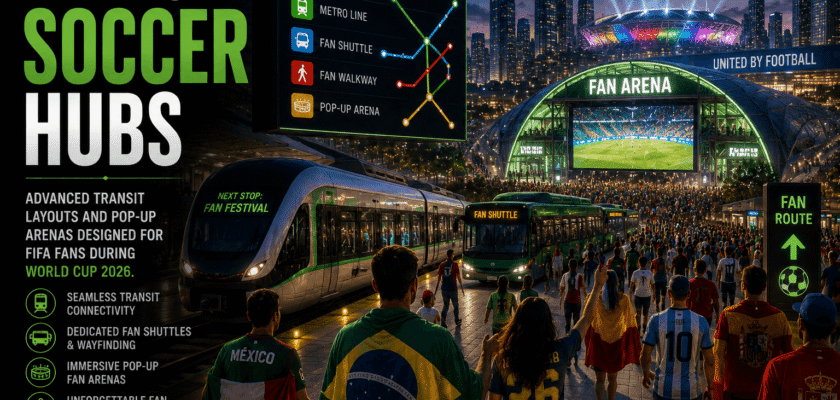
Immersive Soccer Hubs: Why FIFA Travel Is No Longer Just Stadium Travel
Immersive Soccer Hubs are becoming one of the biggest travel trends around FIFA World Cup 2026 because fans are not only travelling to watch matches. They are travelling for full soccer experiences. That includes stadiums, fan festivals, pop-up arenas, city watch parties, cultural events, food zones, metro rides, shuttle hubs, and digital matchday navigation.
The 2026 FIFA World Cup is different because it is spread across 16 host cities in Canada, Mexico, and the United States. FIFA’s official host-city page confirms the tournament is being hosted across three countries, making it one of the most geographically complex World Cup editions ever.
Therefore, Immersive Soccer Hubs are not only entertainment spaces. They are travel systems. They connect fans from airports, hotels, public transport stations, fan festivals, stadiums, and city centres.
Why Immersive Soccer Hubs Matter in 2026
Immersive Soccer Hubs matter because millions of fans will need to move across large cities and multiple countries. Unlike a compact tournament, World Cup 2026 requires serious planning. A fan may watch one match in Miami, another in Dallas, and then travel to New York/New Jersey for a knockout game.
The U.S. Department of Transportation announced $100 million in funding to enhance public transportation in 2026 FIFA World Cup host cities, saying USDOT and local transit agencies will help fans get to games safely and on time.
This shows that World Cup travel is now a government-level mobility project.
Fans will need:
- Matchday shuttles
- Public transport routes
- Fan festival access
- Airport transfers
- Last-mile planning
- Hotel-to-stadium routes
- Crowd management
- Hydration points
- Cooling areas
- Clear digital guidance
In simple words, the best FIFA trip will depend on smart transit planning, not only match tickets.
What Are Immersive Soccer Hubs?
Immersive Soccer Hubs are places where fans gather before, during, and after matches. These hubs may include official fan festivals, pop-up viewing arenas, sponsor experience zones, city squares, cultural stages, food courts, merchandise zones, and shuttle pickup points.
A strong soccer hub includes:
- Big screens
- Live match viewing
- Local food stalls
- Music and cultural events
- Fan activities
- Team-themed zones
- Transit access
- Security checks
- Hydration stations
- Clear crowd flow
These hubs make the World Cup feel bigger than the stadium.
A fan without a match ticket can still enjoy the tournament through official fan festivals and public viewing zones.
FIFA Fan Festivals: The Official Pop-Up Arena Model
FIFA Fan Festivals are the official fan-zone model for World Cup 2026. Reports say every host city will have an official FIFA Fan Festival under the FIFA Fan Festival banner.
These festivals work like pop-up soccer arenas.
They allow fans to:
- Watch matches on big screens
- Celebrate with other supporters
- Enjoy food and music
- Experience local culture
- Buy merchandise
- Join sponsor activations
- Attend concerts
- Meet fans from other countries
- Enjoy football without stadium tickets
- Stay connected to matchday energy
For travel planning, fan festivals are very important because they create separate crowd centres away from stadiums.
That means fans must plan both stadium routes and fan festival routes.
The World Cup Transit Grid: Why It Is Complicated
The World Cup transit grid is complicated because host cities have different transport systems. Some cities have strong rail networks. Some rely more on buses, shuttles, cars, and rideshare. Some stadiums are far from downtown.
Smart Cities Dive reported that international and out-of-town visitors may be unfamiliar with each host city’s transit system, and transit agencies may need extra trains, buses, and operators during the tournament.
This means fans should not assume every city works the same way.
For example:
- New York/New Jersey may push public transport strongly
- Miami may use express shuttle systems
- Los Angeles may enhance Metro services
- Dallas may rely on regional trip-planning tools
- Kansas City has a regional transport plan
- Mexico City has strong metro culture
- Vancouver and Toronto have urban transit networks
Each city needs a different travel strategy.
Miami: Game Day Express and Fan Fest Access
Miami is a strong example of World Cup mobility planning. The official Miami World Cup transportation page encourages fans to plan in advance, allow extra travel time, and use public transportation or shuttle services when possible.
Miami-Dade County also highlights the Miami Game Day Express, which provides free roundtrip shuttle service between confirmed transit hubs and the stadium.
This matters because Hard Rock Stadium is not directly connected by Metrorail.
Miami fans should plan:
- Hotel location carefully
- Shuttle hub access
- Fan Fest at Bayfront Park
- Brightline or transit connections
- Extra travel time
- Post-match exit delays
- Heat and hydration needs
- Rideshare surge risk
- Stadium security rules
- Return travel after night matches
In Miami, the shuttle system may be one of the smartest options for fans.
New York/New Jersey: Public Transport as the Main Route
New York/New Jersey is another major World Cup hub because the final will be staged at MetLife Stadium. The official NYNJ World Cup transportation page says public transportation will be the easiest and most fan-friendly way to get to the stadium, and on match days stadium transportation tickets will be reserved exclusively for match ticket holders.
This is important because NY/NJ crowds will be massive.
Fans should expect:
- Heavy matchday demand
- Reserved transit systems for ticket holders
- Fan festival travel planning
- Long security queues
- Hotel price pressure
- Airport transfer complexity
- Train crowding
- Walking routes
- Shuttle coordination
- Strict timing windows
For the final, fans should avoid last-minute travel planning.
NY/NJ will require early route planning.
Los Angeles: Enhanced Metro Service
Los Angeles is preparing public transport for World Cup matches. Metro announced that it will offer enhanced service, affordable parking, and a celebratory customer experience as the official public transit provider for the Los Angeles World Cup 2026 Host City.
This matters because Los Angeles is famous for car traffic.
For FIFA fans, LA planning should include:
- Metro service options
- Park-and-ride planning
- Shuttle timing
- SoFi Stadium access
- Traffic buffer time
- Airport distance
- Hotel location
- Post-match exit planning
- Fan event locations
- Heat and walking comfort
In LA, transit planning can save fans from traffic stress.
A good route may matter as much as a good seat.
Dallas: Regional Mobility and GoPass Planning
Dallas is another major World Cup city with large match capacity. The official Dallas World Cup transportation page highlights transportation and mobility planning, including GoPass as a regional digital transit ticketing and trip-planning system.
Dallas fans should plan:
- Stadium transfer timing
- GoPass use
- Hotel distance
- Airport arrival route
- Local rail and bus options
- Fan festival access
- Weather planning
- Parking rules
- Group travel
- Return route after matches
Dallas is spread out, so fans should not assume walking distance will be easy.
Trip planning apps and official guidance will be important.
Kansas City: Regional Transportation Planning
Kansas City has also promoted a regional transportation plan called ConnectKC26. The official Kansas City World Cup site says KC2026 planning is supported by civic and brand partners and is designed to exceed FIFA requirements.
Kansas City matters because it is not a typical global mega-city, so World Cup planning can create a strong tourism legacy.
Fans should watch for:
- Official shuttle routes
- Stadium access guidance
- Fan festival location
- Downtown-to-stadium travel
- Regional bus planning
- Parking rules
- Walking zones
- Event-day road closures
- Local hospitality hubs
- Crowd management
Smaller host cities may create some of the best fan atmospheres if transit is managed well.
Why Pop-Up Arenas Are Important for Fans Without Tickets
Pop-up arenas are important because not every fan will get a match ticket. World Cup tickets can be expensive, limited, and difficult to secure. But fan festivals allow people to enjoy the World Cup atmosphere.
Pop-up arenas can help fans:
- Watch matches together
- Support their national team
- Enjoy a stadium-like atmosphere
- Meet other supporters
- Experience local culture
- Avoid ticket resale risk
- Celebrate safely
- Discover host city food
- Attend sponsor activities
- Stay close to official security
For many tourists, the fan festival may become the main World Cup memory.
That is why these hubs must be planned like serious venues.
Heat, Hydration and Fan Safety
Fan safety is a major travel issue for World Cup 2026. Reuters reported that FIFA updated its stadium code of conduct to ban reusable water bottles at World Cup venues, citing safety concerns. FIFA also said it is working with local authorities on heat mitigation strategies such as misting stations, cooling tents, hydration stations, and fans around stadium areas.
This matters because summer conditions in some host cities can be hot.
Fans should prepare by:
- Checking weather daily
- Arriving early but avoiding heat exposure
- Using cooling zones
- Drinking water where available
- Wearing light clothing
- Carrying allowed items only
- Avoiding long direct-sun queues
- Watching for children and elderly fans
- Planning transport after sunset carefully
- Following official venue rules
Travel comfort and safety must be part of the FIFA fan plan.
Why Rideshare Alone May Not Be Enough
Rideshare alone may not be enough during World Cup matches. Demand can spike before and after games, roads may close, and surge pricing can rise.
Fans depending only on rideshare may face:
- Long pickup waits
- Surge pricing
- Road closures
- Driver cancellations
- Walking to pickup zones
- Phone battery issues
- Poor network signal
- Confusing exits
- Late-night delays
- Higher stress
Official shuttles, rail, buses, and fan routes may be more reliable.
The best strategy is to combine official transit with backup options.
Airport-to-Stadium Planning
Airport-to-stadium planning is important because many fans will fly in on matchdays or one day before. This is risky if traffic or security delays increase.
Fans should avoid tight schedules.
Before booking flights, check:
- Airport distance from stadium
- Hotel location
- Match kickoff time
- Public transport access
- Shuttle availability
- Baggage storage options
- Security entry timing
- Local traffic patterns
- Weather delays
- Post-match airport transfers
Do not land too close to kickoff.
World Cup travel needs extra buffer time.
Hotel Location Strategy for FIFA Fans
Hotel location can make or break the trip. The closest hotel to the stadium is not always the best option. Sometimes staying near a transit hub or fan festival is smarter.
Choose hotels based on:
- Transit hub access
- Shuttle pickup points
- Fan festival distance
- Airport connection
- Safety at night
- Food options
- Walkability
- Match schedule
- Budget
- Return route after match
For multi-city fans, staying near airports or major rail hubs may be more practical.
For single-city fans, staying near official transit routes is better.
Multi-City Travel Across Three Countries
World Cup 2026 is spread across the U.S., Canada, and Mexico. Multi-city travel needs serious planning because border rules, flight times, hotel prices, and stadium distances can create stress.
Fans should prepare:
- Passport and visa requirements
- Flight connections
- Travel insurance
- Match spacing
- Hotel cancellation policies
- Airport transfer time
- SIM or roaming plans
- Local currency/payment options
- Stadium bag rules
- Emergency contacts
A fan following one national team may need to move quickly between cities.
Flexible bookings can help.
Fan Festival vs Stadium: Different Travel Plans
Fan festival travel and stadium travel are not the same. Stadiums usually have stricter security, ticket checks, and larger crowd exit pressure. Fan festivals may be downtown and easier to access, but they can also become crowded.
Plan separately for:
- Stadium matchday
- Fan festival viewing
- Opening ceremony events
- Team celebrations
- Sponsor zones
- City cultural events
- Nightlife
- Return transport
- Food and rest stops
- Emergency meeting points
A good FIFA itinerary should include both match and non-match days.
Why Digital Navigation Will Matter
Digital navigation will matter because fans will move through unfamiliar cities. Official apps, transit apps, maps, ticket apps, and city alerts can reduce confusion.
Fans should use:
- Official FIFA updates
- Host city transport pages
- Transit apps
- Google Maps or Apple Maps
- Airline apps
- Hotel apps
- Weather apps
- Emergency alerts
- Digital wallet tickets
- Offline maps
But fans should also save information offline.
Mobile networks can get crowded near stadiums.
What Fans Should Save Offline
Fans should save important details offline before leaving the hotel.
Save:
- Match ticket
- Stadium route
- Shuttle pickup point
- Hotel address
- Emergency contact
- Passport copy
- Transit ticket
- Fan festival location
- Return route
- Meeting point with friends
A dead phone or weak signal should not ruin the day.
Paper backup can also help.
Pop-Up Arenas and Local Tourism
Pop-up arenas can also boost local tourism. Fans who come for football may stay for food, museums, nightlife, beaches, parks, and cultural events.
Host cities can use soccer hubs to promote:
- Local cuisine
- Music
- Art
- History
- Shopping districts
- Walking tours
- Night markets
- Cultural shows
- Local businesses
- Regional attractions
This is why World Cup travel is not only sports travel.
It is city tourism.
Why Local Businesses Should Prepare
Local businesses near fan hubs should prepare for large crowds. Restaurants, cafés, hotels, transport operators, souvenir shops, and tour companies can benefit.
Businesses should prepare:
- Multilingual menus
- Faster payment systems
- Crowd-friendly service
- Extended hours
- Clear signage
- Water and shade support
- Group booking options
- Football-themed offers
- Local guide content
- Staff training
A good fan experience can turn one tourist into a repeat visitor.
Security and Crowd Flow
Security and crowd flow are important because World Cup hubs attract large international crowds. Fans should expect checkpoints, bag rules, restricted items, and crowd control routes.
Fans should:
- Arrive early
- Carry only allowed items
- Follow signs
- Avoid pushing crowds
- Set meeting points
- Keep documents safe
- Watch belongings
- Avoid unofficial ticket sellers
- Stay in lit areas
- Follow police and steward instructions
Smooth fan movement depends on cooperation.
A little planning helps everyone.
Food, Water and Rest Planning
Fans often forget basic comfort. Long matchdays can involve hours of walking, waiting, cheering, and travelling.
Plan for:
- Breakfast before leaving
- Allowed snacks if permitted
- Water access
- Cooling breaks
- Comfortable shoes
- Weather-appropriate clothing
- Sunscreen
- Power bank
- Light bag
- Rest time after match
World Cup travel is exciting, but tiring.
Smart fans protect energy.
Group Travel Tips
Group travel needs more coordination. Large fan groups can easily get separated in transit hubs, fan festivals, or stadium exits.
Groups should:
- Choose one meeting point
- Share hotel address
- Decide return plan early
- Use group chat
- Carry portable chargers
- Avoid last-minute route changes
- Book shuttles early
- Assign one route planner
- Keep tickets ready
- Plan for slow walkers
The larger the group, the earlier the planning should start.
Accessibility for FIFA Fans
Accessibility is an important part of immersive soccer hubs. Fans with disabilities, elderly travellers, children, and medical needs require clear information.
Fans should check:
- Accessible stadium entry
- Wheelchair seating
- Shuttle accessibility
- Elevator access
- Restroom access
- Cooling zones
- Medical tents
- Seating at fan festivals
- Distance from transit stops
- Staff assistance points
Host cities must make the World Cup inclusive.
A great fan hub should work for everyone.
Budget Planning for World Cup Travel
World Cup travel can become expensive quickly. Tickets, flights, hotels, food, transport, merchandise, and fan events can all add up.
Budget for:
- Match tickets
- Hotel surge pricing
- Airport transfers
- Local transit
- Food and water
- SIM card
- Travel insurance
- Fan merchandise
- Emergency cash
- Multi-city flights
Public transport and official shuttles can reduce costs.
Avoid last-minute rideshare and hotel bookings where possible.
Common Mistakes FIFA Fans Should Avoid
Fans should avoid common planning mistakes.
Do not:
- Arrive too close to kickoff
- Depend only on rideshare
- Ignore official transit updates
- Carry banned items
- Forget heat protection
- Book hotels far from transit
- Keep all tickets only online
- Underestimate walking distance
- Skip travel insurance
- Ignore return travel after night matches
World Cup crowds can make normal city travel much slower.
Plan with extra time.
Best Strategy for Matchday
A strong matchday strategy is simple.
Follow this plan:
- Check official transport update
- Leave early
- Use public transport or official shuttle
- Carry only allowed items
- Save ticket offline
- Eat before long queues
- Use cooling and hydration points
- Enter stadium early
- Set post-match meeting point
- Use planned return route
This reduces stress.
The goal is to enjoy football, not fight logistics.
Best Strategy for Fan Festival Day
Fan festival days can be more relaxed, but still need planning.
Do this:
- Check match screening schedule
- Arrive before big matches
- Use transit instead of parking
- Carry light items
- Wear comfortable shoes
- Keep water access in mind
- Set a meeting point
- Protect phone battery
- Try local food
- Leave before peak exit if needed
Fan festivals are best enjoyed when you are not rushed.
Treat them like mini-stadiums.
Future of Sports Tourism
Immersive Soccer Hubs show the future of sports tourism. Major tournaments are no longer only about stadium seats. They are about citywide experiences.
Future sports tourism will include:
- Fan festivals
- Pop-up arenas
- Transit hubs
- Digital ticketing
- AR experiences
- Local food zones
- Sponsor villages
- Cultural stages
- Smart crowd management
- Multi-city travel planning
The World Cup is becoming a full travel ecosystem.
Fans are not only spectators.
They are city explorers.
Final Verdict
Immersive Soccer Hubs are reshaping FIFA travel because World Cup 2026 is spread across 16 host cities in three countries. Fans will need more than match tickets. They will need smart transit planning, shuttle awareness, fan festival routes, hydration strategies, hotel-location planning, and digital navigation.
Official planning is already visible. The U.S. DOT has announced major public-transit support, Miami is using Game Day Express shuttles, NY/NJ is pushing public transport for stadium access, LA Metro is enhancing service, and Dallas is highlighting regional trip-planning tools.
In simple words, the best World Cup fan experience will happen where football energy and transit planning meet.
The fans who plan early will enjoy more football, less stress, and better memories.


