Mass Gathering Advisory: Why PAHO’s Measles Warning Matters Now
Mass gathering advisory has become a serious public health topic because global travel is rising at the same time measles cases are increasing across the Americas. Large international events can bring together fans, workers, volunteers, athletes, media teams, and tourists from many countries. If measles enters a crowd with immunity gaps, one case can quickly become many.
The PAHO/WHO message is simple: countries should not wait for outbreaks to explode. They should strengthen surveillance, improve vaccination coverage, and prepare rapid response systems before major events begin. This advisory matters because measles is highly contagious, but also highly preventable through vaccination.
For readers, this is not a panic story. It is a preparation story. The goal is to protect families, travellers, healthcare workers, event staff, and communities before travel-linked transmission grows.
Why the Mass Gathering Advisory Matters in 2026
The advisory matters because World Cup 2026 and other global events will create heavy movement across borders. PAHO reported that 20,521 measles cases and 25 deaths were confirmed in 16 countries and one territory in the Americas between epidemiological weeks 1 and 20 of 2026. That was a fourfold increase from the same period in 2025 and already higher than the previous year total.
This makes surveillance urgent. A measles case during a normal week can spread locally. A measles case during a global event can travel across airports, hotels, buses, stadiums, fan zones, and family gatherings before symptoms are recognized.
In simple words, mass gatherings do not create measles by themselves. They increase the chance that measles can travel faster when immunity gaps already exist.
What PAHO Is Asking Countries To Do
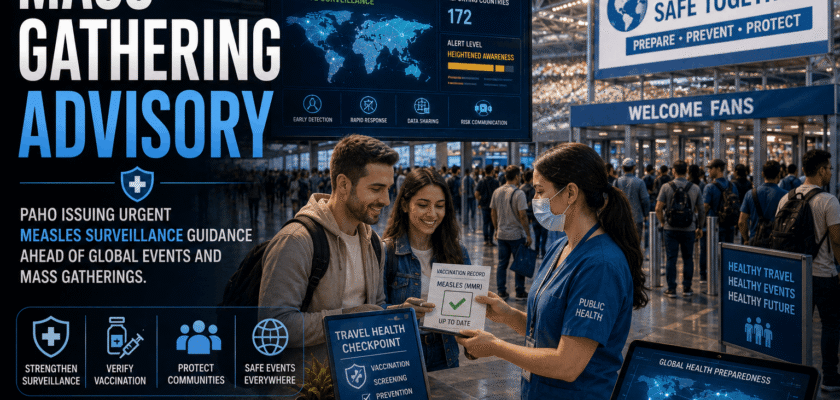
PAHO/WHO is urging Member States to prioritize three core actions: stronger surveillance, stronger vaccination activity, and rapid response to suspected measles cases. These are basic public health steps, but they become more important during global events.
Countries should prepare healthcare workers to recognize symptoms quickly, test suspected cases, isolate when needed, trace contacts, and close vaccination gaps in communities at risk. Border points, event venues, hotels, clinics, and emergency departments should know how to respond if a suspected case appears.
The advisory is also a reminder that routine immunization systems matter. Emergency campaigns help, but they cannot replace strong year-round vaccination coverage.
Why Measles Is a Mass Gathering Risk
Measles is one of the most contagious human infections. It spreads through the air when an infected person coughs or sneezes. A person can be exposed by being in a room where an infected person was present.
During mass gatherings, people spend time in crowded indoor and outdoor spaces: airports, transit lines, stadium gates, fan festivals, hotel lobbies, restaurants, clinics, and public transport. This makes early detection important.
Large events also include people from different countries and different vaccination backgrounds. If vaccination records are incomplete or immunity is low, transmission risk increases.
The Americas Measles Situation
PAHO’s 2026 updates show that measles has resurged across the Americas after years of elimination efforts. The region saw a sharp increase in 2025 and continued transmission into 2026.
PAHO situation reporting in May 2026 identified Mexico, Guatemala, the United States, and Canada among the countries accounting for most confirmed cases. The United States also reported substantial outbreak activity, with CDC data showing 2,030 confirmed cases as of June 4, 2026.
The important point is that measles is not isolated to one city or one country. It is a regional risk that moves with people.
Why Vaccination Coverage Is the Main Defense
Vaccination is the strongest defense against measles. CDC says two doses of the MMR vaccine are 97% effective at preventing measles, and one dose is 93% effective. High community coverage protects people who cannot be vaccinated, such as some infants or medically vulnerable individuals.
The problem is that coverage gaps can form inside communities, schools, religious groups, migrant populations, rural areas, or regions with poor access to healthcare. Even if national coverage looks acceptable, local gaps can fuel outbreaks.
For mass gatherings, vaccination checks should happen before travel. Waiting until symptoms appear is too late.
What Travellers Should Do Before Global Events
Travellers should check measles vaccination status before international trips or large events. This is especially important for families with children, students, event volunteers, healthcare workers, and people travelling to countries with known outbreaks.
Practical steps include checking MMR records, talking to a healthcare provider before travel, keeping vaccine documentation available, monitoring symptoms after travel, and avoiding travel when sick.
Fans should also understand that fever and rash after travel should not be ignored. Early reporting helps protect others.
Warning Signs of Measles
Measles symptoms usually begin with fever, cough, runny nose, and red eyes. A rash follows later and spreads across the body. People may be contagious before the rash appears, which makes surveillance difficult.
Common warning signs include high fever, cough, runny nose, red or watery eyes, small white spots inside the mouth, and rash. Anyone with these symptoms after travel or event exposure should call a healthcare provider before visiting a clinic, so the clinic can prevent further exposure.
Do not self-diagnose through social media. Measles needs proper medical and public health handling.
Why Event Organizers Must Prepare
Event organizers should treat measles preparedness as part of crowd safety. They already plan security, transport, emergency medicine, food safety, heat management, and crowd control. Infectious disease response should be part of the same planning.
Organizers can coordinate with local health departments, train medical teams, display vaccination reminders, create isolation protocols, support communication in multiple languages, and prepare referral routes for suspected cases.
The best event health plan is invisible when everything goes well. It becomes critical when one suspected case appears.
Healthcare Worker Readiness
Healthcare workers are central to the advisory. A missed early measles case can expose waiting rooms, emergency departments, ambulances, and clinics. Staff must recognize symptoms, ask about travel, ask about vaccination status, and follow isolation procedures quickly.
Laboratory confirmation and public health notification should be fast. Contact tracing should begin immediately when suspicion is high. Delayed reporting can allow transmission chains to grow.
Healthcare systems should also protect staff through vaccination verification and infection-control training.
Surveillance: The Real Meaning
Surveillance does not mean spying on people. In public health, surveillance means collecting, reporting, testing, and analyzing disease signals early enough to stop outbreaks.
For measles, surveillance includes suspected case detection, rash-fever reporting, lab confirmation, genotype tracking, contact tracing, vaccination status review, and rapid outbreak response.
Good surveillance helps officials answer simple but important questions: where is measles spreading, who is affected, who is unprotected, and what action is needed now?
Why Airports and Transit Hubs Matter
Airports and transit hubs matter because infected travellers can move across cities before symptoms become obvious. Large events increase international arrivals and domestic travel. That creates more opportunities for exposure.
Public health teams should coordinate with airports, airlines, immigration points, hotels, transport operators, and event venues. This does not mean shutting down travel. It means preparing communication, referral, and response systems.
Clear public messages help travellers act quickly if they develop symptoms.
What Schools and Colleges Should Learn
Schools and colleges should use this advisory as a reminder to check immunization awareness. Students travel, attend festivals, join sports events, live in hostels, and interact in crowded settings.
Institutions can share vaccine guidance, encourage students to keep health records, prepare campus health clinics, and prevent misinformation. If a suspected case appears, campus response must be quick and calm.
Education institutions should not wait for a campus outbreak before discussing measles prevention.
Why Misinformation Makes Outbreaks Worse
Misinformation can make measles outbreaks worse by reducing vaccination confidence. False claims, fear-based posts, and anti-vaccine rumours can create pockets of unvaccinated people where measles spreads quickly.
Public communication should be simple and factual. Measles is highly contagious. MMR vaccination is effective. People with symptoms should contact healthcare providers. Communities should protect children and vulnerable people.
Trust is part of outbreak control. If people do not trust health messages, they delay action.
Mass Gathering Advisory and World Cup 2026
World Cup 2026 is one of the clearest examples of why PAHO issued recommendations. The tournament will involve Canada, Mexico, and the United States, with massive international movement across host cities.
Fans will move through airports, hotels, stadiums, fan festivals, shuttle systems, restaurants, and local attractions. That makes vaccination and surveillance planning essential.
The goal is not to cancel events. The goal is to make events safer by reducing preventable disease risk.
What Families Should Do
Families should check vaccination records before travel, especially for children. Parents should talk to doctors if they are unsure about MMR timing or travel needs.
Families should also watch for symptoms after travel. If a child develops fever and rash after a trip or large event, parents should call ahead before visiting a clinic. This helps healthcare teams protect other patients.
Preparation is simple, but it must happen before exposure.
What Employers Should Do
Employers sending staff to global events should include measles prevention in travel-health planning. This applies to media teams, logistics staff, hospitality workers, sports staff, event vendors, corporate travellers, and healthcare support teams.
Employers can encourage vaccination checks, share official travel health guidance, support sick leave for symptomatic workers, and coordinate with occupational health services.
A sick employee returning from a global event can create workplace exposure if symptoms are ignored.
What Public Health Teams Should Prioritize
Public health teams should prioritize vaccination coverage, active surveillance, laboratory readiness, case investigation, rapid communication, and event-linked response planning.
They should also map high-risk communities, support mobile vaccination where needed, ensure hospitals know reporting rules, and prepare multilingual public messaging.
During mass gatherings, speed matters. A delayed response can turn a single case into a multi-city exposure event.
Practical Traveller Checklist
Before travel, check MMR records, talk to a healthcare provider, follow official advisories, save travel insurance details, and keep vaccination documents accessible.
During travel, avoid close contact with sick people, follow hygiene basics, and seek medical guidance if fever, cough, red eyes, or rash appear.
After travel, monitor symptoms and inform healthcare providers about recent travel or event exposure.
Final Verdict
Mass gathering advisory from PAHO/WHO is a timely warning because measles cases are rising while major global events are bringing people together across borders. The advisory is not about fear. It is about preparation.
Countries need stronger surveillance, vaccination, laboratory testing, healthcare worker readiness, and rapid response systems. Travellers need to check vaccination status before attending global events. Event organizers need infectious disease plans alongside security and transport planning.
In simple words, measles is preventable, but only if action happens before exposure. PAHO’s advisory reminds the world that safe global events depend not only on stadiums and tickets, but also on public health readiness.


