
Stock Market Shakeup: Why Good Jobs News Became Bad Market News
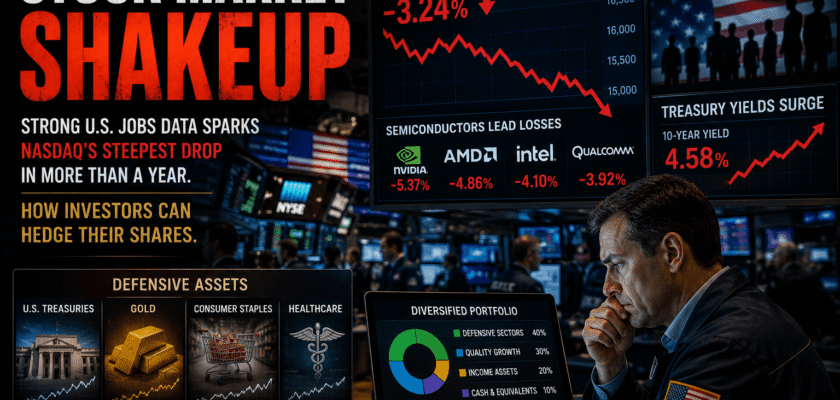
Stock market shakeup became the defining finance story of June 5, 2026, after stronger-than-expected U.S. employment data triggered a sharp selloff in technology and semiconductor shares. The Nasdaq Composite fell 4.18%, its biggest daily percentage decline since April 2025, while the S&P 500 lost 2.64% and the Dow fell 1.35%.
At first, the reaction looked confusing. A strong labour market should normally support economic growth and corporate earnings. But investors were focused on interest rates. The jobs report reduced hopes for Federal Reserve rate cuts and increased concern that rates could remain higher for longer or even rise again.
That matters most for expensive growth stocks because their valuations depend heavily on future profits. When bond yields rise, those future profits become less valuable in today’s terms.
What the May Jobs Report Showed
The U.S. economy added 172,000 jobs in May 2026, far above the roughly 85,000 forecast in the Reuters poll. The unemployment rate remained at 4.3% for a third month.
The report also showed that the labour market remained resilient despite geopolitical uncertainty and earlier expectations of slower hiring. Strong employment reduced fears of an immediate recession, but it also shifted the market’s attention back toward inflation and interest-rate risk.
Key signals included:
- 172,000 new nonfarm payrolls
- 4.3% unemployment
- Upward revisions to earlier months
- Continued strength in services
- Less urgency for rate cuts
- Rising probability of tighter policy later in 2026
Why Strong Jobs Data Hurt the Nasdaq
The Nasdaq contains many technology, semiconductor and high-growth companies. These businesses often trade at high price-to-earnings multiples because investors expect strong profits far into the future.
When interest-rate expectations rise:
- Government bond yields increase
- Future earnings are discounted more heavily
- High valuations become harder to justify
- Investors move toward cash-flow-rich defensive sectors
- Leveraged companies face higher financing costs
- Speculative positions are reduced
This is why the same jobs report that supported the economic outlook damaged technology valuations.
The Steepest Nasdaq Drop in More Than a Year
Reuters reported that the Nasdaq fell 4.18%, the largest one-day percentage decline since April 2025. The index also recorded a drop of more than 1,100 points.
The decline was not limited to one company. It reflected a broad reset in technology risk after a long rally driven by artificial intelligence enthusiasm.
The selloff ended Wall Street’s strong multi-week run and reminded investors that even high-quality companies can fall sharply when valuation, rates and positioning change at the same time.
Semiconductor Stocks Took the Hardest Hit
Chipmakers suffered some of the day’s largest losses. Reuters reported steep declines across Nvidia, Intel, AMD, Broadcom and Qualcomm, while the Philadelphia Semiconductor Index suffered a severe one-day fall.
Semiconductor shares were vulnerable because:
- AI expectations had pushed valuations higher
- The sector had become crowded with momentum investors
- Rising yields reduce the appeal of long-duration growth
- Broadcom’s outlook added company-specific pressure
- Profit-taking accelerated once support levels broke
- Options and algorithmic trading amplified the move
A powerful long-term theme can still experience violent short-term corrections.
Bond Yields and the Hawkish Pivot
The jobs report pushed Treasury yields higher. Reuters reported the 10-year U.S. Treasury yield near 4.54% and the two-year yield around 4.16% during the market reaction.
Higher yields affect stocks in two ways.
First, bonds become more attractive compared with equities. An investor can earn a stronger return from government debt without taking company-specific risk.
Second, the discount rate used to value future earnings rises. This hurts companies whose expected profits are far in the future.
The hawkish pivot does not mean a rate hike is guaranteed. It means the market had to price a higher probability of tighter policy.
Why the Federal Reserve May Stay Cautious
A strong labour market gives the Federal Reserve more time to focus on inflation. If employment remains healthy, policymakers may feel less pressure to stimulate the economy through lower rates.
The Fed must balance:
- Inflation risk
- Wage growth
- Labour-market resilience
- Oil and energy shocks
- Financial stability
- Consumer spending
- Geopolitical uncertainty
- Market expectations
The market selloff reflected fear that the balance had shifted away from rate cuts.
Why Gold Also Fell
Gold often rises during fear, but it declined sharply during the same session. Reuters reported a fall of about 3.6%.
The reason was interest-rate expectations. Gold does not pay interest. When real yields rise, holding bonds or cash becomes more attractive compared with holding gold.
This shows that no hedge works in every market shock. Gold can help during currency stress or geopolitical fear, but it can fall when the main driver is a sudden rise in real-rate expectations.
Was the Selloff Only About Jobs?
The jobs report was the main trigger, but the selloff had several supporting pressures.
These included:
- High technology valuations
- Broadcom-related concerns
- Heavy investor concentration in AI trades
- Rising Treasury yields
- Middle East uncertainty
- Oil and inflation concerns
- Profit-taking after a long rally
- Large upcoming technology listings
- Options-market positioning
Market declines usually have one trigger and several hidden vulnerabilities.
Why Crowded Trades Fall Faster
A crowded trade happens when many investors own the same stocks for the same reason. AI chip companies had become one of the market’s most popular positions.
When sentiment changes, many investors try to exit together. This can cause:
- Sharp gaps lower
- Reduced liquidity
- Forced selling
- Options-driven volatility
- ETF outflows
- Momentum reversal
- Stop-loss activation
Diversification protects investors from depending too heavily on one popular theme.
How to Check Whether Your Portfolio Is Overexposed
Before buying a hedge, investors should measure their actual risk.
Ask:
- What percentage is in technology?
- How much is in semiconductors?
- Are several funds holding the same stocks?
- Is one company more than 10% of the portfolio?
- Are positions financed with margin?
- Is emergency cash available?
- When will the money be needed?
- Can the portfolio tolerate a 20% fall?
- Are valuations very high?
- Is the plan long term or short term?
A portfolio can look diversified while still being dominated by the same mega-cap companies.
Hedge 1: Maintain a Cash Buffer
Cash is the simplest hedge. It reduces portfolio volatility and creates buying power during a correction.
A reasonable cash buffer can help investors:
- Avoid forced selling
- Handle emergencies
- Rebalance after declines
- Reduce emotional pressure
- Buy quality assets at lower prices
Too much cash can reduce long-term returns, so the correct level depends on goals and risk tolerance.
Hedge 2: Rebalance Instead of Panic Selling
Rebalancing means returning the portfolio to its planned asset allocation.
Example:
If an investor planned 60% equity, 30% debt and 10% gold, but a technology rally pushed equity to 75%, the investor can trim part of the overweight position and restore the original balance.
Rebalancing is useful because it:
- Forces profit-taking after rallies
- Reduces concentration
- Creates disciplined buying after falls
- Prevents emotional decisions
- Keeps risk aligned with goals
It is usually safer than trying to predict the exact market bottom.
Hedge 3: Add High-Quality Bonds or Short-Duration Debt
Higher yields make quality bonds more useful as a portfolio stabilizer. Short-duration debt is generally less sensitive to future rate changes than long-duration bonds.
Debt exposure can provide:
- Lower volatility
- Interest income
- Liquidity
- Capital for rebalancing
- Reduced dependence on equity returns
Investors should still check credit quality, duration and currency risk.
Hedge 4: Use Defensive Equity Sectors
Defensive sectors often have steadier demand and cash flows. They may not avoid every decline, but they can reduce dependence on high-growth technology.
Defensive areas may include:
- Consumer staples
- Healthcare
- Utilities
- Selected telecom companies
- High-quality dividend businesses
- Essential services
The goal is not to chase whatever rose during one bad day. The goal is to build a portfolio with different return drivers.
Hedge 5: Reduce Position Size in Overvalued Winners
Investors do not always need to sell an entire winning position. Trimming can reduce risk while preserving long-term exposure.
Possible actions include:
- Sell a small percentage
- Stop automatic over-allocation
- Redirect new contributions
- Set maximum position limits
- Diversify across sectors
- Review valuation against earnings
Position sizing is one of the strongest risk-management tools because it controls the damage any single mistake can create.
Hedge 6: Protective Put Options
A protective put gives the investor the right to sell an asset at a specified price before expiry. It can limit downside while allowing upside participation.
However, put options have costs and complexity:
- Premium can expire worthless
- Volatility can make protection expensive
- Timing and strike selection matter
- Tax treatment may vary
- Options require active monitoring
They are better suited to investors who understand derivatives. Beginners should not use options simply because markets are falling.
Hedge 7: Covered Calls for Income
A covered call involves holding a stock and selling a call option against it. The premium can provide income and modest downside protection.
The trade-off is limited upside if the stock rises sharply.
Covered calls may suit investors who:
- Already own the shares
- Expect moderate rather than explosive gains
- Understand assignment risk
- Can manage option expiry
- Want additional income
This is not a full crash hedge. It is an income strategy with limited protection.
Hedge 8: International and Currency Diversification
Investors concentrated in one country or currency can reduce risk through global diversification.
Possible exposure includes:
- Developed-market funds
- Emerging-market funds
- International bonds
- Export-oriented companies
- Foreign-currency assets
- Global sector funds
Global markets can fall together during major shocks, but long-term diversification reduces dependence on one policy cycle.
Hedge 9: Gold, but in a Limited Allocation
Gold can provide diversification during geopolitical or currency stress. However, the June 5 decline showed that gold can fall when real yields jump.
A limited allocation may help over a full market cycle, but investors should avoid assuming gold will rise every time stocks fall.
Gold works best as one part of a broader strategy, not as the only protection.
Hedge 10: Avoid Leverage
Leverage magnifies both gains and losses. During a sudden 4% index fall, leveraged positions can face margin calls and forced liquidation.
Investors should be especially careful with:
- Margin accounts
- Leveraged ETFs
- Short-dated options
- Concentrated futures
- Borrowed-money investing
- Unhedged derivatives
The first rule of surviving volatility is avoiding a position that forces action at the worst time.
What Long-Term Investors Should Do
Long-term investors should focus on fundamentals and allocation rather than one trading session.
A practical response is:
1. Review concentration
2. Check emergency cash
3. Continue diversified contributions
4. Rebalance if targets changed
5. Avoid emotional selling
6. Review company earnings and valuation
7. Keep a multi-year time horizon
A market correction can improve future returns for disciplined investors, but only if their financial plan remains strong.
What Short-Term Traders Should Do
Short-term traders face different risks. They need clear entry, exit and position-size rules.
Important controls include:
- Predefined stop-loss levels
- Smaller positions during high volatility
- No averaging down without a plan
- Awareness of economic releases
- Reduced overnight exposure
- Option-implied volatility checks
- Strict leverage limits
Trading without rules becomes especially dangerous when indexes move several percentage points in one day.
How Indian Investors May Be Affected
Indian markets can feel the impact through global risk appetite, foreign institutional flows, technology valuations and currency movement.
Indian investors should watch:
- Nasdaq futures
- U.S. bond yields
- Dollar index
- FII flows
- IT-sector valuations
- Rupee movement
- Oil prices
- Federal Reserve guidance
A U.S. technology selloff can pressure Indian IT and growth stocks even when domestic fundamentals remain unchanged.
Mistakes to Avoid After a Nasdaq Crash
Avoid these common mistakes:
- Selling everything after the fall
- Buying every dip without valuation checks
- Using leverage to recover losses
- Chasing inverse products late
- Assuming the market must rebound immediately
- Ignoring taxes
- Copying social-media trades
- Holding concentrated positions without review
- Using options without understanding them
- Changing a long-term plan because of one day
Good risk management is calm, measured and repeatable.
A Simple Portfolio Stress Test
Imagine that:
- Technology falls another 20%
- Bond yields remain high
- Gold stays flat
- The dollar strengthens
- Income remains unchanged
Ask whether the portfolio can still meet near-term financial needs.
If the answer is no, the portfolio may be too aggressive.
A stress test is more useful than predicting tomorrow’s market direction.
What to Watch Next
The next market direction may depend on:
- U.S. inflation data
- Federal Reserve statements
- Treasury yield movement
- Oil prices
- Middle East developments
- Technology earnings
- Semiconductor guidance
- Investor fund flows
- Upcoming IPO demand
- Further labour-market data
A single jobs report changed the rate outlook. Future data can change it again.
Final Verdict
Stock market shakeup on June 5, 2026 showed how quickly strong economic data can become negative for expensive growth stocks. The U.S. added 172,000 jobs in May, unemployment remained 4.3%, and investors sharply reduced expectations for rate cuts.
The Nasdaq fell 4.18%, its steepest daily percentage drop since April 2025. Semiconductor and AI-linked stocks suffered the most because valuations were high, positions were crowded and bond yields moved upward.
In simple words, the jobs report did not make companies suddenly bad. It changed the price investors were willing to pay for future growth.
The best hedge is not panic. It is a balanced portfolio, sensible position sizes, sufficient cash, quality debt, limited leverage and a clear plan for rebalancing. Advanced tools such as options should be used only by investors who fully understand their risks.


