
New Salary and Tax Rules from April 1: The 2-Day Final Settlement Mandate Explained
Every financial year in India brings changes to tax slabs, salary structuring, and regulatory compliance. However, the changes effective from April 1, 2026, are arguably the most impactful in recent memory, moving beyond simple tax tweaks to fundamentally restructure how employees are paid and how their tenure ends.
The centerpiece of this transformation is a groundbreaking regulatory change that directly targets employee welfare and corporate efficiency: the 2-Day Final Settlement Mandate.
For both employees and employers, understanding this new landscape is critical to financial planning and compliance. Here is a definitive guide explaining the new salary and tax rules and, critically, how the final settlement mandate works.
The April 1 Shift: Beyond Basic Tax Changes
While the core of the new rules centers on settlement, several other changes are also effective:
- Rationalized Tax Slabs: Slight adjustments in the new tax regime, making it more attractive and reducing the overall tax burden for middle-income earners.
- Standardized Allowances: A simplified list of tax-exempt allowances, designed to make salary structuring cleaner and reduce complex calculations.
- Mandatory Digital Payslips: All employers must issue digital-only payslips, linked directly to the employee’s unified digital identity (e-PAN/Aadhaar) for real-time validation.
These changes set the stage for the main event: a fundamental modernization of payroll processing.
The 2-Day Final Settlement Mandate: The Core Change Explained
Historically, the process of ‘Full and Final (F&F)’ settlement in India has been a source of significant delay and stress. It typically takes a company 30 to 45 days (sometimes longer) after an employee’s last working day to calculate, approve, and disburse all dues.
From April 1, 2026, this standard practice is illegal.
The new mandate, introduced under the revamped ‘Payment of Wages Act (2026 Extension)’, dictates:
All employers must complete the Full and Final Settlement and disburse the entire payable amount to a resigning, retiring, or terminated employee within TWO WORKING DAYS of their last date of employment.
What Does “Complete Settlement” Include?
The mandate is comprehensive. The 2-day period must cover:
- Salary & Arrears: Payment of all accrued salary up to the last working day.
- Leave Encashment: Calculation and payment for all eligible, accumulated leaves.
- Gratuity: Calculation and disbursement of gratuity dues (if applicable).
- Bonus & Commissions: Pro-rata bonus or other guaranteed performance pay.
- Reimbursements: Cleared and approved expense reimbursements.
- Full Deductions & Adjustments: All final tax deductions (TDS), salary advances, and professional tax adjustments must be finalized.
- Final Payslip & Compliance Documents: Issue of the final digital payslip and necessary tax forms (e.g., Form 16 details).
How Companies Can Comply with the 2-Day Rule
For HR and Payroll departments, this is a seismic operational shift. Achieving a complete, compliant F&F settlement in just 48 hours requires moving from manual processing to Agentic AI and seamless integration.
Companies must deploy:
- Integrated HRIS (Human Resource Information Systems): A single platform where attendance, leave balance, performance data, and expense reimbursements are updated in real-time.
- Automated F&F Workflows: Systems that can trigger, calculate, approve, and disburse the final amount within defined timeframes, with minimal human intervention.
- Agentic AI for Payroll: Sophisticated AI agents that can cross-verify data, apply complex tax rules instantly, and generate compliant documentation without manual calculations.
- Real-time TDS Validation: Direct integration with tax authorities for instant confirmation of final tax dues.
Benefits and Impact
For Employees:
- Financial Security: Instant access to their hard-earned money during transition.
- Reduced Stress: Eliminates the month-long wait and follows-ups for F&F dues.
- Smoother Transition: Facilitates easier onboarding with new employers by providing final tax and compliance documents instantly.
For Employers (Long-term):
- Better Employee Relations: Drastically improves the offboarding experience, protecting employer brand.
- Reduced Liability: Minimizes the risk of legal disputes over delayed payments.
- Operational Efficiency: Drives the adoption of advanced, integrated payroll technologies, making the entire organization more efficient.
Conclusion
The April 1, 2026, rules represent a defining moment in India’s journey toward a modernized, digital economy that prioritizes employee welfare. The 2-Day Final Settlement Mandate is a clear directive to employers: automate or face non-compliance. While the initial operational hurdle is high, the long-term benefits in efficiency, transparency, and employee satisfaction will redefine payroll and HR practices for decades to come.
Conceptual and Meaningful Image
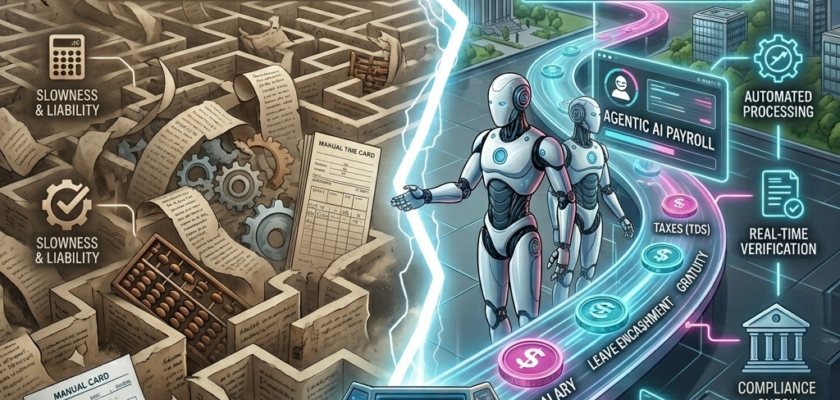
This image is a meaningful visual metaphor for the shift. It visualizes the traditional, “slow” final settlement process being replaced by a modern, digital alternative. A complex maze representing the 30-45 day wait is shown collapsing, while a new, streamlined digital path—labeled 2-Day Final Settlement—emerges, guided by automated agents.


