


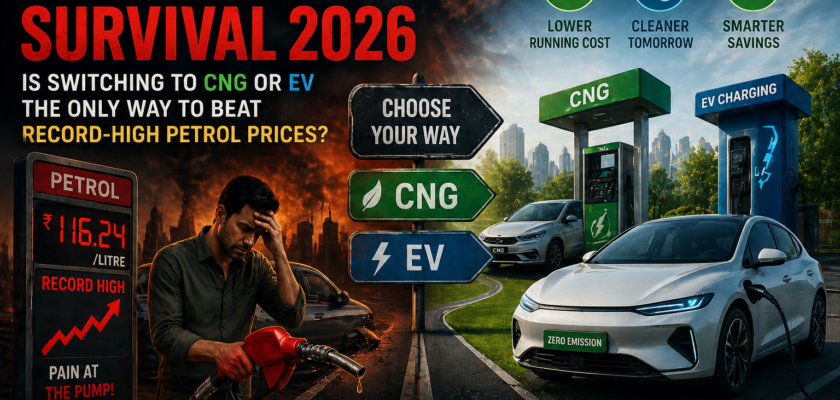
Fuel Crisis Survival 2026: Is Switching to CNG or EV the Only Way to Beat Record-High Petrol Prices?
As of April 25, 2026, the daily commute has officially turned into a battle for the bank balance. With international Brent crude surging past $106 per barrel due to the ongoing Strait of Hormuz blockade, petrol prices in Jaipur have touched a painful ₹106.08 per litre. For many, Fuel Crisis Survival 2026 is no longer a choice—it is a necessity.
Whether you are driving to your office in Sitapura or planning a weekend trip, the question remains: is it time to ditch the petrol pump for a charging plug or a CNG station? Let’s break down the economics of survival in this high-cost era.
1. The Reality of the 2026 Fuel Squeeze
The Fuel Crisis Survival 2026 is driven by a global supply shock. While the Indian government has tried to keep prices stable through subsidies, the sheer pressure of $100+ oil has pushed retail rates to record levels.
- Petrol (Jaipur): Hovering between ₹104 and ₹107 all through April.
- Diesel: Staying steady at ₹88–₹90, but industrial costs are rising.
- The “Wait Time” Factor: As petrol costs rise, the “Slowness & Liability” of traditional fuel is showing. You aren’t just paying more; you are paying for an Uncertain Return on your monthly transport budget.
2. CNG: The Bridge to Sanity
For many, including owners of the Tata Nexon iCNG (which pioneered the turbo-CNG segment), the Fuel Crisis Survival 2026 strategy is simple: switch to gas.
- Running Cost: At approximately ₹77 per kg, CNG offers a running cost of roughly ₹3.20 per km, nearly half of petrol’s ₹6–₹8 per km.
- The Convenience Factor: With the government fast-tracking over 467 new CNG/CBG stations this month, the “Abacus Maze” of long queues is finally being simplified.
- The Hybrid Edge: Bi-fuel cars allow for Autonomous Precision—run on CNG for the city and switch to petrol for long highway stretches where gas pumps might be scarce.
3. EV: The Ultimate “Outcome-Based” Play
If you can charge at home, the Fuel Crisis Survival 2026 winner is undeniably electric.
- Cost Per KM: Home charging typically costs between ₹1.10 and ₹1.50 per km. Even with public DC fast chargers (₹22/unit), the cost stays under ₹3.50 per km.
- Maintenance Advantage: EVs eliminate the “Slowness & Liability” of oil changes, spark plugs, and timing belts. Your 5-year service cost is often 50% lower than a petrol car.
- Tax Shields: In 2026, many states continue to offer 100% Road Tax waivers and waiving registration charges, making the high upfront cost of a Tata Tigor EV or Nexon EV easier to digest.
4. Strategic Matrix: Survival Economics 2026
| Metric | Petrol (ICE) | CNG (Bi-Fuel) | EV (Electric) |
| Running Cost / KM | ₹6.50 – ₹8.50 | ₹3.10 – ₹4.50 | ₹1.10 – ₹2.50 |
| Upfront Price | Lowest | Moderate (+₹90k) | High (+₹4-6 Lakh) |
| Refueling Time | 5 Minutes | 10 – 20 Minutes | 1 – 8 Hours (Charging) |
| Maintenance | High (Mechanical) | Moderate | Lowest (Electronic) |
| 2026 Strategy | High Risk / Liability | High Value / Transition | Highest Long-Term Return |
Conclusion
Fuel Crisis Survival 2026 isn’t about which technology is “best”—it’s about which one fits your daily Outcome.
- If you drive less than 10,000 km a year and can’t charge at home, sticking to your petrol car might still be the most Minimized Risk path.
- If you are a high-mileage city commuter, the ₹16,700 Crore global current is moving toward EVs.
- For everyone else caught in the middle, a turbo-CNG SUV offers the best Autonomous Precision to beat the petrol hike today without the “Range Anxiety” of tomorrow.
The old era of cheap, easy petrol is gone. To survive 2026, you need to choose a fuel that works as hard as you do.


