
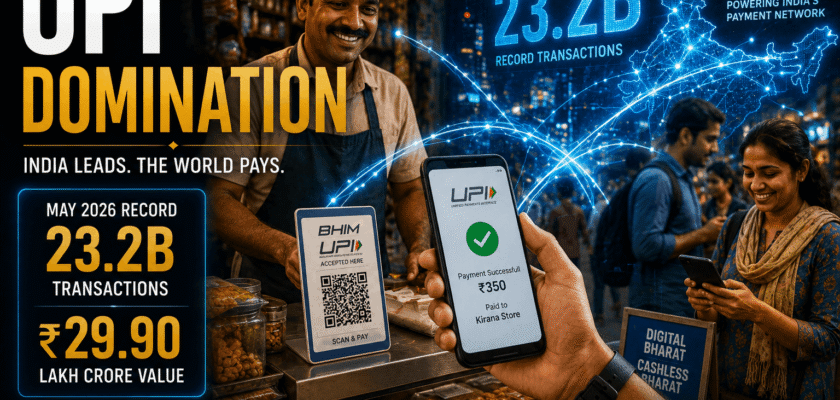
UPI Domination: Why May 2026 Became a Record Month
UPI domination reached a new level in May 2026 as India’s real-time payment system processed 23.2 billion transactions worth ₹29.90 lakh crore. This was one of the clearest signs that UPI is no longer only a payment option. It has become the daily payment habit of India.
From tea stalls to supermarkets, from rent transfers to online shopping, from travel bookings to IPL-season spending, UPI now sits at the centre of India’s digital economy.
Therefore, May 2026 was not just another strong month. It showed how deeply UPI has entered retail payments, small business transactions, consumer spending, and everyday money movement.
Why UPI Domination Matters in 2026
UPI domination matters because India’s digital payment system is scaling at a speed few countries can match. In May 2026, UPI processed 23.2 billion transactions, up from 22.35 billion in April. The total transaction value reached ₹29.90 lakh crore, up 3% month-on-month and 19% year-on-year.
This growth shows that UPI is expanding in both volume and value.
Volume means more people are using UPI more often.
Value means bigger money movement is also happening through UPI.
Together, these numbers prove that UPI has become India’s default digital payment rail.
What Does 23.2 Billion UPI Transactions Mean?
23.2 billion transactions means 2,320 crore payments in one month. That is a massive number.
It means UPI handled payments across:
- Shops
- Street vendors
- Grocery stores
- Fuel stations
- Food delivery
- E-commerce
- Travel bookings
- Utility bills
- Subscriptions
- Peer-to-peer transfers
This scale shows that UPI is not limited to urban users. It is also spreading through smaller towns, local markets, and semi-urban commerce.
In simple words, UPI has become the digital version of cash for India.
UPI Domination and ₹29.90 Lakh Crore Value
UPI domination becomes even more powerful when we look at value. In May 2026, UPI transactions crossed ₹29.90 lakh crore, which is close to ₹30 lakh crore in a single month.
This number matters because it shows UPI is not only used for ₹10, ₹50, or ₹100 payments. It is also used for higher-value transfers and business payments.
However, UPI is still mostly a high-frequency, smaller-ticket payment system compared with large-value rails like RTGS. The RBI’s payment system data shows UPI dominates payment volume, while RTGS dominates high-value transfers.
So, UPI’s strength is clear: frequent, fast, low-friction payments at massive scale.
Why May 2026 UPI Growth Was So Strong
May 2026 UPI growth was strong because several spending categories became active at the same time. Consumer spending, IPL-related payments, summer travel, food delivery, shopping, bill payments, and small merchant transactions all likely supported higher usage.
Moneycontrol reported that IPL and summer travel helped power UPI to its record May transaction value of ₹29.9 lakh crore.
This makes sense.
May is a high-spending month for many users. Families travel. Students pay fees. Cricket season drives food and entertainment spending. Small businesses also see more retail activity.
UPI captured that activity.
UPI as India’s Retail Payment Backbone
UPI is becoming India’s retail payment backbone because it works across banks, apps, merchants, and users. A customer can pay from one app to another app. A small shop can accept payments without expensive card machines. A user can send money instantly with a mobile number, UPI ID, or QR code.
This makes UPI simple.
Its biggest strengths are:
- Instant transfer
- Low friction
- QR-code payments
- Bank-to-bank settlement
- Wide app support
- Merchant adoption
- Small payment convenience
- Easy peer transfers
- Bill payment support
- Strong public trust
This is why UPI has become a daily habit.
Why Small Merchants Love UPI
Small merchants love UPI because it reduces dependence on cash. They can accept payment through a QR code without buying a card machine.
For a small shop, UPI helps with:
- Faster payment collection
- Less change problem
- Lower cash handling
- Digital transaction record
- Easier customer checkout
- Better trust
- Reduced fake currency risk
- More payment options
- Better daily sales tracking
- Simple onboarding
This is why even roadside vendors now display QR codes.
UPI has made digital payments feel normal at the smallest level of commerce.
Why Customers Prefer UPI
Customers prefer UPI because it is fast and familiar. They do not need to carry cash. They do not need to remember card details. They can pay instantly using a PIN.
UPI helps customers with:
- Quick payments
- Easy money transfer
- Bill payments
- Online shopping
- Auto-pay mandates
- Split bills
- Low-value payments
- Emergency transfers
- Merchant payments
- Travel payments
For many Indians, “scan and pay” has become second nature.
That habit is the real reason behind UPI domination.
UPI Lite and Small-Value Payments
UPI Lite is another reason low-value payments are becoming easier. It allows users to make small payments from a pre-loaded wallet without entering a UPI PIN every time.
Times of India recently explained that UPI Lite is useful for daily small payments like tea, snacks, parking, and quick retail purchases because it speeds up checkout and reduces small entries in bank statements.
This matters because India has huge small-ticket transaction volume.
If small payments become faster, UPI volume can grow even more.
UPI and the Decline of Cash Friction
Cash is still used in India, but UPI has reduced cash friction. Earlier, both buyer and seller needed exact change. Now, a customer can pay ₹17, ₹43, or ₹268 instantly.
This helps local commerce.
UPI reduces:
- Change shortage
- Cash counting time
- ATM dependence
- Cash loss risk
- Manual ledger errors
- Payment disputes
- Delay in settlement
- Customer inconvenience
For daily payments, convenience matters more than anything.
That is why UPI keeps growing.
UPI Domination and Digital Inclusion
UPI domination also supports digital inclusion. It allows small merchants, rural users, gig workers, delivery staff, homemakers, students, and senior citizens to use digital payments without needing complex banking tools.
A user only needs:
- Bank account
- Mobile number
- UPI app
- PIN
- Internet access
- Basic digital comfort
This simple model has helped UPI scale widely.
However, digital inclusion also needs safety education. New users must understand fraud risks, wrong QR codes, fake customer care numbers, and OTP scams.
Growth must come with awareness.
What UPI Means for Banks
UPI is both an opportunity and a challenge for banks. It brings more digital transactions, customer engagement, and account activity. But it also reduces reliance on older payment methods like debit cards for small purchases.
Banks benefit from:
- More active accounts
- More digital users
- Better transaction data
- Lower cash handling
- App engagement
- Merchant relationships
- Cross-selling opportunities
- Payment ecosystem presence
At the same time, banks must invest in uptime, fraud control, app security, and customer support.
UPI scale puts pressure on banking infrastructure.
UPI and Fintech Competition
UPI has created a strong fintech layer in India. Payment apps compete on user experience, rewards, merchant tools, credit products, lending, bill payments, and financial services.
Fintech companies use UPI as the base rail and build services around it.
This includes:
- Bill payments
- UPI Lite
- Credit on UPI
- Merchant dashboards
- Personal finance tools
- Auto-pay subscriptions
- Insurance payments
- Investment payments
- Travel payments
- Loyalty programs
UPI is not only a payment system. It is a platform for financial innovation.
Why UPI Is Hard to Replace
UPI is hard to replace because it has network effects. The more users and merchants join, the more valuable it becomes.
A payment system becomes powerful when everyone accepts it.
UPI already has:
- Bank support
- App support
- Merchant QR adoption
- Customer habit
- Public trust
- Government backing
- NPCI infrastructure
- Low-friction design
- Strong brand recall
- Everyday use cases
This creates a strong moat.
A new payment system would struggle to match this scale quickly.
UPI Volume vs UPI Value
UPI volume and value tell two different stories.
Volume shows how many transactions happen.
Value shows how much money moves.
UPI dominates in volume because people use it many times daily. However, RTGS still dominates large-value money movement. Economic Times reported from RBI data that UPI accounted for 85.5% of payment transaction volume in the second half of CY2025, but only 9.5% of total payment value, while RTGS had only 0.1% of volume but 68.6% of value.
This means UPI is India’s retail payment king, while RTGS remains the large-value transfer system.
Why UPI’s May Record Is a Consumption Signal
UPI’s May record is also a consumption signal. When UPI transactions rise, it can indicate more retail activity, travel payments, food orders, shopping, and service payments.
However, one month of UPI growth does not automatically mean the whole economy is booming. It shows digital payment activity, not full economic health.
Still, high UPI usage can suggest:
- Strong retail transaction activity
- Wider merchant acceptance
- More digital comfort
- Higher small-ticket payments
- Seasonal spending growth
- Better payment convenience
- More formal transaction records
UPI data is becoming an important digital economy indicator.
How UPI Helps the Formal Economy
UPI helps the formal economy by creating digital records of transactions. This can help small merchants track income, apply for loans, build credit profiles, and manage daily sales.
Digital records can support:
- Business loans
- Cash-flow analysis
- Tax transparency
- Merchant growth
- Supplier payments
- Customer refunds
- Expense tracking
- Digital bookkeeping
- Credit scoring
- Financial discipline
However, small merchants also need simple accounting tools and tax education to benefit fully.
UPI and Credit Access
UPI transaction data can support future credit access for merchants and users. If a small shop shows consistent digital sales, lenders may feel more confident offering credit.
This can help:
- Kirana stores
- Food stalls
- Service providers
- Small traders
- Home businesses
- Delivery-based sellers
- Local vendors
- Freelancers
- Micro-entrepreneurs
- Rural merchants
Responsible credit built on real cash flow can help small businesses grow.
But lenders must avoid over-lending.
UPI International Expansion
UPI is also becoming part of India’s global fintech image. NPCI International has worked on UPI-linked acceptance in multiple countries, and Indian travellers increasingly expect easy digital payment options abroad.
UPI internationalisation can help:
- Indian tourists
- NRIs
- Cross-border commerce
- Small merchants abroad
- Remittance innovation
- India’s fintech influence
- Digital public infrastructure exports
- Global real-time payment partnerships
However, cross-border UPI needs regulatory coordination, currency conversion, fraud control, and merchant acceptance.
The opportunity is large, but execution must be careful.
UPI Security: The Next Big Challenge
UPI security is the next big challenge because scale attracts fraud. As more users join, scammers also try to exploit confusion.
Common UPI fraud methods include:
- Fake payment screenshots
- Fake customer care numbers
- QR code traps
- Screen-sharing app scams
- Collect request fraud
- UPI PIN stealing
- Loan app scams
- Fake refund messages
- Phishing links
- Impersonation calls
Users must remember one rule: never enter UPI PIN to receive money.
UPI growth must be matched with fraud awareness.
What Users Should Do to Stay Safe
Users can stay safe with simple habits.
Follow these rules:
- Never share UPI PIN
- Never share OTP
- Check receiver name before paying
- Avoid unknown payment links
- Do not scan random QR codes
- Do not install screen-sharing apps for support
- Use official app support only
- Report fraud quickly
- Set transaction limits if needed
- Keep phone locked
Digital payments are safe when users stay alert.
What Merchants Should Do to Stay Safe
Merchants also need UPI safety habits.
They should:
- Verify payment notification
- Avoid trusting screenshots alone
- Use soundbox or official app alerts
- Check settlement reports
- Keep QR code clean and visible
- Replace tampered QR codes
- Train staff
- Avoid sharing merchant login
- Track refunds carefully
- Reconcile daily payments
For small merchants, fake payment screenshots are a common risk.
Verification is essential.
UPI and Government Digital Infrastructure
UPI is one of India’s strongest digital public infrastructure success stories. It connects banks, apps, users, merchants, and regulators through an interoperable payment system.
PIB’s April 2026 UPI anniversary note said UPI had completed 10 years and highlighted FY2025-26 annual volume of 24,161.69 crore transactions, annual value of ₹314 lakh crore, and 85% share of India’s digital payment volumes.
This shows how large the system has become over a decade.
The May 2026 record builds on that growth story.
UPI and India’s Real-Time Payment Leadership
UPI strengthens India’s position in real-time payments. Many countries are still building instant payment systems, while India has already normalised real-time payments at street-vendor scale.
This gives India a fintech advantage.
The UPI model shows that digital public infrastructure can create:
- Scale
- Interoperability
- Low-cost access
- Innovation
- Inclusion
- Merchant acceptance
- App competition
- Consumer trust
- Faster settlement
- Financial behaviour change
This is why UPI is often studied globally.
Why UPI Growth Can Continue
UPI growth can continue because many payment categories are still expanding.
Future growth may come from:
- UPI Lite
- Credit on UPI
- UPI AutoPay
- Rural merchant adoption
- International acceptance
- Government payments
- Transit payments
- Subscription payments
- Small business tools
- Voice-based payments
If safety and uptime remain strong, UPI can keep scaling.
The challenge is not demand. The challenge is managing scale safely.
Risks Behind UPI Domination
UPI domination also brings risks. When one payment rail becomes very important, outages or fraud can affect many users.
Key risks include:
- App downtime
- Bank server issues
- Fraud attacks
- Customer support load
- Transaction failures
- Merchant reconciliation problems
- Overdependence on one rail
- Cybersecurity pressure
- User error
- Scam growth
India must keep improving resilience as UPI scale grows.
A dominant payment system must be highly reliable.
What May 2026 Data Tells Investors
For investors, May 2026 UPI data shows strong digital payment adoption. It can support interest in fintech, payment gateways, merchant SaaS, digital lending, fraud detection, cybersecurity, banking technology, and consumer platforms.
However, investors should avoid thinking that every UPI-linked company will automatically profit.
UPI itself is a low-cost public payment rail. Profit often comes from surrounding services like lending, insurance, SaaS, subscriptions, credit, merchant tools, and data-driven financial products.
So, investors should look at business models carefully.
What May 2026 Data Tells Policymakers
For policymakers, May 2026 UPI data shows that digital public infrastructure is working at massive scale. But it also shows the need for stronger user protection.
Policymakers should focus on:
- Fraud reduction
- Faster dispute resolution
- App uptime standards
- Consumer education
- Merchant protection
- Rural connectivity
- Accessibility
- Multilingual support
- Cybersecurity
- Cross-border rules
UPI’s next phase should be safer, more inclusive, and more resilient.
Final Verdict
UPI domination reached a new record in May 2026 with 23.2 billion transactions worth ₹29.90 lakh crore. The numbers show that UPI is now India’s daily payment backbone for retail, travel, food, shopping, bills, peer transfers, and small business transactions.
The May record also proves that India’s digital payment habits are becoming deeper and more frequent. UPI is not only replacing cash in many situations. It is also creating digital records, supporting small merchants, improving financial inclusion, and building India’s fintech strength.
However, scale also brings responsibility. Fraud awareness, uptime, cybersecurity, merchant reconciliation, and user education must improve as transaction volume grows.
In simple words, UPI is no longer just a payment feature. It is India’s digital money movement engine.


