
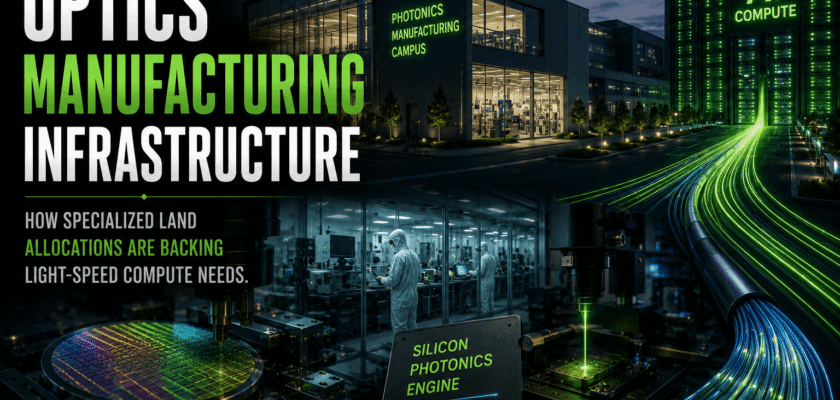
Optics Manufacturing Infrastructure: Why AI Real Estate Is Moving Beyond Data Centers
Optics manufacturing infrastructure is becoming one of the most important real estate themes in the AI economy. Earlier, AI infrastructure discussions focused mostly on GPUs, data centers, cloud regions, and power supply. Now, the bottleneck is also shifting toward how those GPUs communicate with each other.
Modern AI systems need huge clusters of accelerators. These chips must exchange data at extremely high speed. Copper cables are starting to face limits because they create heat, use more energy, and lose signal quality over distance. That is why optical interconnects, silicon photonics, co-packaged optics, fiber systems, laser components, and specialized manufacturing campuses are becoming more important.
Therefore, optics manufacturing infrastructure is not only a semiconductor story. It is also a real estate story about land, cleanrooms, utilities, logistics, water, power, talent corridors, and high-precision industrial zoning.
Why Optics Manufacturing Infrastructure Matters in 2026
Optics manufacturing infrastructure matters because AI data centers are scaling faster than traditional networking can comfortably support. NVIDIA says its Spectrum-X Ethernet Photonics switches integrate co-packaged optics directly onto the ASIC to overcome electrical signaling limits in large-scale AI factories. The company says these switches can support up to 409.6 terabits per second bandwidth and are expected in the second half of 2026.
That means future AI campuses will not only need GPU racks. They will also need optical networking systems that can move data faster and with better energy efficiency.
Business Insider recently reported that the AI boom is running into a copper problem, and photonics is gaining attention because light-based data transmission can reduce heat, cable complexity, and energy loss in large GPU clusters.
In simple words, AI compute needs light-speed connectivity.
And light-speed connectivity needs physical manufacturing infrastructure.
What Is Optics Manufacturing Infrastructure?
Optics manufacturing infrastructure means the physical industrial ecosystem needed to make optical networking components for AI data centers and high-performance computing.
It can include:
- Silicon photonics facilities
- Optical module assembly units
- Laser component production
- Fiber-optic cable facilities
- Co-packaged optics manufacturing
- Advanced packaging lines
- Cleanrooms
- Precision testing labs
- Thermal reliability labs
- Secure logistics zones
This infrastructure is different from normal warehouses or office parks.
It needs stable power, clean environments, high-skilled workers, precision tools, safety systems, and strong supply-chain access.
That is why specialized land allocation matters.
Nvidia’s Optics Push: Why Real Estate Developers Should Watch
Nvidia’s optics push matters because the company is shaping the next layer of AI infrastructure. In March 2026, NVIDIA and Coherent announced a strategic partnership where NVIDIA would invest $2 billion in Coherent to expand supply, deepen R&D, and advance U.S.-based manufacturing for optics technology.
This kind of investment sends a clear signal.
AI hardware demand is not stopping at GPUs. It is moving deeper into the supply chain.
Real estate developers should watch because new demand may emerge for:
- Photonics parks
- Advanced manufacturing campuses
- Optical component factories
- Testing and validation labs
- Fiber logistics hubs
- Semiconductor supplier clusters
- AI infrastructure industrial zones
- Cleanroom-ready buildings
- Secure high-value warehousing
- Power-rich industrial land
The next big AI real estate opportunity may sit between the data center and the semiconductor factory.
Why Copper Is Becoming a Problem
Copper has served data centers for years, but AI workloads are changing the scale. When thousands or even millions of GPUs must work together, data movement becomes a major bottleneck.
Copper faces issues like:
- Signal loss over distance
- Higher heat generation
- More power consumption
- Cable bulk
- Limited reach
- Physical complexity
- Cooling pressure
- Rack design constraints
- Maintenance difficulty
- Scaling limits
Business Insider reported that photonics can help AI companies connect large GPU clusters more efficiently, with startups like Lightmatter working on optical systems that reduce cable complexity and improve training performance.
This is why AI infrastructure is moving toward light.
Optics can move data faster across longer distances with lower energy loss.
Silicon Photonics: Simple Meaning
Silicon photonics uses light to move data through tiny optical components built with semiconductor-style manufacturing methods. Instead of only pushing electrical signals through copper, silicon photonics converts data into light signals.
This matters for AI because GPU clusters need extremely fast communication.
Silicon photonics can help with:
- Higher bandwidth
- Lower latency
- Better energy efficiency
- Less cable clutter
- Longer reach
- Denser networking
- Lower heat pressure
- Faster AI training
- Better rack-scale design
- Future AI factory scaling
NVIDIA says its co-packaged optics with silicon photonics can deliver better power efficiency and resiliency for scalable AI networking.
For real estate, this means photonics manufacturing sites become strategic assets.
Co-Packaged Optics and AI Factories
Co-packaged optics, or CPO, places optical components very close to the networking chip. This reduces the distance electrical signals must travel and can improve power efficiency.
NVIDIA says co-packaged optics eliminate pluggable transceivers, boosting resiliency and power efficiency in data center networking.
This matters because AI factories need extreme networking performance.
CPO can support:
- Massive GPU clusters
- Higher bandwidth density
- Lower power use
- Reduced cable complexity
- Better system reliability
- Faster deployment
- Larger AI training runs
- Agentic AI workloads
- Scalable Ethernet fabrics
- Future million-GPU clusters
However, CPO also changes manufacturing needs.
It requires advanced packaging, thermal testing, precision assembly, and specialized facilities.
That is where real estate enters the story.
Specialized Land Allocations: Why They Matter
Specialized land allocations matter because optics manufacturing cannot be dropped into any random industrial shed. These facilities need the right land, utilities, approvals, and ecosystem.
Good sites need:
- Reliable high-capacity power
- Clean water availability
- Stable roads and logistics
- Low vibration zones
- Cleanroom readiness
- Skilled labour access
- Supplier proximity
- Security planning
- Waste handling systems
- Expansion land
If governments and industrial developers want AI supply-chain investment, they must prepare land that meets these needs.
The best industrial zones will not only say “factory-ready.”
They will say “photonics-ready.”
Why Optics Facilities Need Cleanrooms
Optics facilities often need cleanroom environments because dust, contamination, and vibration can damage precision components. Manufacturing lasers, photonic chips, optical modules, and advanced packaging systems requires controlled conditions.
Cleanroom-ready real estate must support:
- Air filtration
- Humidity control
- Temperature stability
- Anti-static flooring
- Vibration control
- Process gas lines
- Chemical handling
- Tool installation
- Secure access
- Waste treatment
This makes optics manufacturing closer to semiconductor real estate than normal industrial real estate.
Developers who understand this can create higher-value facilities.
Power Demand Is Not Only for Data Centers
Power demand is not only for data centers. Manufacturing optical components also needs reliable power for cleanrooms, testing equipment, precision tools, thermal systems, and environmental controls.
A photonics manufacturing campus may require:
- Redundant power feeds
- Backup generation
- UPS systems
- Stable voltage
- Energy monitoring
- Cooling power
- Cleanroom HVAC
- Tool-specific power
- Expansion capacity
- Grid reliability
Power-rich industrial land becomes more valuable in the AI era.
A site without reliable power may fail even if it has cheap land.
Cooling and Thermal Testing Infrastructure
Cooling matters because optical modules, lasers, networking chips, and AI hardware must be tested under demanding thermal conditions. AI data centers already face cooling challenges, and optics components must survive intense operating environments.
Facilities may need:
- Thermal chambers
- Reliability labs
- Liquid cooling test areas
- Environmental stress testing
- Burn-in rooms
- Precision metrology
- Failure analysis labs
- Clean assembly areas
- Airflow control
- Secure equipment rooms
Reuters reported that Foxconn and Intel’s 2026 AI infrastructure partnership will also emphasize high-speed interconnects, cooling designs, and energy efficiency, showing how closely networking and thermal design now connect.
This is the new AI infrastructure stack.
Compute, cooling, and connectivity must be planned together.
Fiber Capacity Is Becoming a Real Estate Factor
Fiber capacity is becoming a real estate factor because AI campuses need massive internal and external data movement. A location with weak fiber connectivity is less attractive for AI infrastructure.
Tom’s Hardware recently reported that AI data centers may require far more fiber than standard server designs, creating supply pressure and long cable lead times.
This means land near strong fiber corridors can become more valuable.
Real estate investors should watch:
- Existing fiber routes
- Dark fiber availability
- Carrier-neutral access
- Nearby internet exchanges
- Data center clusters
- Subsea cable landing routes
- Metro fiber density
- Redundant network paths
- Right-of-way access
- Fiber logistics suppliers
In AI real estate, connectivity is now as important as road access.
Why Optical Component Suppliers Need Clusters
Optical component suppliers benefit from clustering because the supply chain is complex. A silicon photonics company may need wafers, lasers, packaging, testing, fiber assemblies, precision tooling, and logistics.
Clusters reduce friction.
A strong optics cluster may include:
- Photonics chip makers
- Laser suppliers
- Optical module assemblers
- Fiber cable suppliers
- Packaging firms
- Testing labs
- Tool vendors
- Data center customers
- Universities
- Skilled workforce pipelines
This is why specialized industrial parks can attract more investment than isolated factories.
One supplier attracts another.
That creates a real estate multiplier.
AI Data Centers Are Reshaping Industrial Land Demand
AI data centers are reshaping industrial land demand because they need surrounding support infrastructure. A giant data center campus may create demand for equipment storage, power components, cooling systems, fiber contractors, chip logistics, and optical networking suppliers.
This creates demand for:
- Nearby warehouses
- Secure staging areas
- High-value component storage
- Repair labs
- Optical testing facilities
- Field-service hubs
- Substation land
- Cooling infrastructure
- Fiber route access
- Supplier office space
So, the real estate opportunity is bigger than the data center building.
The whole AI supply chain needs land.
Nvidia, Marvell and the Optical Networking Signal
Nvidia’s CEO Jensen Huang recently highlighted Marvell as a key company in the AI infrastructure shift. The Wall Street Journal reported that Huang described the move from copper cables to optical communications as critical for next-generation AI infrastructure, while Marvell’s CEO emphasized that AI’s future depends on efficient data interconnection.
This matters because optics is becoming a strategic layer in AI.
If the largest AI hardware players are talking about optical links, real estate planners should listen.
The supply chain will need:
- More optical component capacity
- More manufacturing campuses
- More testing facilities
- More power-ready land
- More skilled labour ecosystems
- More logistics routes
- More data center adjacency
- More government support
- More specialized industrial zoning
- More long-term leases
Optics is becoming infrastructure.
Why Coherent and Lumentum Matter
Coherent and Lumentum matter because they are important suppliers in optical communications and photonics. NVIDIA’s Coherent partnership directly mentions expanding supply, R&D, and U.S.-based manufacturing.
Barron’s also reported that networking stocks such as Coherent, Lumentum, and Corning rose after investor attention shifted toward optical networking demand in AI data centers.
This shows the supply-chain effect.
When AI demand rises, it does not only affect Nvidia.
It can affect:
- Optical transceiver makers
- Laser suppliers
- Fiber companies
- DSP chip makers
- Packaging firms
- Cleanroom contractors
- Industrial real estate
- Power utilities
- Logistics providers
- Testing equipment vendors
AI is creating a full infrastructure economy.
Why Specialized Facilities Need Government Support
Specialized facilities often need government support because photonics manufacturing requires land, utilities, permits, workforce training, and sometimes incentives.
Governments can help through:
- Semiconductor zones
- Photonics parks
- Fast-track approvals
- Power infrastructure
- Water infrastructure
- Road connectivity
- Tax incentives
- R&D grants
- University partnerships
- Skill development programs
If a region wants high-value AI infrastructure investment, it must compete on more than cheap land.
It must offer an ecosystem.
What Real Estate Developers Should Build
Real estate developers should build facilities that match the needs of optics and AI supply-chain tenants. Generic industrial parks may not be enough.
Developers should consider:
- Cleanroom-capable shells
- High floor loading
- Redundant power paths
- Controlled HVAC systems
- Secure loading docks
- Precision lab areas
- Expansion-ready plots
- Fiber-rich connectivity
- High-security perimeters
- Utility corridors
The goal is to reduce tenant setup time.
If a photonics company can move faster into a site, that land becomes more valuable.
Why “Shovel-Ready” Is Not Enough
“Shovel-ready” land means land is ready for construction. But optics manufacturing needs more than that.
It needs “infrastructure-ready” land.
That means:
- Power commitments are clear
- Water supply is available
- Fiber access is mapped
- Environmental approvals are smoother
- Cleanroom conversion is possible
- Tool delivery access is planned
- Security zoning is allowed
- Waste systems are designed
- Expansion land is reserved
- Skilled workforce is nearby
A normal industrial plot may be cheap, but a photonics-ready site can command premium demand.
AI Supply Chain Real Estate: New Tenant Categories
AI supply-chain real estate will attract new tenant categories beyond cloud operators.
Possible tenants include:
- Optical module makers
- Silicon photonics companies
- Fiber suppliers
- Advanced packaging firms
- Data center equipment integrators
- Cooling technology firms
- AI server rack builders
- Testing labs
- Power equipment suppliers
- High-value logistics companies
This creates a broader industrial real estate opportunity.
Developers should not only chase hyperscale data centers.
They should also chase the suppliers that make hyperscale possible.
Why Location Near Data Centers Helps
Location near data centers helps because optical networking components may need fast delivery, testing, replacement, and field support. AI campuses are high-value environments where downtime is expensive.
Nearby supplier facilities can support:
- Faster replacement
- Local testing
- Field engineering
- Reduced logistics delay
- Better service contracts
- Inventory staging
- Custom integration
- Emergency response
- Lower shipping risk
- Stronger customer relationships
This is why data center clusters can attract supplier clusters.
Infrastructure demand creates real estate gravity.
Why Ports and Airports Still Matter
Ports and airports still matter because optics components and semiconductor equipment often move through global supply chains. High-value components need secure, fast, and reliable logistics.
A strong site should have access to:
- International airport cargo
- Major ports
- Express logistics
- Customs support
- Highway connectivity
- Secure warehousing
- Temperature-controlled transport
- High-value shipment handling
- Supplier import routes
- Export support
Optics manufacturing is global.
Even local production depends on global equipment and materials.
Talent Corridors Are Also Real Estate Assets
Talent corridors are important because photonics manufacturing needs skilled engineers, technicians, operators, quality teams, and researchers.
A strong location should connect with:
- Engineering colleges
- Research universities
- Semiconductor training centres
- Optical engineering programs
- ITI and vocational institutes
- Electronics manufacturing clusters
- Data center workforce
- Automation specialists
- Quality engineers
- Maintenance talent
Real estate becomes stronger when talent is nearby.
A factory without skilled workers struggles even if land is perfect.
Why India Should Watch This Trend
India should watch this trend because the country wants to grow electronics manufacturing, semiconductor assembly, data centers, and AI infrastructure. Optics manufacturing could become a future opportunity if policy, land, and manufacturing ecosystems align.
India may benefit from:
- Semiconductor mission support
- Electronics manufacturing clusters
- Data center growth
- Large engineering workforce
- Rising AI adoption
- Global supply-chain diversification
- Telecom fiber experience
- Industrial corridor development
- Renewable power potential
- Export-oriented manufacturing
But India must build specialized industrial capabilities, not only generic land banks.
Photonics-ready zones could become strategic.
India’s Data Center Growth and Optical Demand
India’s data center market is expanding due to cloud adoption, AI workloads, digital payments, OTT platforms, enterprise digitization, and data localization needs.
As data centers grow, optical demand can rise for:
- High-speed campus links
- Internal data center networking
- Metro fiber routes
- AI cluster connectivity
- Cloud interconnects
- Edge data centers
- Telecom backhaul
- Enterprise connectivity
- Submarine cable links
- Network redundancy
This creates space for optical component supply chains.
India can either import most of this infrastructure or build more of it locally.
Why Land Policy Must Move Faster
Land policy must move faster because AI infrastructure demand is moving fast. If land approvals, utilities, and zoning take too long, investment may go elsewhere.
Governments should prepare:
- Pre-approved industrial zones
- Utility-ready plots
- Single-window approvals
- Clear environmental rules
- Power purchase options
- Water management plans
- Worker housing support
- Skill training pipelines
- Logistics access
- Security permissions
High-tech manufacturing investors value speed and certainty.
Delayed approvals reduce competitiveness.
ESG and Clean Manufacturing
ESG matters because AI infrastructure already faces criticism for power and water use. Optics manufacturing facilities must manage environmental impact responsibly.
Developers should plan:
- Renewable power sourcing
- Water recycling
- Efficient HVAC
- Waste treatment
- Low-emission logistics
- Green building standards
- Solar rooftops
- Battery backup
- Smart metering
- Carbon reporting
A clean technology supply chain should not ignore sustainability.
Future tenants may prefer parks with strong ESG credentials.
Why Water Planning Matters
Water planning matters because some cleanroom and manufacturing processes need reliable water. At the same time, many regions face water stress.
A photonics-ready industrial zone should consider:
- Industrial water supply
- Recycling systems
- Wastewater treatment
- Rainwater harvesting
- Process water quality
- Cooling needs
- Environmental permits
- Local community impact
- Drought resilience
- Water monitoring
Water is a real estate risk.
A site with weak water planning may face community and regulatory problems later.
Security for High-Value Components
Security is important because optical components, chips, lasers, and AI hardware are high-value assets. Facilities need both physical and cyber security.
Security planning may include:
- Access control
- CCTV
- Secure loading docks
- Visitor management
- Inventory tracking
- Cyber-secure networks
- IP protection
- Cleanroom access rules
- Guarded perimeters
- Emergency response
AI supply-chain real estate is not normal logistics real estate.
It needs higher trust.
Why Serviceability Matters in CPO Infrastructure
Co-packaged optics can improve performance, but serviceability is a challenge. A 2026 academic paper on co-packaged optics argues that deployment depends not only on device performance but also on packaging, thermal management, system robustness, standardization, and serviceability.
This matters for manufacturing and real estate.
Facilities must support:
- Testing
- Repair workflows
- Failure analysis
- Reliability validation
- Thermal labs
- Field-return processing
- Quality control
- Packaging inspection
- Standardized tooling
- Engineering feedback loops
The manufacturing site must support the full lifecycle, not only first assembly.
What Investors Should Watch
Real estate investors should watch optics manufacturing infrastructure as a long-term AI supply-chain theme.
Important signals include:
- Nvidia optics partnerships
- Coherent and Lumentum capacity expansion
- Marvell optical networking demand
- AI data center growth
- Fiber shortage reports
- Government photonics incentives
- Semiconductor park announcements
- Cleanroom construction demand
- Power-rich industrial land pricing
- Data center cluster expansion
This is not a quick-flip theme.
It is a long-term industrial infrastructure trend.
Risks in Optics Manufacturing Real Estate
There are risks too. Not every optics or photonics plan will succeed. Technology changes fast, and specialized facilities can be expensive.
Risks include:
- Technology shifts
- Tenant concentration
- High capex
- Utility delays
- Regulatory approvals
- Power shortages
- Water stress
- Global supply-chain disruption
- Export controls
- Overbuilding risk
Investors should avoid hype.
They should focus on real tenants, signed leases, utility access, and proven supply-chain demand.
Why This Is More Than a Nvidia Story
This is more than a Nvidia story because AI infrastructure is becoming a full ecosystem. Nvidia may drive demand, but many suppliers and facility types support the system.
The ecosystem includes:
- GPU makers
- Networking chip companies
- Optical module makers
- Fiber suppliers
- Foundries
- Packaging firms
- Cooling providers
- Data center developers
- Power utilities
- Real estate owners
Goldman Sachs estimated that AI infrastructure could require trillions of dollars of capital between 2026 and 2031 across compute, data centers, and power.
That capital will flow into physical infrastructure.
Real estate is one of the biggest beneficiaries.
Future of Optics Manufacturing Infrastructure
The future of optics manufacturing infrastructure looks strong because AI systems are becoming more connected, more distributed, and more bandwidth-hungry. As AI agents, multimodal models, robotics, and scientific computing grow, data movement will become even more important.
Future facilities may support:
- Co-packaged optics
- Silicon photonics
- Optical circuit switching
- Advanced lasers
- Fiber assembly
- AI networking racks
- Thermal testing
- High-speed validation
- Photonic chiplets
- AI data center integration
The regions that prepare specialized land early may attract the next generation of AI supply-chain investment.
Final Verdict
Optics manufacturing infrastructure is becoming a critical real estate theme because AI compute now depends on high-speed optical connectivity. Nvidia’s silicon photonics push, its Coherent partnership, and the broader shift from copper to optical interconnects show that AI infrastructure is moving into a new phase.
This phase needs more than data centers. It needs specialized land, cleanrooms, power, cooling, fiber access, testing labs, logistics, security, and talent corridors.
In simple words, the AI boom is creating a new industrial real estate category: photonics-ready infrastructure.
The winners will be regions and developers that understand this early and build land platforms ready for light-speed compute supply chains.


