
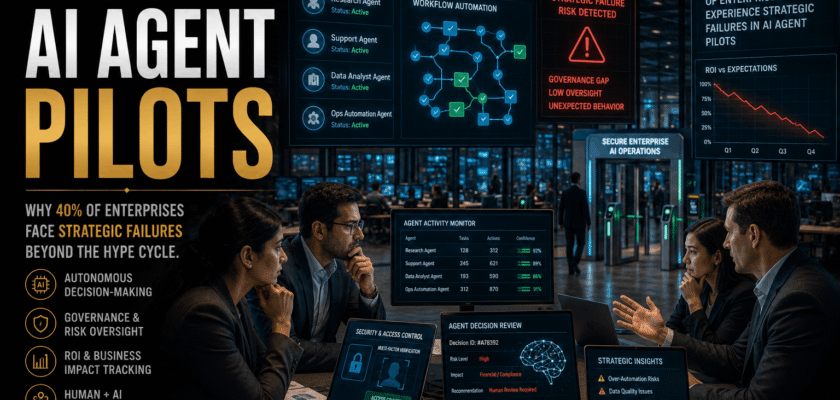
Autonomous AI Agent Workplace Pilots: Why the Hype Is Breaking
Autonomous AI agent workplace pilots are facing a serious reality check in 2026. Many companies rushed into agentic AI because the promise looked powerful: AI agents could answer emails, update CRMs, write reports, schedule meetings, analyze data, manage workflows, and even take business actions with limited human input.
But the early hype is now meeting operational reality.
Gartner predicted that over 40% of agentic AI projects will be canceled by the end of 2027 because of rising costs, unclear business value, and weak risk controls.
This does not mean AI agents are useless. It means many companies are implementing them badly.
Therefore, autonomous AI agent workplace pilots need strategy, governance, data readiness, workflow design, employee training, and measurable ROI. Without these, they become expensive experiments.
Why Autonomous AI Agent Workplace Pilots Matter in 2026
Autonomous AI agent workplace pilots matter because companies are no longer only testing chatbots. They are testing systems that can act inside business workflows. That creates more value, but also more risk.
A normal chatbot may only answer a question.
An autonomous AI agent may send an email, approve a ticket, change a record, trigger a refund, schedule a meeting, update a pipeline, or contact a customer.
That difference is huge.
Gartner’s 2026 governance warning says applying the same governance to all AI agents can cause enterprise AI agent failure. It also predicts that by 2027, 40% of enterprises will demote or decommission autonomous AI agents due to governance failures.
In simple words, companies are learning that autonomy without control is not transformation. It is risk.
What Are Autonomous AI Agent Workplace Pilots?
Autonomous AI agent workplace pilots are small test projects where companies deploy AI agents inside workplace workflows. These agents can observe, decide, and act across tools like email, CRM, ERP, HR systems, spreadsheets, project management apps, customer support platforms, and internal knowledge bases.
They may be used for:
- Customer support
- Sales follow-up
- HR onboarding
- Finance reconciliation
- IT service tickets
- Report generation
- Meeting summaries
- Procurement workflows
- Legal document review
- Operations planning
The goal is to see whether AI agents can reduce manual work and improve productivity.
But pilots often fail when the company does not define exactly what success means.
Why 40% of Agentic AI Projects May Be Canceled
The 40% cancellation warning matters because it shows the market is entering the post-hype phase. Gartner says the major reasons are escalating costs, unclear business value, and inadequate risk controls.
These are not small issues.
They mean companies may be spending money on AI agents without knowing:
- What problem they solve
- Who owns the workflow
- How ROI will be measured
- What data the agent can access
- When human approval is required
- What happens when the agent is wrong
- Who audits the output
- How risk is controlled
- How employees should use it
- When to stop the pilot
A pilot without these answers becomes fragile.
It may look innovative, but it will not scale.
Beyond the Hype Cycle: What Companies Got Wrong
Beyond the hype cycle, companies are discovering that AI agents are not plug-and-play employees. They are software systems with probabilistic behaviour, access risks, workflow limits, and governance needs.
Many companies got these things wrong:
- They started with technology, not business problem
- They gave agents too much access
- They did not train employees
- They did not define ROI
- They skipped risk controls
- They expected perfect autonomy too soon
- They ignored data quality
- They had no escalation path
- They measured activity instead of outcomes
- They treated pilots as press-release projects
The result is predictable.
The agent works in a demo but fails in real work.
Strategic Failure vs Technical Failure
Many autonomous AI agent workplace pilots fail strategically, not technically. The model may be capable. The demo may work. The agent may complete simple tasks. But the business still fails to get real value.
Strategic failure happens when:
- The use case is not important
- The workflow is poorly designed
- The agent solves the wrong problem
- Employees do not trust it
- Managers cannot measure impact
- Governance slows everything down
- Costs exceed savings
- Risk is higher than reward
- The agent does not fit existing systems
- Leadership loses patience
This is why AI agent strategy matters more than AI agent hype.
A smart use case beats a flashy demo.
The Cost Problem
Cost is one of the biggest reasons AI pilots fail. AI agents can become expensive because they run multiple model calls, use tools, search databases, read documents, retry actions, and sometimes require human review.
Costs can include:
- Model API usage
- Tool integration
- Cloud infrastructure
- Data preparation
- Security review
- Monitoring tools
- Employee training
- Vendor licensing
- Human oversight
- Maintenance
A company may begin with a small pilot and later discover that full deployment is much more expensive than expected.
This is why Gartner highlighted escalating costs as a major cancellation driver.
The Unclear ROI Problem
Unclear ROI is another major issue. Many companies say they want AI agents to improve productivity, but they do not define productivity clearly.
ROI should answer:
- How many hours were saved?
- Was work quality improved?
- Did revenue increase?
- Did cost decrease?
- Did customer satisfaction improve?
- Did errors reduce?
- Did employees adopt it?
- Did cycle time improve?
- Did risk decrease?
- Did the pilot scale?
Without clear ROI, leadership sees the pilot as a cost centre.
That is when cancellation becomes likely.
The Governance Problem
Governance is the biggest hidden issue in autonomous AI agent workplace pilots. Governance means rules, permissions, monitoring, ownership, approvals, escalation, and audit.
Gartner warned that applying uniform governance across all AI agents can cause failures because agents differ by autonomy level and scope of access.
This is important.
A meeting-summary agent does not need the same governance as a finance approval agent.
A customer-service draft agent does not need the same controls as an agent that issues refunds.
An HR FAQ agent is not the same as an agent that changes employee records.
Governance must match risk.
Too little governance creates danger.
Too much uniform governance kills usefulness.
Why Uniform Governance Fails
Uniform governance fails because not all agents are equal. Some agents only read information. Some write drafts. Some change systems. Some trigger transactions. Some contact customers. Some make recommendations. Some take actions automatically.
Each level needs different controls.
A useful governance model should classify agents by:
- Read-only access
- Draft-only output
- Human-approved action
- Limited autonomous action
- High-risk autonomous action
- Sensitive data access
- External communication
- Financial transaction ability
- Legal or compliance impact
- Customer-facing impact
This helps companies set the right guardrails.
A low-risk agent should not be buried in heavy approval.
A high-risk agent should not operate freely.
The Access Scope Problem
Access scope is a major risk. AI agents often need access to data and tools to be useful. But more access also increases risk.
An agent may access:
- Emails
- Customer records
- CRM data
- HR data
- Financial data
- Internal documents
- Contracts
- Slack or Teams chats
- Ticketing systems
- Knowledge bases
If access is too broad, the agent may expose sensitive data or take actions outside its purpose.
The Wall Street Journal recently described AI agents as a new insider-risk category because agents can be granted broad workplace access and then become targets for attackers or misuse.
This is why access must be limited by role, task, and lifecycle.
AI Agents as New Insider Risks
AI agents can become insider risks because they operate inside company systems. They may not be malicious, but they can be exploited, misconfigured, or tricked.
Risks include:
- Data leakage
- Prompt injection
- Wrong tool use
- Unauthorized access
- Customer data exposure
- Incorrect approvals
- Fake vendor instructions
- Malicious email actions
- Sensitive file sharing
- Unclear audit trail
TechRadar reported that autonomous AI agents are outrunning traditional security controls, with Deloitte research showing only 21% of organizations have mature governance for autonomous AI while 73% are concerned about AI-related security and privacy risks.
This is a serious warning.
AI agent governance must be operational, not only written in policy documents.
Employee Training Is Often Missing
Employee training is often missing, and that hurts adoption. Many companies introduce AI tools but do not explain when, how, or why employees should use them.
TechRadar reported that a Nexthink study found only 16% of U.S. workers had received formal AI training, while 28% used AI tools several times a week. It also reported that 56% of employees said they were not consulted about how AI tools were added to their roles.
This creates confusion.
Employees may:
- Avoid the tool
- Use unofficial tools
- Use AI wrongly
- Trust AI too much
- Not trust AI at all
- Create shadow workflows
- Expose sensitive data
- Duplicate work
- Ignore outputs
- Resist automation
A workplace AI pilot cannot succeed if workers are left alone to figure it out.
Shadow AI and Unofficial Tools
Shadow AI happens when employees use AI tools without approval. This often happens when official tools are slow, confusing, or unavailable.
Shadow AI can create:
- Data privacy risks
- Compliance problems
- Inconsistent workflows
- Security gaps
- Untracked outputs
- Vendor risk
- Wrong customer communication
- No audit trail
- Legal exposure
- Duplicate costs
Companies should not only block everything.
They should provide safe, approved, useful AI tools and clear training.
If official AI is bad, employees will find unofficial AI.
Why Agent Pilots Fail in Customer Support
Customer support is a common AI agent use case, but it can fail if agents are allowed to act without proper escalation.
Failures may include:
- Wrong refund advice
- Hallucinated policy
- Poor tone
- No emotional understanding
- Misreading customer complaint
- Incorrect order update
- Bad escalation timing
- Privacy exposure
- Repeated scripted replies
- Customer frustration
A support agent should start with controlled tasks:
- Draft response
- Summarize ticket
- Find policy
- Suggest next action
- Route complaint
- Identify priority
- Detect sentiment
- Recommend refund eligibility
- Flag fraud
- Escalate to human
Full autonomy should come later.
Why Agent Pilots Fail in Sales
Sales AI agents can fail when they automate outreach without strategy. More messages do not always mean more revenue.
Sales-agent failures include:
- Spammy outreach
- Wrong lead targeting
- Poor personalization
- Bad timing
- Inaccurate CRM updates
- Hallucinated product claims
- Weak handoff to sales rep
- No ROI tracking
- Bad prospect experience
- Over-automation
A sales agent should improve lead quality, not only increase message volume.
Good sales AI should help humans close better, not flood inboxes.
Why Agent Pilots Fail in HR
HR AI agents are sensitive because they deal with people, careers, personal data, and policy interpretation.
HR agent risks include:
- Wrong policy answers
- Bias in screening
- Privacy exposure
- Poor handling of complaints
- Incorrect leave guidance
- Misclassification of employees
- Sensitive data leakage
- No human escalation
- Legal risk
- Trust damage
HR agents should be carefully limited.
They can help with FAQs, onboarding checklists, document summaries, and training reminders.
They should not make high-stakes employment decisions without human review.
Why Agent Pilots Fail in Finance
Finance AI agents can be valuable, but risky. They may handle invoices, reconciliation, payments, forecasts, expenses, and approvals.
Finance-agent failures include:
- Wrong invoice matching
- Duplicate payment risk
- Fraud exposure
- Hallucinated financial explanation
- Poor audit trail
- Policy violation
- Wrong account coding
- Unauthorized approval
- Compliance gaps
- Forecasting errors
Finance agents need strict controls.
They should have clear approval limits, audit logs, and exception handling.
Autonomy in finance must be earned gradually.
Why Agent Pilots Fail in Supply Chain
Supply chain is complex because it involves real-world movement, vendors, weather, customs, inventory, quality, and physical constraints.
TechRadar argued that AI agents should not fully run supply chains because they may lack real-world context and should support human decision-making rather than replace it.
Supply-chain failures may include:
- Wrong reorder decision
- Poor vendor judgment
- Ignoring hidden trade-offs
- Bad delay prediction
- Missing physical constraints
- Over-optimizing cost
- Underestimating disruption
- Wrong inventory priority
- Poor human communication
- Risky autonomous action
AI can support supply chains, but humans must remain in the loop for strategic trade-offs.
Why Cloud and IT Agents Fail
IT and cloud operations are attractive for AI agents because there are tickets, logs, alerts, and workflows. But autonomous troubleshooting can fail when agents misread data or explore incompletely.
A 2026 research paper on cloud root-cause analysis found that LLM-based RCA agents often fail due to pitfalls such as hallucinated data interpretation and incomplete exploration, and that these failures persisted across models because they came from shared agent architecture issues.
This matters because better models alone may not fix agent failures.
Companies need better architecture, monitoring, and verification.
An IT agent should not restart systems or change configurations without strong safeguards.
Why Long-Horizon Tasks Are Hard
Long-horizon tasks are hard for AI agents because they require many steps. The more steps an agent takes, the more chances it has to make mistakes.
Long workflows can involve:
- Reading files
- Searching systems
- Calling APIs
- Updating records
- Writing messages
- Checking results
- Handling exceptions
- Waiting for responses
- Replanning
- Escalating
A small error early can damage the final result.
A 2026 paper on diagnosing AI agent failures notes that failed agent executions are hard to localize because they are probabilistic, long-horizon, multi-agent, and affected by noisy tool outputs.
This is why audit trails matter.
Companies must know where an agent failed, not only that it failed.
The Human-in-the-Loop Requirement
Human-in-the-loop means a human reviews or approves important actions before they happen. This is essential for high-risk tasks.
Human review should be required for:
- Payments
- Refunds above limits
- Legal statements
- HR decisions
- Customer escalations
- Contract changes
- External communication
- Sensitive data sharing
- System configuration changes
- High-value sales commitments
Autonomy should increase only after performance is proven.
The best enterprise AI agents do not remove humans immediately.
They make humans faster and better.
Managed Autonomy: The Better Model
Managed autonomy is a better model than full autonomy. It means the agent can act within clear boundaries, detect uncertainty, pause when confidence drops, and escalate to humans.
A 2026 paper on managed autonomy argues that intelligent AI systems should detect uncertainty drift, attempt recovery, and surrender control when reliability decreases.
This is a powerful idea for enterprise AI.
A good agent should know when to stop.
It should not keep acting blindly just because the workflow says so.
Why Escalation Paths Matter
Escalation paths matter because every agent will eventually face something it cannot handle. The question is not whether failure will happen. The question is whether failure is contained.
A good escalation path defines:
- When the agent stops
- Who gets notified
- What information is passed
- What action is blocked
- How urgent the case is
- Whether customer sees delay
- What audit log is saved
- Who can override the agent
- How the system learns
- How the case is closed
Without escalation, agents either fail silently or act dangerously.
Both are bad.
The Data Quality Problem
AI agents depend on data. If company data is outdated, fragmented, duplicated, or locked in different systems, the agent will struggle.
Data problems include:
- Old customer records
- Duplicate CRM entries
- Missing product details
- Conflicting policies
- Unstructured documents
- Poor permissions
- Bad tagging
- Inconsistent naming
- Incomplete ticket history
- No source of truth
An AI agent with messy data can confidently produce wrong answers.
Data readiness must come before agent autonomy.
The Workflow Problem
Many workplace workflows are not clean. They exist through habits, exceptions, undocumented rules, manual approvals, and informal knowledge.
AI agents fail when companies automate messy workflows without redesigning them.
Before deploying an agent, ask:
- What is the exact workflow?
- What are the exceptions?
- Who owns each step?
- What system is source of truth?
- What requires approval?
- What data is needed?
- What is the failure mode?
- What is the escalation path?
- What is the success metric?
- What should never be automated?
If the workflow is unclear for humans, it will be worse for AI.
The Integration Problem
AI agents need integration with workplace tools. Without integration, they become fancy chat interfaces. With poor integration, they become dangerous.
Integration challenges include:
- API limitations
- Permission complexity
- Legacy systems
- Poor documentation
- Tool downtime
- Data sync issues
- Security approvals
- Workflow mismatch
- Vendor lock-in
- Monitoring gaps
A successful agent must connect safely with the systems it uses.
That is why enterprise AI implementation takes time.
Why Proof of Concept Is Not Production
A proof of concept is not production. Many AI agents work well in a demo because the test environment is clean and controlled. Real work is messy.
Production requires:
- Security review
- Data access controls
- Monitoring
- Error handling
- User training
- Compliance approval
- Cost controls
- Performance testing
- Support process
- Rollback plan
A demo answers: “Can it work once?”
Production answers: “Can it work safely every day?”
These are different questions.
The Pilot-to-Production Gap
The pilot-to-production gap is where many AI projects die. A pilot may be exciting, but scaling it across departments is harder.
Scaling requires:
- Executive ownership
- Budget clarity
- Change management
- Process redesign
- Governance
- Training
- Integration
- Security
- ROI tracking
- Continuous improvement
The Financial Times noted that many AI strategies risk becoming distractions when leaders focus on activity over measurable outcomes, especially when pilots are too narrow or metrics are weak.
This is why pilot success must be measured by business impact, not excitement.
Why Employees Resist AI Agents
Employees may resist AI agents because they fear job loss, surveillance, extra workload, or poor-quality outputs. Resistance is not always ignorance. Sometimes employees see real problems leadership misses.
Employees may worry about:
- Replacement
- More monitoring
- Loss of control
- Bad outputs blamed on them
- Extra review burden
- Poor training
- Unclear policies
- Tool fatigue
- Workflow disruption
- Customer complaints
Companies should involve employees early.
Workers know the workflow details that AI teams often miss.
AI Agent Failure Pattern 1: No Clear Owner
A pilot fails when no one owns it. IT may build it, operations may use it, legal may regulate it, and leadership may fund it — but nobody owns the outcome.
Every pilot needs:
- Business owner
- Technical owner
- Risk owner
- Process owner
- Data owner
- User champion
- Executive sponsor
- Support owner
- Compliance reviewer
- Success metric owner
Without ownership, problems get passed around.
That slows adoption and kills trust.
AI Agent Failure Pattern 2: Too Much Autonomy Too Soon
Many companies give agents too much autonomy too soon. They move from demo to action without enough testing.
A safer path is:
- Read-only assistant
- Draft generator
- Recommendation engine
- Human-approved action
- Limited autonomous action
- Monitored autonomous workflow
- Expanded scope after proven safety
This staged approach builds trust.
Do not start with full autonomy.
Start with controlled usefulness.
AI Agent Failure Pattern 3: Weak Metrics
Weak metrics make pilots look successful when they are not. A company may say the agent answered 10,000 questions, but that does not prove value.
Better metrics include:
- Time saved
- Error reduction
- Customer satisfaction
- Ticket resolution time
- Revenue impact
- Cost per task
- Human review rate
- Escalation rate
- Rework rate
- Adoption rate
Measure outcomes, not activity.
An agent that produces more work is not useful.
An agent that reduces useful work safely is useful.
AI Agent Failure Pattern 4: No Risk Boundary
No risk boundary means the agent can act in areas where mistakes are expensive. This is dangerous.
Set boundaries like:
- Maximum refund amount
- No legal advice
- No HR decision
- No customer promise without approval
- No payment release
- No external email above risk score
- No sensitive data sharing
- No system change without review
- No action on low confidence
- No action outside assigned workflow
Boundaries turn autonomy into controlled autonomy.
AI Agent Failure Pattern 5: Poor Change Management
Poor change management kills adoption. Employees need to know what is changing, why it matters, how to use the tool, and what happens to their role.
Good change management includes:
- Training sessions
- Use-case explanation
- Clear do’s and don’ts
- Feedback channels
- Pilot champions
- Role redesign
- Support materials
- Manager coaching
- Trust-building communication
- Iteration based on feedback
AI transformation is not only technical.
It is human.
How to Choose the Right AI Agent Use Case
Choose the right use case by looking for repeated, measurable, low-to-medium risk work. Avoid starting with high-stakes decisions.
Good first use cases:
- Meeting summaries
- Internal FAQ
- Ticket routing
- Draft responses
- Knowledge search
- Report summaries
- CRM cleanup suggestions
- Document classification
- Data extraction
- Workflow reminders
Bad first use cases:
- Final legal decisions
- Final HR decisions
- Large payments
- Medical advice
- High-risk compliance calls
- Autonomous customer promises
- Unsupervised system changes
- Strategic negotiation
- Sensitive personal data handling
- Complex crisis decisions
Start where the cost of error is low.
How to Build a Better AI Agent Pilot
A better AI agent pilot should be designed like a business experiment, not a tech demo.
Steps:
- Choose a clear problem
- Define success metrics
- Map the workflow
- Clean the data
- Limit access
- Add human approval
- Train users
- Monitor outputs
- Measure ROI
- Expand only after proof
This approach reduces failure risk.
It also helps leadership decide whether to continue, improve, or stop.
What CIOs Should Ask Before Approving AI Agents
CIOs should ask tough questions before approving autonomous agents.
Ask:
- What business problem does this solve?
- Who owns the outcome?
- What systems will it access?
- What can it change?
- What is the risk level?
- Where is human approval required?
- What is the ROI metric?
- How are errors tracked?
- What is the kill switch?
- What happens if the vendor changes pricing?
These questions prevent hype-led spending.
What CEOs Should Understand
CEOs should understand that AI agents are not only productivity tools. They change organizational design, accountability, risk, and management.
AI agents can affect:
- Team structure
- Decision rights
- Process ownership
- Employee roles
- Customer experience
- Data governance
- Compliance
- Security
- Budget allocation
- Competitive strategy
The Financial Times discussion on AI disruption highlighted that AI changes knowledge work, team dynamics, firm boundaries, and decision-making authority.
This means AI agents are not small automation plugins.
They are operating-model decisions.
What CFOs Should Watch
CFOs should watch AI agent cost carefully. A pilot may seem cheap, but scaling can create large recurring cost.
CFOs should track:
- License cost
- API cost
- Cloud cost
- Integration cost
- Training cost
- Security cost
- Human review cost
- Error correction cost
- Vendor lock-in risk
- ROI per workflow
AI agents should have unit economics.
If the agent costs more than the task it replaces or improves, the business case fails.
What CHROs Should Watch
CHROs should watch employee adoption, trust, and role redesign. AI agents may change how people work.
CHROs should plan:
- Training
- AI usage guidelines
- Job impact communication
- Skill development
- Employee feedback
- Fair performance metrics
- Human oversight roles
- Mental pressure reduction
- Change management
- Internal mobility
AI agents should reduce low-value work, not create fear and confusion.
If employees do not trust the agent, adoption fails.
What CISOs Should Watch
CISOs should treat AI agents as identities inside the enterprise. Each agent should have clear permissions, monitoring, and lifecycle controls.
Security teams should define:
- Agent identity
- Access scope
- Authentication
- Logging
- Behaviour monitoring
- Prompt injection protection
- Data loss prevention
- Vendor risk checks
- Incident response
- Deactivation process
TechRadar’s security analysis warns that governance must move beyond checklists to real-time enforcement and verified permissions for agents.
Security cannot be added later.
It must be built into the pilot.
Why AI Agent Governance Should Be Tiered
Tiered governance means different agents get different controls based on risk.
Example tiers:
Tier 1: Low Risk
Read-only internal search or summaries.
Tier 2: Medium Risk
Drafts, recommendations, routing, classification.
Tier 3: Controlled Action
Actions require human approval.
Tier 4: Limited Autonomy
Agent acts within strict limits and is monitored.
Tier 5: High Risk
Sensitive data, financial action, legal impact, HR impact, external commitments.
This structure helps companies avoid both over-control and under-control.
Why Audit Logs Are Essential
Audit logs are essential because companies need to know what the agent saw, decided, and did. Without logs, errors become hard to investigate.
Audit logs should capture:
- User request
- Data sources accessed
- Tools used
- Output generated
- Action taken
- Confidence level
- Human approval
- Error messages
- Escalation path
- Final outcome
This helps compliance, debugging, training, and trust.
No audit log means no accountability.
Why Kill Switches Matter
Kill switches matter because companies must be able to stop an agent quickly. If an agent starts sending wrong messages, changing records, or exposing data, teams need immediate shutdown ability.
A kill switch should allow:
- Disable agent
- Freeze actions
- Revoke access
- Stop external communication
- Lock workflow
- Notify owners
- Preserve logs
- Start incident review
- Roll back changes where possible
- Restart only after approval
Autonomy without a kill switch is dangerous.
Why Human Trust Is the Real Bottleneck
Human trust is the real bottleneck. Employees and managers will not rely on AI agents if they do not understand them.
Trust grows when the agent is:
- Accurate
- Transparent
- Easy to use
- Limited properly
- Helpful
- Auditable
- Escalates correctly
- Does not create extra work
- Respects privacy
- Improves real outcomes
Trust is not built by announcement.
It is built by repeated safe performance.
What Successful AI Agent Pilots Do Differently
Successful AI agent pilots usually do a few things differently.
They:
- Start with clear use cases
- Limit autonomy
- Use clean data
- Define ROI
- Train employees
- Add governance early
- Monitor outputs
- Create escalation paths
- Involve business owners
- Scale gradually
They do not chase “fully autonomous” first.
They chase useful automation first.
That is the practical difference.
Autonomous AI Agents Are Not Digital Employees Yet
Autonomous AI agents are often marketed like digital employees, but that is misleading. Employees understand context, culture, ethics, exceptions, and consequences in ways AI agents still struggle with.
AI agents are better understood as:
- Workflow assistants
- Decision-support systems
- Drafting tools
- Process accelerators
- Search helpers
- Task automation layers
- Monitoring tools
- Recommendation engines
- Controlled action systems
- Human productivity amplifiers
Calling them employees can create unrealistic expectations.
They need supervision.
What Comes After the Hype Cycle
After the hype cycle, the market will become more practical. Companies will stop buying AI agents because they sound exciting and start buying them because they solve measurable problems.
The next phase will focus on:
- ROI
- Governance
- Security
- Integration
- Reliability
- Human adoption
- Data readiness
- Workflow redesign
- Compliance
- Cost control
This is healthy.
It means agentic AI will mature.
Bad pilots will die. Good systems will scale.
Final Verdict
Autonomous AI agent workplace pilots are facing strategic failures because companies are moving faster than their governance, data, training, and ROI models can support. Gartner’s warning that over 40% of agentic AI projects may be canceled by 2027 shows that the market is moving beyond hype and into accountability.
The problem is not that AI agents have no value. The problem is that many organizations deploy them without clear business goals, access boundaries, employee training, escalation paths, audit logs, and cost controls.
In simple words, AI agents fail when companies treat them like magic workers.
They succeed when companies treat them like managed automation systems with measurable outcomes and strong human oversight.
The future belongs to businesses that build controlled autonomy — not blind autonomy.


