
May Retail Surge: Why 2.53 Million Units Matter
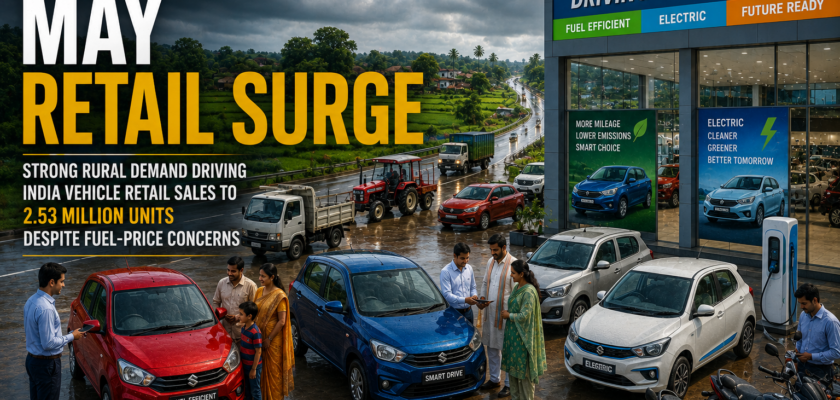
May retail surge became the strongest automobile story of the month after India recorded 25,33,217 vehicle registrations in May 2026. FADA said total retail sales rose 9.55% from a year earlier despite higher fuel prices, extreme heat and uncertainty linked to West Asia.
The number matters because it reflects actual customer registrations rather than factory dispatches. It shows that demand remained broad across passenger vehicles, two-wheelers, three-wheelers, commercial vehicles and tractors.
Rural India Was the Main Growth Engine
Rural demand was not a supporting detail. It was one of the main reasons the market stayed strong.
Passenger-vehicle registrations in rural areas grew 37.6% year on year, far ahead of 15.2% urban growth. Commercial vehicles also showed stronger rural momentum, with rural registrations rising 8.1% compared with 2.62% in urban markets.
This indicates that farm income, local trade, replacement demand and improved road access are influencing automobile growth beyond the largest cities.
Passenger Vehicles Posted the Fastest Major-Segment Growth
Passenger-vehicle retail sales reached 3,49,813 units, up 23.25% year on year.
The growth was supported by:
- GST-led affordability gains
- Lower financing costs
- Rural cash flows
- Wedding-season purchases
- Continued SUV and compact-car demand
- Interest in CNG, hybrid and electric options
However, dealer commentary also noted that higher fuel prices and selective model shortages limited part of the momentum.
Two-Wheelers Still Carried the Market
Two-wheelers remained the largest part of India’s retail market, with 19,00,591 registrations in May 2026, up 7.54% year on year.
Demand was supported by rural mobility needs, marriage-season buying, lower taxes and improved cash flows. At the same time, consumers became more sensitive to running costs, which helped electric two-wheelers increase their market share to 9.25% from 6.11% a year earlier.
Commercial Vehicles Showed Wider Economic Activity
Commercial-vehicle registrations reached 83,823 units, up 5.29% year on year.
Light commercial vehicles grew faster than heavy trucks, showing strength in last-mile delivery, e-commerce movement, small-business logistics and replacement demand.
Rural CV growth also exceeded urban growth, suggesting that goods movement is expanding outside metros.
Tractors Confirmed the Rural Recovery
Tractor registrations rose 11.17% to 83,092 units.
Tractor demand often reflects expectations around farm income, crop conditions, credit availability and monsoon confidence. Dealers expected normal monsoon progress and Kharif sowing activity to support rural cash flows in the months ahead.
Why Fuel Worries Did Not Stop Buyers
Fuel prices remained a serious concern, but they changed buying behaviour more than they stopped buying.
Customers increasingly asked about:
- CNG variants
- High-mileage petrol cars
- Hybrid vehicles
- Electric scooters
- EV running costs
- Smaller engines
- Total ownership cost
The market therefore shifted toward efficiency rather than collapsing under fuel pressure.
EV Share Rose Across Key Segments
The strongest visible change was in two-wheelers, where EV share climbed to 9.25%.
Higher fuel costs improve the relative appeal of electric vehicles, but buyers still compare charging availability, battery warranty, purchase price, resale value and service support.
The May data suggests that EV adoption is becoming part of mainstream retail demand rather than a small experimental category.
Why Retail Data Is More Useful Than Dispatch Data
Wholesale dispatches show how many vehicles manufacturers send to dealers. Retail registrations show how many vehicles customers actually register.
Retail data is useful because it reveals:
- Final customer demand
- Regional buying patterns
- Dealer inventory movement
- Fuel-type preference
- Rural and urban differences
- Finance conversion
For demand analysis, registrations often provide a clearer picture than factory shipments alone.
Rural Passenger-Vehicle Growth Needs Context
The 37.6% rural growth rate was exceptional, but it should not be treated as a permanent monthly pace.
Growth rates can be influenced by a lower comparison base, registration timing, model availability and local seasonal events. The direction is still important: rural passenger-vehicle demand grew much faster than urban demand in May.
How GST and Financing Supported Sales
Earlier tax reductions improved affordability in mass-market segments, while lower interest rates supported loan demand.
For many buyers, the decision depends on monthly EMI rather than only the ex-showroom price. A lower tax burden and more stable financing can make a vehicle affordable even when fuel costs remain uncertain.
Wedding Season and Local Consumption
Vehicle buying often rises during marriage seasons because motorcycles, scooters and cars are linked with household mobility and major family purchases.
The extended wedding season supported two-wheeler and passenger-vehicle demand, especially in smaller towns where vehicle ownership remains closely connected to family and work needs.
Heatwave Conditions Made the Result More Important
Severe heat can reduce showroom visits, test drives and outdoor economic activity. FADA said heatwave conditions affected walk-ins in several markets.
The fact that registrations still increased shows that underlying purchase intent remained strong enough to overcome some physical disruption.
West Asia Conflict Remained a Supply and Price Risk
The West Asia conflict created concerns around crude oil, freight, imported components, metals and supply-chain timing.
The immediate retail effect remained limited in May, but prolonged instability could raise:
- Fuel prices
- Steel and aluminium costs
- Tyre and rubber costs
- Imported component prices
- Vehicle insurance values
- Logistics expenses
Dealers and manufacturers therefore remained cautious about the coming months.
Small Cars and Efficient Sedans Regained Attention
Fuel concerns can shift demand toward efficient cars. The Maruti Suzuki Dzire became the best-selling car in May 2026 with 24,546 units dispatched, showing that a fuel-efficient sedan with petrol and CNG options can compete strongly with SUVs.
This does not end the SUV trend, but it shows that running-cost mathematics still matters.
Dealer Inventory and Supply Gaps
Strong retail demand does not mean every model was freely available. Dealers reported selective variant-level supply gaps.
These gaps can reduce sales when customers want a specific fuel type, transmission, colour or trim. Better inventory planning will be important if rural and efficient-vehicle demand continues.
What the Surge Means for Automakers
Automakers should respond by:
- Increasing supply of efficient variants
- Expanding rural sales and service
- Improving CNG and EV availability
- Protecting small-car affordability
- Supporting faster finance approvals
- Monitoring fuel-cost sensitivity
- Strengthening spare-parts supply
Growth will be easier to sustain when the product mix matches the new demand pattern.
What the Surge Means for Dealers
Dealers need to focus on total-cost selling rather than only features.
A useful customer discussion should include:
- EMI
- Fuel cost per kilometre
- Service cost
- Insurance
- Resale value
- Charging or CNG availability
- Warranty
- Expected monthly running
Buyers worried about fuel prices need clear ownership calculations.
What Buyers Should Do
Buyers should not rush only because market sales are rising.
Before booking:
1. Set a maximum EMI
2. Compare petrol, CNG, hybrid and EV running costs
3. Check insurance and maintenance
4. Verify waiting period
5. Ask about upcoming price revisions
6. Keep an emergency fund
7. Compare dealer and bank finance
8. Choose the vehicle for actual monthly usage
A popular market can still contain poor personal purchase decisions.
Can the Momentum Continue?
FADA expected monsoon progress and Kharif sowing to support rural demand. The outlook remains positive if farm income, financing and vehicle supply remain stable.
Risks include higher fuel prices, weak monsoon distribution, geopolitical escalation, rising material costs and slower loan approvals.
Final Verdict
May retail surge showed that India’s automobile market remained resilient under difficult conditions. Registrations reached 2.53 million units and rose 9.55% year on year, with rural demand providing the strongest signal.
Passenger vehicles grew 23.25%, two-wheelers 7.54%, commercial vehicles 5.29% and tractors 11.17%. Higher fuel costs did not stop demand, but they pushed buyers toward efficient and alternative-powertrain vehicles.
In simple words, rural cash flow and mobility needs kept the market moving, while fuel worries changed what customers wanted to buy.


