
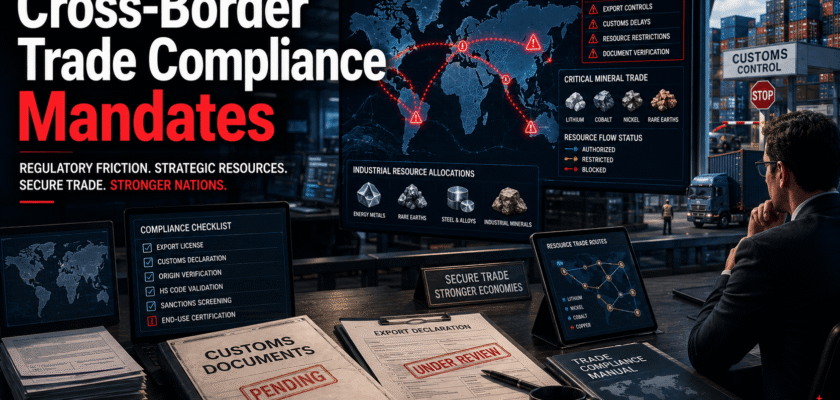
Cross-Border Trade Compliance Mandates: Why the Friction Is Rising
Cross-border trade compliance mandates are now shaping industrial policy as much as customs paperwork. Governments are using export controls, tariffs, origin rules and licensing checks to manage strategic materials. As a result, companies can no longer treat raw materials as simple commercial inputs.
The pressure is strongest around critical minerals, battery inputs, semiconductors, steel, aluminium and advanced manufacturing equipment. These resources sit at the meeting point of national security, industrial growth and climate-transition supply chains.
According to the OECD’s 2026 inventory, new export restrictions on critical raw materials introduced in 2024 came from a wider group of countries than before. This signals broader use of resource controls by developing economies in Africa and Asia.
Therefore, the main political question is no longer only who owns the resources. The harder question is who can move them across borders legally, quickly and at a predictable cost.
| KEY TAKEAWAYResource allocation is becoming a compliance issue. A company may secure supply on paper, but border rules, export licences, sanctions checks and origin documentation can still delay movement. |
Cross-Border Trade Compliance Mandates in Industrial Resource Allocation
Industrial resource allocation means deciding where strategic inputs will go and who can use them. In the past, price and logistics did most of the work. Today, politics also decides the flow.
For example, a battery manufacturer may need lithium, cobalt, nickel, graphite or rare earth magnets. However, each input may face different export permissions, supplier declarations, forced-labour checks, carbon reporting or end-use rules.
Because of this, compliance teams now work closer to procurement teams. They must know the supplier, the origin, the customs classification and the final use before goods are moved.
Why Critical Minerals Are the Centre of the Debate
Critical minerals are central because they power electric vehicles, energy storage, electronics, defence systems and clean-energy infrastructure. Demand is rising, yet processing capacity remains concentrated in a few markets.
IEEFA has noted that India is fully import-dependent for lithium, cobalt and nickel. It also warned that export restrictions, resource nationalism, onshoring and friend-shoring are fragmenting markets that India has relied on.
At the same time, countries with resource power want more domestic value addition. They may restrict raw exports, promote local refining or demand stronger compliance proof before approving shipments.
The Main Sources of Regulatory Friction
✓ Export controls that require licences before strategic goods can leave a country.
✓ Customs classification errors that delay shipments or create penalties.
✓ Rules-of-origin checks that decide tariff eligibility and market access.
✓ Sanctions and entity-list screening that block risky counterparties.
✓ Critical-mineral restrictions that change availability for downstream users.
✓ Carbon border rules and sustainability reporting that add documentation burden.
✓ Forced-labour and traceability checks that require deeper supplier proof.
✓ Data-sharing limits that make cross-border compliance records harder to centralise.
| COMPLIANCE RISK BOXThe most expensive mistake is not always a fine. It can be a held shipment, missed production window, cancelled customer order or loss of preferred-supplier status. |
How Fresh Industrial Resource Allocations Become Political
Fresh allocations become political when governments link resources to jobs, security and local industry. A country may prefer to supply domestic manufacturers first. It may also reserve certain inputs for strategic partners.
This creates friction for global companies. A supplier may be ready to sell, but the government may require end-use proof. In addition, a buyer may need to show that the material will not support a restricted military or technology use.
Consequently, procurement teams must plan for policy risk before signing contracts. A low-price deal can become costly if the shipment cannot clear export or import controls.
What 2026 Trade Policy Signals Show
The 2026 trade environment is moving toward managed resilience. Reuters legal analysis has described a shift where trade law, export controls, sanctions and national-security tools are increasingly connected.
Another Reuters analysis noted that businesses are facing more fragmented trade rules, tariff complexity and cross-border supply-chain legal risk. This is especially visible in transport, EVs, batteries and advanced manufacturing.
Meanwhile, Avalara’s 2026 Cross-Border Chaos Report found that many business leaders see international operations becoming more complex. This supports a wider point: compliance is now a strategic operating cost, not a back-office detail.
How Companies Should Respond
✓ Build a trade-compliance map before sourcing critical materials.
✓ Check customs classification and origin rules before shipment booking.
✓ Screen suppliers, buyers, banks and logistics partners for sanctions risk.
✓ Collect end-use and end-user documents early.
✓ Track export-control changes in supplier countries, not only buyer countries.
✓ Create backup supply routes for materials exposed to political restriction.
✓ Use digital audit trails for certificates, licences and declarations.
✓ Train procurement teams so they do not promise impossible delivery dates.
India, EU and Supply-Chain Diplomacy
India and the European Union are both trying to reduce critical-mineral vulnerability. ORF analysis in 2026 argued that after financing, regulatory standards and compliance become key friction points for India-EU critical-mineral cooperation.
This shows why resource partnerships need more than investment. They need compatible standards, traceability, predictable paperwork and trusted verification systems.
If countries cannot align compliance rules, even friendly supply chains can become slow. Therefore, trade diplomacy increasingly includes technical standards and digital documentation.
What Policymakers Should Balance
✓ National security and industrial growth.
✓ Domestic value addition and global supply stability.
✓ Environmental standards and practical documentation burdens.
✓ Resource sovereignty and trusted trade partnerships.
✓ Strict enforcement and predictable business timelines.
✓ Anti-circumvention checks and smooth legal trade.
Risks for Businesses That Ignore Compliance
⚠ Shipments may be stopped at the border.
⚠ Licences may be delayed or denied.
⚠ Tariff benefits may be lost because origin proof is weak.
⚠ Banks or insurers may refuse transactions linked to high-risk parties.
⚠ Customers may cancel contracts after repeated delays.
⚠ Regulators may investigate false or incomplete declarations.
Organic Search Summary for Readers
Cross-border trade compliance mandates matter because industrial resources now move through a political filter. Critical minerals, energy inputs and advanced manufacturing goods can face rules that change quickly.
Companies need more than supplier contracts. They need proof of origin, export permissions, sanctions screening, end-use checks and customs accuracy.
The winners will be companies that treat compliance as a supply-chain advantage. They will move faster because their documents, partners and routes are prepared before the border challenge arrives.
Conclusion
Cross-border trade compliance mandates are changing the politics of industrial resource allocation. They turn raw-material access into a regulated, documented and strategically monitored process.
This shift is not temporary. Critical minerals, clean-energy inputs and advanced manufacturing tools will remain tied to national priorities.
For companies, the message is clear. Resource security now depends on compliance readiness. The cheapest supply is not useful if it cannot cross the border legally and on time.
Frequently Asked Questions
Q. What are cross-border trade compliance mandates?
They are rules that control how goods move across borders, including customs declarations, export controls, origin checks, sanctions screening and licensing.
Q. Why are industrial resource allocations facing more friction?
Governments are treating critical minerals, battery inputs and advanced manufacturing resources as strategic assets.
Q. Which sectors are most affected?
EV batteries, semiconductors, clean energy, defence manufacturing, steel, aluminium and advanced electronics are strongly affected.
Q. How can companies reduce compliance risk?
They can verify supplier origin, prepare licences, screen counterparties, use digital records and build backup routes.
Q. Is this article legal advice?
No. It is a policy explainer. Companies should consult trade-compliance professionals for specific transactions.


