
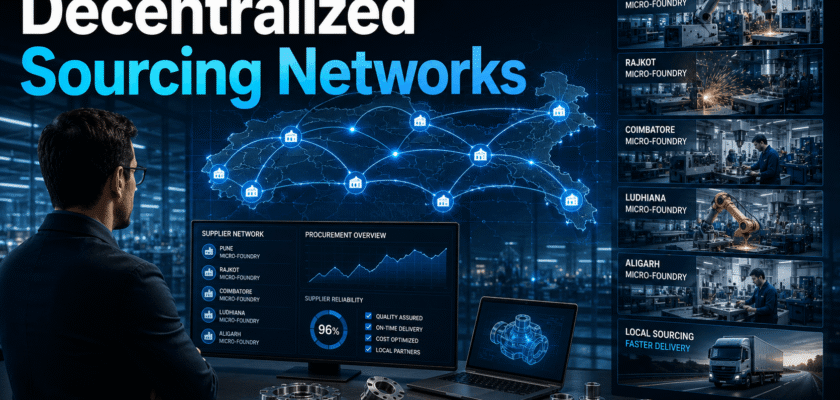
Decentralized Sourcing Networks: The New Procurement Reality
Decentralized sourcing networks are becoming a serious option for mid-tier manufacturing brands in 2026. The reason is simple. Global procurement is still useful, but it is no longer enough on its own.
Brands that once depended on long offshore supply chains now want faster response, better visibility and more backup capacity. Local micro-foundries are entering this gap. They can produce smaller batches, test components quickly and support urgent replacement needs.
This shift is not a rejection of global trade. It is a correction. Manufacturers are building a layered sourcing model. Global suppliers handle scale. Regional suppliers handle resilience. Local micro-foundries handle speed, prototyping and disruption control.
That is why decentralized sourcing networks matter. They turn procurement from a single pipeline into a flexible supplier web.
| KEY TAKEAWAYMid-tier manufacturers are not only chasing the cheapest supplier. They are building resilient sourcing webs that combine cost control, local speed, supplier diversity and digital visibility. |
Why Mid-Tier Brands Are Rethinking Procurement
Large enterprises often have the capital to hold safety stock, negotiate global contracts and run advanced supplier-risk systems. Mid-tier brands face a different reality. They need resilience, but they cannot always pay enterprise-level costs.
Local micro-foundries and small manufacturing cells give these brands a practical middle path. They allow selective localization without rebuilding the entire supply chain.
Recent global sourcing discussions show the same direction. Businesses are focusing on supplier diversification, supply-chain visibility and stronger supplier relationships. The goal is not only lower cost. The goal is continuity.
What Local Micro-Foundries Actually Do
A local micro-foundry is not always a traditional foundry. In modern procurement language, it can mean a compact regional production partner with casting, machining, fabrication, 3D printing, tooling or component-finishing capacity.
✓ Produces smaller and faster batches for urgent demand.
✓ Supports prototype-to-production testing close to the customer.
✓ Reduces dependency on one distant supplier.
✓ Improves design feedback between engineers and production teams.
✓ Cuts emergency freight exposure during supply shocks.
✓ Creates a backup supplier base for critical parts.
The Four Business Drivers Behind the Shift
1. Lead-Time Compression
Long supply chains can slow product changes. Local micro-foundries reduce waiting time for trial parts, repair components and small-batch orders.
2. Supplier-Risk Diversification
A decentralized network spreads risk across several capable nodes instead of depending on one offshore supplier.
3. Faster Design Feedback
Engineers can test changes with nearby manufacturing partners. This makes product iteration simpler and less expensive.
4. Inventory Discipline
Smaller local batches can reduce the pressure to overstock every component. This helps cash flow for mid-tier businesses.
| PROCUREMENT SHIFTThe old question was: Where is the cheapest supplier? The new question is: Which supplier mix gives the best balance of cost, speed, reliability and control? |
How Decentralized Sourcing Networks Work
A decentralized sourcing network uses multiple supplier nodes instead of one fixed procurement chain. Each node has a role. One may handle high-volume production. Another may support regional demand. A third may handle emergency parts or short production runs.
Digital supplier platforms, quality dashboards and audit trails make this system easier to manage. Without data, a decentralized network can become chaotic. With good data, it becomes a controlled resilience engine.
The best networks use supplier scoring. They measure delivery time, defect rate, capacity, compliance, cost and recovery speed. This gives procurement teams a real-time view of who can deliver under pressure.
Why This Matters More in 2026
Supply chains are still exposed to shipping delays, energy volatility, geopolitical friction and sudden demand changes. Research and industry reports continue to show rising interest in nearshoring, reshoring and diversified sourcing.
Manufacturers are also using more automation and digital decision tools. That makes smaller regional production more realistic. When labor cost is not the only deciding factor, proximity and responsiveness become more valuable.
For mid-tier brands, this is a strategic opening. They can use local partners to behave more like agile enterprises without carrying the full cost of owning every production asset.
Benefits for Mid-Tier Manufacturing Brands
✓ Faster recovery when one supplier fails.
✓ Lower exposure to emergency imports and premium freight.
✓ Better customization for local market needs.
✓ More control over urgent production changes.
✓ Stronger relationships with regional suppliers.
✓ Improved ability to serve B2B customers with shorter timelines.
✓ Better traceability when supplier data is integrated correctly.
The Risks No Brand Should Ignore
⚠ Quality may vary across several small suppliers.
⚠ Unit cost can rise if local production is not planned well.
⚠ IP protection needs stronger contracts and access controls.
⚠ Supplier onboarding can become complex without digital tools.
⚠ Small partners may have limited capacity during demand spikes.
⚠ Compliance audits must be repeated across the network.
| RISK CONTROL BOXA decentralized sourcing network needs standards. Brands should use clear drawings, quality gates, digital purchase records, supplier scorecards and backup contracts before shifting critical parts. |
A Practical Framework for Implementation
✓ Map critical parts: Identify components with long lead times, high failure impact or limited supplier options.
✓ Classify production roles: Separate suppliers for scale production, pilot batches, emergency orders and regional customization.
✓ Create quality gates: Use common drawings, test procedures and acceptance standards across all supplier nodes.
✓ Digitize supplier visibility: Track order status, defects, capacity and delivery performance in one dashboard.
✓ Start with non-core parts: Test the model with low-risk components before moving to critical assemblies.
✓ Review total cost: Measure freight, delay penalties, inventory cost and missed sales, not only unit price.
What This Means for Indian and Global Manufacturers
India’s manufacturing ecosystem, Southeast Asian supplier clusters, Eastern European industrial zones and North American nearshoring hubs can all benefit from this model. The common factor is proximity to demand and the ability to respond quickly.
Mid-tier brands that operate in auto components, appliances, industrial equipment, consumer hardware, EV parts and specialty packaging may see the strongest use cases.
The winning companies will not simply replace one supplier with another. They will build a portfolio. Each supplier will be selected for a clear job in the network.
The Bigger Business Trend
Decentralized sourcing networks show a deeper change in business strategy. Procurement is moving closer to product design, risk management and customer experience.
When a part arrives late, the problem is not only operational. It affects launch timing, customer trust and working capital. That is why sourcing is now a boardroom issue for many growing manufacturers.
Local micro-foundries are valuable because they bring production closer to the point of decision. They make supply chains more responsive, not just shorter.
Conclusion
Decentralized sourcing networks are not a temporary buzzword. They are a response to the real limits of long, fragile and overly centralized procurement chains.
Mid-tier manufacturing brands are using local micro-foundries to add speed, optionality and resilience. The model works best when it is supported by digital visibility, strict quality control and clear supplier roles.
The future of procurement will not be fully local or fully global. It will be intelligently distributed.
Frequently Asked Questions
Q. What are decentralized sourcing networks?
They are procurement systems that use multiple supplier nodes instead of depending on one central supplier or one long supply chain.
Q. Why are mid-tier manufacturers interested in local micro-foundries?
They offer faster small-batch production, local backup capacity and quicker design feedback.
Q. Do decentralized networks reduce cost?
They may not always reduce unit cost. They can reduce total risk cost by lowering delays, emergency freight and missed production windows.
Q. Are local micro-foundries suitable for every component?
No. They work best for selected parts, prototypes, urgent components and regional customization needs.
Q. What is the biggest risk in this model?
Quality inconsistency is the biggest risk. Clear specifications, testing and supplier scorecards are essential.


