Micro-SaaS Inversion: Why Procurement Teams Are Rethinking Suites
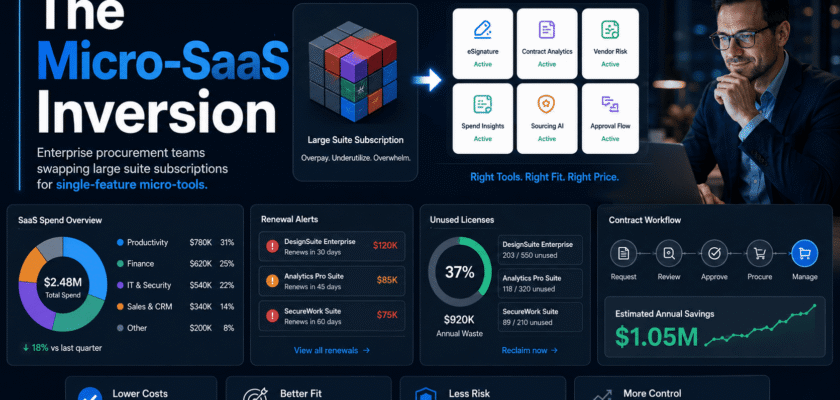
Micro-SaaS inversion is becoming a serious enterprise software trend. For years, large teams bought big software suites because one platform promised many features. Now, procurement teams are asking a sharper question: do we need the whole suite, or only one outcome?
Budgets are under pressure, and software stacks are crowded. As a result, enterprise buyers are checking unused seats, duplicate features and slow adoption. When a suite becomes too broad for a narrow problem, a single-feature micro-tool can look more practical.
This does not mean suites are dead. In many companies, suites still control core records, finance, HR, CRM and procurement workflows. However, the new trend is clear. Teams want smaller tools that plug into the stack and solve one painful workflow fast.
Therefore, the micro-SaaS inversion is not only a startup trend. It is a procurement response to SaaS fatigue, budget scrutiny and workflow-first buying.
| KEY TAKEAWAYEnterprise procurement is moving from feature-count buying to outcome buying. A focused micro-tool can win when it removes one expensive bottleneck better than a large suite module. |
Micro-SaaS Inversion and SaaS Spend Pressure
Procurement leaders now need stronger control over software spend. SaaS spend management vendors and advisory reports continue to highlight waste from unused licenses, overlapping tools and weak renewal discipline.
Some 2026 spend-management guides estimate that companies can lose a meaningful share of software budgets to unused or poorly managed subscriptions. Even when exact numbers vary, the issue is easy to understand. A team may pay for many seats but use only a few features.
Because of this, procurement teams are not only negotiating lower prices. They are also asking whether a large suite should be renewed at all. In certain cases, a focused micro-tool can replace one costly module without disturbing the core system.
Why Single-Feature Micro-Tools Are Winning Attention
✓ They solve one narrow workflow without forcing a full platform rollout.
✓ They often have faster onboarding and clearer usage tracking.
✓ They can reduce paying for unused suite features.
✓ They are easier to test through a small pilot.
✓ They can integrate with existing systems through APIs or browser workflows.
✓ They make ROI easier to measure because the use case is specific.
The Shift From Feature Lists to Workflow Outcomes
Enterprise buyers are becoming less impressed by long feature lists. A large suite may offer many modules, but that does not mean every module is adopted.
Recent SaaS commentary shows that the next wave of SaaS is moving toward workflow-first products. Enterprises want tools that fit the real work process, not dashboards that only look complete during a demo.
Micro-tools benefit from this change. They can focus on invoice exception detection, renewal reminders, vendor-risk checks, contract clause review or spend leakage alerts. Each tool has one job, and that job is easy to judge.
| PROCUREMENT LENSA micro-tool should not be bought because it is small. It should be bought because it removes a measurable workflow cost that the current suite fails to solve well. |
Where Micro-SaaS Fits Inside Enterprise Procurement
Micro-SaaS tools are strongest at the edge of enterprise systems. They can handle tasks that are too small for a full transformation project but too painful to ignore.
For example, a procurement team may keep its source-to-pay suite as the system of record. Then it may add a micro-tool for supplier email parsing, contract renewal alerts, tail-spend intake or compliance evidence collection.
That model is practical because it avoids a full rip-and-replace. The suite remains the backbone, while the micro-tool becomes a targeted performance layer.
Best Use Cases for Single-Feature Micro-Tools
✓ SaaS renewal alerts before auto-renewal dates.
✓ Unused license discovery across departments.
✓ Vendor document collection and expiry reminders.
✓ Tail-spend request intake for small purchases.
✓ Contract clause comparison for high-volume reviews.
✓ Invoice mismatch alerts for recurring services.
✓ Security questionnaire automation for small vendors.
✓ Procurement policy nudges inside chat or email.
When Suite Subscriptions Still Make Sense
Suites still matter when companies need a stable system of record. Finance, procurement, HR and CRM data need strong governance. In these cases, replacing a suite with many small tools can create risk.
Moreover, large suites are improving. Oracle, SAP and other enterprise vendors are adding AI agents and workflow automation into their platforms. This makes the market more competitive.
Therefore, the better strategy is not suite versus micro-tool. It is suite plus micro-tool, but only when the added tool proves a clear outcome.
Risks Procurement Teams Must Control
⚠ Too many micro-tools can create a new form of SaaS sprawl.
⚠ Weak integrations can trap data outside the main system.
⚠ Security reviews may become harder across many small vendors.
⚠ Small vendors may have limited support or compliance maturity.
⚠ Shadow IT can grow if teams buy tools without approval.
⚠ A cheap tool can become expensive if it creates duplicate work.
How to Build a Micro-SaaS Buying Framework
Procurement teams should use a strict buying framework before adding micro-tools. Otherwise, the cure can become another layer of software waste.
First, define the exact workflow problem. Next, measure the cost of the problem in time, money or risk. Then compare the micro-tool against the existing suite module.
Finally, run a short pilot. If the tool does not show adoption, integration value and measurable savings, it should not move to full rollout.
Micro-Tool Evaluation Checklist
✓ Does it solve one clear workflow?
✓ Does the meta problem exist often enough to justify a paid tool?
✓ Can it integrate with the current suite or data store?
✓ Can usage be measured in the first 30 days?
✓ Does the vendor pass security and compliance checks?
✓ Can the tool be removed without breaking core operations?
✓ Does it reduce cost, time or risk more than it adds complexity?
What This Means for Micro-SaaS Founders
Micro-SaaS founders should not pitch as a cheaper suite. That is the wrong battle. They should pitch as a sharper workflow fix.
Enterprise procurement teams want proof. A strong micro-tool needs clear onboarding, strong security documentation, clean pricing and measurable ROI.
Additionally, founders should design for integration. The tool must live inside the buyer’s current workflow, not ask the buyer to create a new habit from scratch.
What This Means for Enterprise Leaders
Enterprise leaders should treat the micro-SaaS inversion as a stack-design choice. A large suite can remain useful, but every module should earn its place.
If a micro-tool cuts manual work, improves compliance or reduces renewal waste, it may deserve a pilot. However, if it only adds another login, it should be rejected.
The winning software stack will be controlled, not crowded. It will combine core platforms with carefully selected workflow tools.
Organic Search Summary for Readers
Micro-SaaS inversion describes the shift from broad suite subscriptions toward smaller single-feature tools. The trend is driven by SaaS waste, unused licenses, budget pressure and workflow-first buying.
Enterprise procurement teams are not replacing every suite. Instead, they are testing focused tools that solve one painful job faster than a suite module.
The best approach is disciplined. Keep core systems stable, test micro-tools carefully and measure savings before scaling.
Conclusion
The micro-SaaS inversion is reshaping enterprise procurement. It shows that software value is no longer measured by the longest feature list.
Procurement teams now want focused tools that reduce waste, speed up work and support clear business outcomes. This creates a serious opening for well-designed micro-SaaS products.
Still, the trend must be managed carefully. Too many micro-tools can create new sprawl. The smarter path is a lean stack where every tool has a measurable purpose.
Frequently Asked Questions
Q. What is the micro-SaaS inversion?
Micro-SaaS inversion is the shift from broad suite subscriptions toward focused single-feature tools that solve one workflow well.
Q. Why are procurement teams interested in micro-tools?
They can reduce SaaS waste, speed up adoption and make ROI easier to measure.
Q. Will micro-SaaS replace enterprise suites?
Not usually. Many companies will keep core suites and add micro-tools for narrow workflow gaps.
Q. What is the biggest risk of micro-tools?
The biggest risk is creating another layer of software sprawl with weak integration and poor governance.
Q. How should a company test a micro-tool?
Run a short pilot, measure adoption, check integration quality and compare savings against the existing suite module.


