
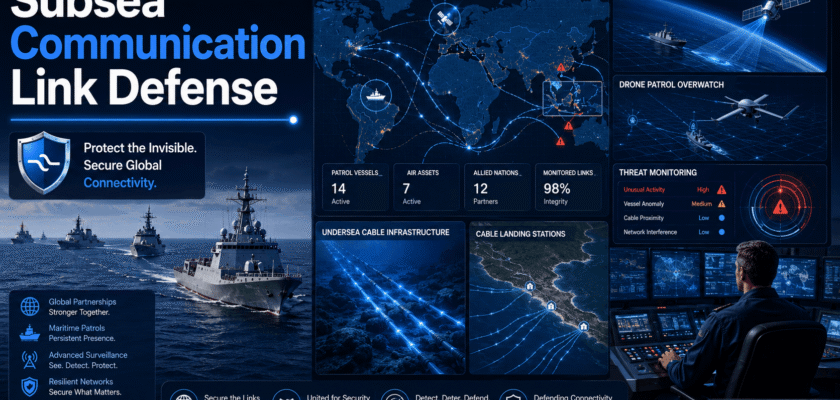
Subsea Communication Link Defense: Why Maritime Data Cables Matter
Subsea communication link defense has become a major security priority because maritime data cables carry the hidden traffic of daily digital life. Banking, cloud services, government communication, streaming, logistics and AI data flows all depend on undersea routes.
NATO launched Baltic Sentry in January 2025 after repeated infrastructure incidents in the Baltic Sea. The mission was designed to raise maritime presence, improve surveillance and strengthen response options around critical undersea infrastructure.
The European Union also published a cable security action plan in February 2025. It focused on prevention, detection, response, recovery and deterrence. Reuters reported that the plan included better surveillance and a reserve fleet concept for emergency cable repairs.
Because of these shifts, cable defense is no longer only a telecom issue. It is now part of naval planning, cyber resilience, economic security and crisis readiness.
| KEY TAKEAWAYMaritime data cables are private-sector infrastructure with public-security consequences. Protecting them requires navies, coast guards, cable operators, regulators and repair fleets to coordinate before a crisis starts. |
Subsea Communication Link Defense and the Patrol Framework
A modern patrol framework does not simply place ships over every cable. That is impossible because cable systems stretch across vast maritime routes.
Instead, patrols focus on chokepoints, shallow waters, landing zones, repair routes and areas where suspicious vessel behavior is easier to detect. Naval aircraft, drones, AIS monitoring, seabed sensors and intelligence sharing can work together.
NATO said Baltic Sentry would enhance military presence and improve the ability to respond to destabilizing acts. This indicates a layered model: watch, deter, investigate and respond.
Why Multi-National Coordination Is Needed
✓ Cables cross national waters, exclusive economic zones and international waters.
✓ A single incident can affect several countries at once.
✓ Private companies often own or operate the cable systems.
✓ Naval forces may detect threats, but repair ships restore service.
✓ Legal attribution can be difficult after a suspected sabotage event.
✓ Governments need fast contact channels before an emergency begins.
The Four Layers of Cable Protection
Cable protection works best when it is layered. The first layer is prevention through better routing, charts, seabed planning and awareness among ships.
The second layer is detection. This can include maritime patrols, vessel tracking, acoustic monitoring and reports from cable operators.
The third layer is response. States must quickly investigate incidents and secure the affected area. The fourth layer is recovery through repair ships, spare cable, permits and landing-station coordination.
Layered Defense Checklist
✓ Map vulnerable cable zones and landing stations.
✓ Monitor anchor activity and suspicious slow-speed vessel behavior.
✓ Share risk data between navies, coast guards and cable operators.
✓ Pre-clear emergency repair permissions where possible.
✓ Maintain regional repair-vessel access and spare-cable logistics.
✓ Protect landing stations as well as seabed routes.
Why the Baltic Sea Became a Test Case
The Baltic Sea has become a visible test case because it is busy, shallow and strategically sensitive. Several recent incidents involving energy and data links pushed European governments to act faster.
AP reported that NATO’s Baltic Sentry mission involved frigates, maritime patrol aircraft and naval drones to support surveillance and deterrence.
This does not mean every cable incident is sabotage. Fishing, anchors and accidents remain real risks. However, the geopolitical environment has made attribution and deterrence more urgent.
What Cable Operators Need From Governments
✓ Fast repair permits during emergencies.
✓ Clear laws against cable damage.
✓ Shared maritime threat information.
✓ Accurate cable charting and seabed-use coordination.
✓ Protection around landing stations and cable repair zones.
✓ Legal support when incidents cross jurisdictions.
What Governments Need From Cable Operators
✓ Accurate cable route data under secure sharing rules.
✓ Incident reporting without delay.
✓ Repair readiness plans and vessel availability.
✓ Technical knowledge of cable faults and failure patterns.
✓ Participation in resilience exercises.
✓ Contact points for crisis coordination.
The ICPC and Global Best-Practice Role
The International Cable Protection Committee promotes submarine cable protection and resilience. Its public materials encourage cooperation between governments and industry so cables remain resilient, protected and repairable.
ICPC guidance also highlights the importance of government best practices. These include better laws, policies and practical arrangements that protect submarine telecommunications cables.
This matters because most cable systems are not owned by navies. Governments must work with industry instead of treating cable defense as a purely military task.
Common Threats to Maritime Data Cables
⚠ Ship anchors dragged across cable routes.
⚠ Fishing gear and seabed activity.
⚠ Accidental damage during marine construction.
⚠ Suspicious vessel loitering near cable corridors.
⚠ Sabotage in shallow or strategic waters.
⚠ Cyber or physical risk at landing stations.
⚠ Delayed repairs due to permits, weather or vessel shortages.
How Patrols Can Reduce Risk Without Militarizing Every Cable
No navy can guard every kilometer of cable at every hour. The better goal is smarter risk reduction.
Patrols can create deterrence in high-risk areas. Surveillance can document suspicious movements. Repair fleets can reduce outage duration. Exercises can make the response faster when damage occurs.
In this model, defense is not only about stopping every incident. It is about making disruption harder, detection faster and recovery smoother.
The Repair Fleet Problem
Cable repair is specialized. A damaged subsea cable may require a repair ship, trained crew, spare cable, sea conditions, permits and coordination with multiple authorities.
Reuters reported that the EU action plan included the idea of a fleet of vessels for emergency undersea cable repairs. This shows that resilience is not only surveillance. It is also recovery speed.
Fast repair capacity is important because cable outages can affect financial, government and consumer services even when traffic is rerouted.
What This Means for Global Internet Users
Most users never see undersea cables, but they rely on them. A phone payment, cloud upload, video call or stock-market trade may cross the seabed without the user knowing.
When a cable is cut, internet traffic may be rerouted. However, rerouting can create latency, congestion or regional service stress.
Therefore, cable resilience is also consumer resilience. Stronger protection helps keep digital life stable during geopolitical tension and maritime accidents.
Organic Search Summary for Readers
Subsea communication link defense is now a central part of critical-infrastructure security. Naval patrols, drones, intelligence sharing and repair fleets all play different roles.
The strongest framework combines prevention, detection, response and recovery. It also connects governments with private cable operators.
As AI, cloud services and digital finance grow, maritime data cable protection will become even more important for global stability.
Conclusion
Subsea communication link defense has moved from a technical issue to a geopolitical priority. Recent cable incidents have shown that digital infrastructure is physically exposed on the ocean floor.
Multi-national naval patrol frameworks can improve deterrence and surveillance, but they are only one part of the answer. Legal coordination, private-sector sharing and repair readiness are equally important.
The future of cable security will depend on how quickly countries build shared procedures before the next incident happens.
Frequently Asked Questions
Q. What is subsea communication link defense?
It is the protection of undersea data cables through prevention, surveillance, patrols, repair readiness and government-industry coordination.
Q. Why are maritime data cables important?
They carry major international internet, financial, cloud and communication traffic between continents.
Q. Can navies protect every cable?
No. Navies focus on high-risk zones, chokepoints, landing areas and suspicious vessel activity.
Q. What is Baltic Sentry?
Baltic Sentry is a NATO activity launched to increase critical undersea infrastructure security in the Baltic Sea.
Q. Who repairs damaged subsea cables?
Specialized cable repair ships and operators usually handle repairs, often with government permits and maritime coordination.


