
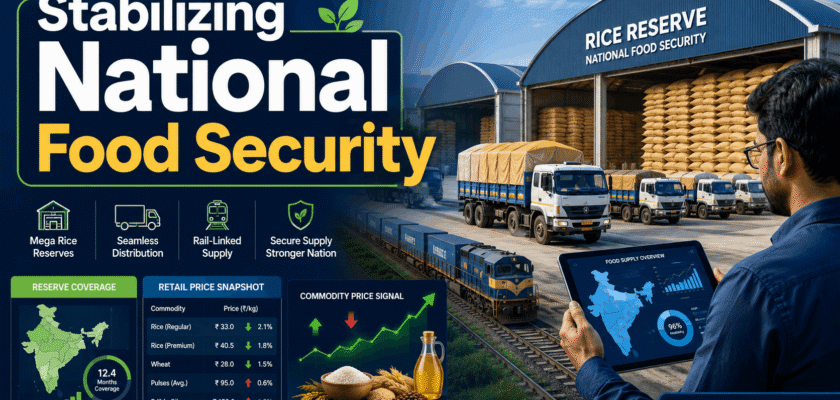
Mega Rice Reserve Distribution: Why It Matters Now
Mega rice reserve distribution is becoming a major food-security story in 2026. India now has very large government rice stocks. That gives policymakers more room to manage public supply, retail pressure and export confidence.
Reuters reported that India had 68.43 million metric tons of rice, including unmilled paddy, in government stocks on June 1, 2026. That was far above the July 1 target of 13.5 million tons. This gap shows how large the reserve buffer has become.
Large reserves do not lower prices by themselves. The impact depends on logistics. Rice must move from procurement zones to storage centers, then to welfare schemes, state buyers, open-market sales or retail channels.
Therefore, the real story is not only the stock number. It is how reserve rice moves through the national food chain and changes retail commodity pricing metrics.
| KEY TAKEAWAYFood security is no longer only a storage question. It is a movement question. A strong reserve works best when procurement, storage, auction, transport and retail channels are connected. |
Mega Rice Reserve Distribution and Retail Pricing
Retail rice pricing depends on more than farm output. It also depends on release timing, transport cost, milling quality, state demand, trader stock and consumer brand preference.
When government reserves are high, officials can release grain to increase market supply. A PIB update in April 2026 said FCI can release surplus wheat and rice under OMSS(D) to augment supply, stabilize prices and contain inflation.
However, the price effect can vary by city. A metro with strong retail competition may react faster. A distant district may still face transport and handling costs.
How the Rice Reserve Distribution System Works
✓ Farmers sell paddy or rice through procurement channels.
✓ FCI and state agencies store grain in central pool stocks.
✓ Rice moves into welfare schemes, state allocations, OMSS sales or special retail programs.
✓ Bulk buyers may purchase through approved e-auctions or fixed-price windows.
✓ Retail availability improves when logistics and local release timing match demand.
✓ Price pressure eases when supply reaches markets before panic buying starts.
Why Mega Stocks Can Change Market Psychology
Food markets react to expectations. If traders believe reserves are low, they may hold stock more tightly. If reserves look comfortable, the fear premium can reduce.
This is why official stock data matters. It signals whether the government has room to intervene if retail prices rise too fast.
For 2026, record rice stock gives the government a stronger supply cushion. Still, weather risk, logistics cost and regional demand can keep prices uneven.
| PRICE SIGNAL BOXA high rice stock does not guarantee cheaper rice in every shop. But it can reduce panic risk and give the government more tools to calm supply pressure. |
The Role of OMSS in Food Price Stability
Open Market Sale Scheme Domestic, or OMSS(D), is one of the main tools for market intervention. It lets FCI release surplus food grains into the open market under policy rules.
PIB noted in February 2025 that state governments and corporations could purchase rice at Rs 2,250 per quintal under OMSS(D), subject to limits. Later updates also described rice e-auctions in regional markets.
This matters because OMSS can connect reserve stocks with bulk users. If timed well, it can improve supply and reduce stress in wholesale channels.
Bharat Rice and Retail Distribution Signals
Retail programs can also shape consumer prices. The Department of Food and Public Distribution year-end review said Bharat Rice was part of Phase-III sales up to June 30, 2026, with allocated rice for this phase.
Such programs do not replace the full retail market. Yet they can create a reference price for basic rice packs. They also help lower-income households when private retail prices rise.
For food-security planners, the key task is to match stock release with real consumer need.
How Logistics Overheads Affect Rice Prices
✓ Storage rent and warehouse handling costs add to the final chain.
✓ Long transport routes increase freight cost.
✓ Milling and quality sorting affect usable supply.
✓ Local taxes, mandi charges and packaging add more cost.
✓ Poor last-mile planning can delay retail impact.
✓ Weather damage or storage quality loss can reduce usable stock.
✓ Digital stock tracking can reduce leakage and planning gaps.
What Retail Commodity Metrics Should Track
Food-security reporting should not stop at stock volume. A big stock number can look strong, but retail price relief needs different metrics.
Planners should track release volume, transit time, storage quality, state-level allocation, auction participation, wholesale price spread and retail price movement.
If those metrics move together, reserve distribution becomes more powerful. If they do not, large stocks can remain locked inside warehouses while consumers still pay more.
Practical Metrics Dashboard
✓ Central pool rice stock versus buffer norm.
✓ State-wise release and offtake speed.
✓ Average transport time from warehouse to market.
✓ Wholesale and retail rice price spread.
✓ Auction participation by bulk buyers.
✓ Quality rejection or storage loss rate.
✓ Retail availability in low-income districts.
Risks in a Mega Reserve System
⚠ High stocks can create storage pressure if movement is slow.
⚠ Old stocks need quality checks before distribution.
⚠ Too much release can hurt farmer price expectations.
⚠ Too little release can fail to calm retail prices.
⚠ Transport bottlenecks can weaken price impact.
⚠ State-level demand may not match central release timing.
⚠ Export decisions can complicate domestic supply signals.
Why Rice Reserve Planning Affects Food Businesses
Food businesses also watch reserve policy. Rice mills, packaged-food brands, cloud kitchens, hotels and small retailers all respond to wholesale price changes.
If reserve releases increase supply, bulk buyers may see more stable procurement costs. If logistics costs rise, the benefit may be smaller.
This is why food businesses need a purchase plan. They should track official releases, wholesale rates and inventory days instead of reacting only to retail headlines.
How Better Infrastructure Can Improve the Outcome
Mega reserves need modern infrastructure. Better warehouses, scientific storage, rail-linked movement, digital stock dashboards and local release planning can reduce waste.
Cold-chain is not always needed for rice. Still, moisture control, pest control and safe storage are essential. Poor storage can damage quality and reduce the useful reserve.
In the long run, food security will depend on smart supply-chain design as much as on procurement volume.
Organic Search Summary for Readers
Mega rice reserve distribution helps explain how government stocks affect food security and retail commodity prices. Large reserves can improve confidence, but only if rice moves quickly and cleanly through the supply chain.
India’s 2026 rice stock position is very strong. This gives policymakers more tools for market release, state supply and price stabilization.
However, stock alone is not enough. Logistics, timing, quality and local market delivery decide whether consumers feel real price relief.
Conclusion
Stabilizing national food security now requires more than buying grain. It requires a strong reserve distribution system that can move rice from storage to consumers at the right time.
Mega rice reserve distribution can change retail pricing metrics by improving supply confidence and reducing panic pressure. It can also help bulk food businesses plan better.
The next challenge is execution. If storage, transport, auctions and retail channels work together, reserve rice can become a stronger tool for both food security and price stability.
Frequently Asked Questions
Q. What is mega rice reserve distribution?
It means moving large government rice stocks through welfare, state, open-market and retail channels to support food security.
Q. How can rice reserves affect retail prices?
High reserves can allow market releases that improve supply and reduce price pressure, but local logistics still matter.
Q. What is OMSS(D)?
OMSS(D) is the Open Market Sale Scheme Domestic. It allows FCI to release surplus food grains into the market under policy rules.
Q. Does high rice stock always mean lower prices?
No. Prices also depend on transport cost, local demand, quality, trader behavior and release timing.
Q. Why should food businesses track reserve policy?
Reserve releases can affect wholesale supply, procurement costs and retail pricing expectations.


