
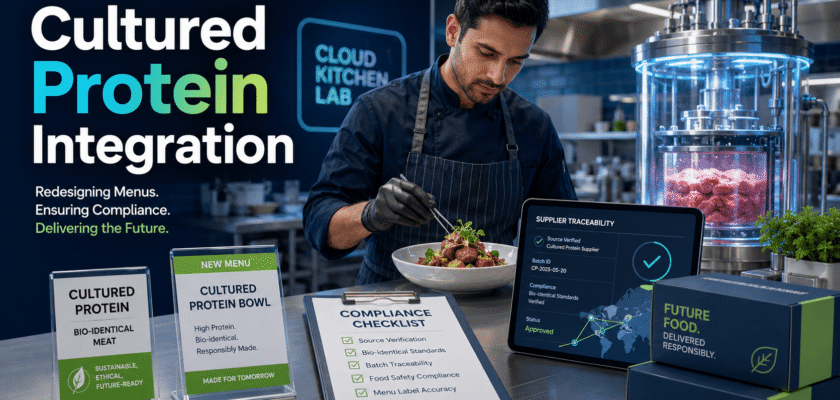
Cultured Protein Integration: Why Kitchens Must Move Slowly
Cultured protein integration is now a serious food-tech topic.
Yet it is not a normal menu update.
Cloud kitchens must treat it as a compliance project.
They need safe sourcing first.
Then they need clear labels.
After that, they need a clean cooking plan.
This matters because cell-cultivated meat is still new.
Also, approvals differ across markets.
The U.S. uses joint FDA and USDA oversight.
FDA covers cell collection, cell banks, and cell growth.
USDA-FSIS takes over at harvest and handles production and labels.
So, cloud kitchens cannot copy normal meat rules blindly.
| KEY TAKEAWAYCultured protein can change menus. However, it must enter kitchens through law, labels, safety checks, and honest customer messaging. |
Cultured Protein Integration and Bio-Identical Meat Compliance
Bio-identical meat means the product comes from animal cells.
It is not the same as a soy patty.
It is also not simple lab marketing.
The product needs safety review.
Then it needs approved production steps.
Finally, it needs a clear name on the menu.
Singapore uses a pre-market approval system for novel food.
The system includes cultivated meat.
It aims to protect consumers and still support food innovation.
Therefore, restaurants need country-specific compliance before launch.
Why Cloud Kitchens Are Watching This Shift
Cloud kitchens need fast menus.
They also need lower waste.
Cultured protein may help both goals later.
Still, it will not work without trust.
Customers must know what they are buying.
Kitchen teams must know how to store it.
Procurement teams must know who made it.
So, the real change starts before the recipe.
The 7-Step Compliance Menu Plan
✓ Check if sale is legal in the target market.
✓ Buy only from approved suppliers.
✓ Keep batch records and invoices.
✓ Use clear menu names.
✓ Train staff before launch.
✓ Separate test runs from live orders.
✓ Track customer feedback daily.
What Commercial Kitchens Must Check First
First, check local approval.
Next, check label rules.
Then, check storage needs.
Also, check allergen notes.
After that, test texture and taste.
Finally, set a refund and complaint plan.
This simple order avoids panic.
It also protects the brand.
Kitchen Readiness Checklist
✓ Approved product source.
✓ Clear supplier certificate.
✓ Cold-chain or storage guide.
✓ Menu name with no false claim.
✓ Staff script for customer questions.
✓ Recipe test sheet.
✓ Waste and recall log.
Recipe Design Must Stay Simple
A new protein should not carry a complex recipe first.
Instead, kitchens should start with familiar dishes.
For example, bowls can work well.
Wraps can also work well.
Small sliders can work too.
These formats reduce customer doubt.
They also make cost tracking easier.
Most importantly, they show taste clearly.
| MENU DESIGN BOXDo not hide the product. Say what it is. Keep the dish simple. Then let taste, price, and trust do the work. |
How Sourcing Changes for Cultured Protein
Sourcing becomes more data-heavy.
A kitchen needs more than a delivery bill.
It needs batch details.
It needs safety documents.
It needs supplier approval proof.
Also, it needs clear storage instructions.
This can raise back-end work.
However, it can reduce confusion later.
Cost Control for Cloud Kitchens
Cultured protein may cost more at first.
So, kitchens need tight portion control.
They also need low waste recipes.
A small launch can reduce risk.
Limited-time menus can help too.
In addition, combo meals can test demand.
The goal is not hype.
The goal is stable unit economics.
Customer Trust Is the Real Margin Driver
Food-tech margins need trust.
A customer may try a new product once.
However, repeat orders need clarity.
So, the menu should answer basic doubts.
Is it animal-cell based?
Is it approved for sale here?
Does it contain known allergens?
Can it fit the customer diet?
Clear answers reduce friction.
Mistakes Cloud Kitchens Should Avoid
⚠ Do not sell before local approval.
⚠ Do not use vague menu names.
⚠ Do not call it vegan meat.
⚠ Do not ignore allergen checks.
⚠ Do not mix test stock with live stock.
⚠ Do not skip batch records.
⚠ Do not overpromise health benefits.
⚠ Do not launch without staff training.
How India-Focused Kitchens Should Think
India is a large food market.
Yet cultured meat needs clear rules first.
So, Indian kitchens should watch FSSAI updates.
They should also track global approvals.
Until then, plant-based and fermentation proteins may move faster.
Still, teams can prepare now.
They can build supplier files.
They can train menu teams.
They can plan honest labels.
Organic Search Summary for Readers
Cultured protein integration is more than a food trend.
It is a compliance and sourcing shift.
Cloud kitchens must handle it with care.
They need legal checks first.
Then they need supplier proof.
Next, they need simple recipes.
Finally, they need clear customer language.
Conclusion
Cultured protein integration can reshape cloud kitchen menus.
However, the change will be gradual.
Regulation will decide the first step.
Customer trust will decide the next step.
Costs will decide the scale.
Therefore, smart kitchens should prepare early.
But they should also move legally and slowly.
Frequently Asked Questions
Q. What is cultured protein integration?
It means adding cell-cultivated or novel protein products into menu, sourcing, label, and kitchen workflows.
Q. Is cultivated meat legal everywhere?
No. Rules differ by country. Kitchens must follow local food law first.
Q. Is cultured meat vegan?
No. It comes from animal cells. So, menus should not call it vegan.
Q. Can cloud kitchens sell it in India now?
They should wait for clear local approval and official food-safety rules.
Q. What is the safest launch plan?
Start small. Use approved suppliers. Keep clear labels. Train staff first.


