
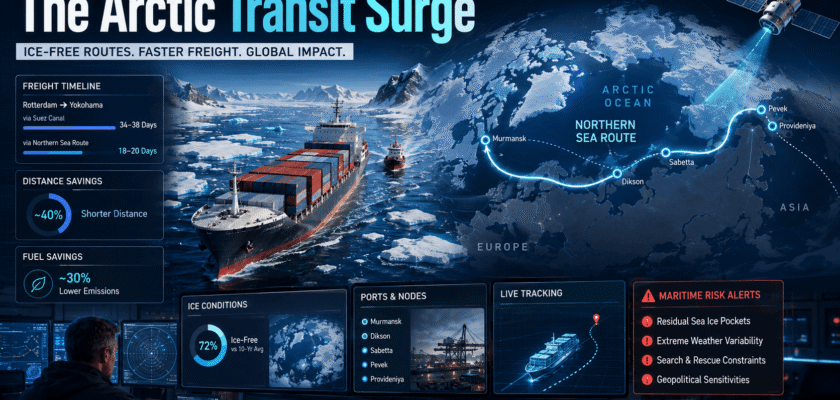
Arctic Transit Surge: Why Freight Planners Are Watching
Arctic Transit Surge is now a major freight story.
Melting sea ice is changing old route maps.
However, this shift is not simple.
The Northern Sea Route can look shorter on a map.
Yet storms, ice, rules, and insurance still matter.
So, freight teams now study the Arctic with care.
They see a possible shortcut.
However, they also see a high-risk corridor.
Arctic Transit Surge and the Northern Sea Route
The Northern Sea Route runs along Russia’s Arctic coast.
It links Europe and Asia through northern waters.
In some cases, it can cut distance.
Even so, it does not replace Suez today.
International Chamber of Shipping notes serious limits.
These include safety, cost, climate, and social risks.
Therefore, the route is still a niche option.
What the Latest Ice Data Shows
Arctic ice is still shrinking in key records.
Copernicus said March 2026 had the lowest March extent in 48 years.
It was 5.7% below the 1991-2020 average.
May 2026 was also low.
Copernicus called it the fourth lowest May in the satellite record.
Therefore, the shipping debate is getting louder.
Still, low ice does not mean safe sailing.
Why Cargo Transit Still Has Limits
Cargo data also needs context.
High North News reported 103 transit voyages in 2025.
Total transit cargo was near 3.2 million tons.
That was notable, but still small globally.
So, the Arctic is not yet a main freight highway.
It is better seen as a seasonal pressure valve.
| SIMPLE TAKEAWAYThe Arctic route may save distance. Yet it can add risk. So, planners must compare speed, safety, cost, and politics. |
How Freight Timelines Could Change
Arctic sailing can shorten some Asia-Europe legs.
Therefore, some cargo owners are watching it.
The interest grows when other chokepoints face stress.
Suez, Panama, and Malacca delays can change route math.
However, Arctic timing is not steady.
Ice can return fast.
Weather can slow ships.
Ports can be far apart.
This makes schedules harder to promise.
Why the Arctic Is Also a Security Story
The Arctic is not only a trade route.
It is also a security zone.
Reuters reported that NATO allies are increasing Arctic focus.
The report pointed to Russia’s large icebreaker fleet.
It also noted the strategic role of the High North.
As a result, freight planning now meets geopolitics.
That adds another layer of risk.
Main Benefits for Freight Planners
✓ Shorter possible distance on some routes.
✓ New backup option during chokepoint stress.
✓ Faster energy cargo moves in select seasons.
✓ New port growth in northern regions.
✓ More route choices for specialized vessels.
Main Risks for Shipping Firms
⚠ Ice risk can change within days.
⚠ Weather can damage schedules.
⚠ Insurance costs may rise.
⚠ Ports and repair hubs are limited.
⚠ Rescue support can be far away.
⚠ Sanctions can block normal planning.
⚠ Environmental damage can be severe.
What Shippers Should Track
First, track ice charts daily.
Next, check vessel class and crew skill.
Then, compare insurance and fuel costs.
Also, check sanctions and port rules.
Finally, compare the Arctic plan with Suez and Cape routes.
This keeps the decision grounded.
Quick Planning Checklist
✓ Use official ice data before sailing.
✓ Check Polar Code needs early.
✓ Use experienced Arctic crews.
✓ Plan emergency fuel and spare parts.
✓ Build extra days into contracts.
✓ Confirm cargo insurance in writing.
✓ Prepare a non-Arctic backup route.
Why It Matters for Asia-Europe Trade
Asia-Europe trade depends on stable timelines.
Any route change affects inventory.
It also affects port bookings.
Moreover, it affects freight pricing.
If Arctic routes grow, logistics models may change.
Still, adoption will likely stay selective.
High-value or time-sensitive cargo may test it first.
Climate Risk Cannot Be Ignored
This story also has a climate cost.
Less sea ice may open routes.
However, it also signals faster warming.
Arctic shipping can disturb fragile ecosystems.
Black carbon can also hurt ice surfaces.
Therefore, green rules will matter more.
What This Means for India and Global Trade
India should watch the route carefully.
Energy, fertilizers, metals, and containers may be affected.
Yet India should not treat it as a magic shortcut.
For now, Suez and Cape routes remain core.
However, Arctic data can help risk teams plan better.
That is useful during chokepoint stress.
Organic Search Summary
Arctic Transit Surge is about seasonal route change.
It is also about freight risk.
The Northern Sea Route may save distance.
However, it adds ice, cost, and security risk.
So, cargo planners need a balanced view.
They should not follow hype alone.
Conclusion
Arctic Transit Surge is changing freight planning.
Yet the change is still controlled by risk.
Ice loss may open more sailing windows.
However, safety and politics still limit growth.
Therefore, the Arctic is not a full replacement route.
It is a selective and sensitive trade option.
Smart shippers will plan slowly.
They will use data before they move cargo.
Frequently Asked Questions
Q. What is Arctic Transit Surge?
It means rising interest in Arctic sea routes for cargo movement.
Q. Is the Northern Sea Route fully ice-free?
No. It is still seasonal and risky.
Q. Can it replace the Suez Canal?
Not now. It is still a niche route.
Q. Why are shippers interested?
They want shorter routes and backup options.
Q. What is the biggest risk?
Ice, weather, insurance, and geopolitics all matter.


