
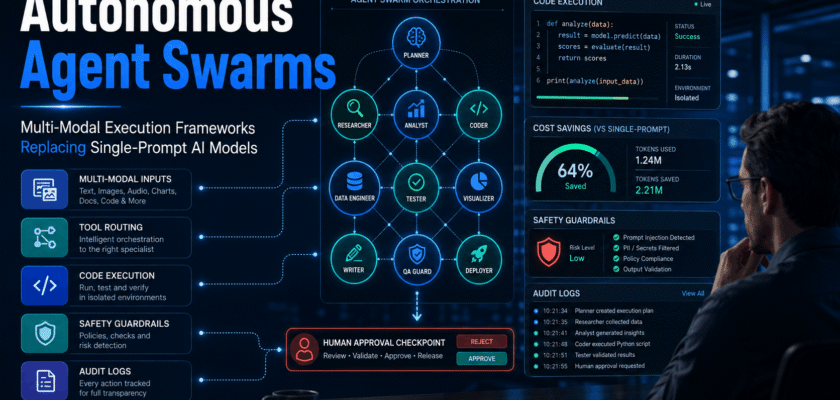
Autonomous Agent Swarms: Why AI Workflows Are Changing
Autonomous agent swarms are changing AI work.
Earlier, teams used one long prompt.
Now, they split work across smaller agents.
Each agent gets one clear job.
So, the system becomes easier to test.
Also, it becomes easier to control.
This shift matters for software teams.
It also matters for content, support, and research teams.
Autonomous Agent Swarms and the New AI Stack
A swarm is not magic.
It is a planned agent network.
One agent may read files.
Another agent may write code.
A third agent may check risk.
Then, a router joins the results.
Because of this, work becomes modular.
Moreover, failure becomes easier to find.
| KEY TAKEAWAYA swarm replaces one heavy prompt with many small jobs. That makes AI work cleaner, safer, and cheaper to tune. |
Why Single-Prompt AI Is Losing Power
Single-prompt AI can work for simple tasks.
However, complex work needs more structure.
A long prompt can hide mistakes.
It can also waste tokens.
Also, the model may forget old details.
So, teams now use agent handoffs.
They also use tools and logs.
As a result, the workflow becomes clearer.
What Makes an Agent Swarm Useful
✓ Each agent has one role.
✓ Each tool has one purpose.
✓ The router controls the path.
✓ Logs show each step.
✓ Guardrails stop risky actions.
✓ Humans review key outputs.
✓ Tests catch weak results.
✓ Budgets limit token waste.
The Multi-Modal Layer
Modern agents do more than text.
They can read images.
They can inspect documents.
They can call APIs.
They can also run code.
Therefore, multi-modal routing matters.
The right agent must get the right input.
Otherwise, the system burns time and money.
How Tool Routing Cuts Token Cost
Token cost grows with messy context.
So, teams reduce context first.
They send only needed data.
Then, they let tools handle details.
Anthropic describes code execution with MCP as a way to handle more tools with fewer tokens.
This idea is simple.
Do not paste every detail into chat.
Instead, fetch the exact detail when needed.
| COST CONTROL BOXGood agent systems do not send everything everywhere. They route small tasks to the best tool. |
Frameworks That Push This Shift
OpenAI Agents SDK supports multi-agent workflows.
It also supports tools and handoffs.
Microsoft Agent Framework combines multi-agent patterns with enterprise features.
Google A2A supports agent-to-agent communication.
Anthropic MCP helps agents connect to tools and data.
Together, these tools shape the new stack.
Still, teams must design the system well.
A bad swarm is only more chaos.
Where Companies Can Use Agent Swarms
✓ Customer support triage.
✓ Software bug checks.
✓ Report writing.
✓ Sales research.
✓ Compliance review.
✓ Data cleanup.
✓ Document search.
✓ Creative production.
The Safe Build Pattern
First, start with one workflow.
Next, map each step.
Then, assign one agent per step.
After that, add tool rules.
Also, add a human review gate.
Finally, track cost and errors.
This keeps the project small.
It also keeps risk lower.
Risks Teams Must Control
⚠ Agents may call wrong tools.
⚠ A prompt may leak private data.
⚠ A tool may return bad data.
⚠ Costs may rise fast.
⚠ Logs may miss key steps.
⚠ Humans may trust weak output.
⚠ Security gaps may grow.
⚠ Vendors may change APIs.
How to Keep Agent Swarms Safe
Use clear permissions.
Keep tools scoped.
Review sensitive actions.
Log every handoff.
Set token budgets.
Test with bad inputs.
Update prompts often.
Above all, keep humans in control.
What This Means for Developers
Developers will design workflows, not only prompts.
They will manage agents like services.
They will track latency, cost, and trust.
Also, they will write clearer tests.
This is a big change.
Yet, it can reduce manual work.
It can also reduce repeated code.
So, agent skills will become more valuable.
What This Means for Businesses
Businesses should avoid hype.
They should start with one pain point.
For example, support triage is a good start.
Invoice checks can also work.
However, risky decisions need humans.
So, full automation should come slowly.
The best gains come from guided automation.
That keeps speed and control together.
Organic Search Summary
Autonomous agent swarms are the next AI workflow layer.
They replace one long prompt with many small agents.
They also use tools, memory, and guardrails.
Therefore, teams can reduce waste.
They can also improve quality.
Still, the design must be safe.
Good routing is the main difference.
Bad routing only creates noise.
Conclusion
Autonomous agent swarms are not a buzzword alone.
They are a new work pattern.
They split tasks into small parts.
Then, agents and tools handle each part.
This can save time and tokens.
It can also improve control.
However, teams need logs and guardrails.
That is how agent swarms become useful.
Frequently Asked Questions
Q. What are autonomous agent swarms?
They are groups of AI agents that split and complete work together.
Q. Are agent swarms replacing prompts?
They replace many long prompts in complex workflows.
Q. Do agent swarms reduce token cost?
They can reduce cost when routing and context are designed well.
Q. Are agent swarms safe?
They need permissions, logs, tests, and human review.
Q. Who should use agent swarms first?
Teams with repeated research, support, coding, or review tasks can test them first.


