
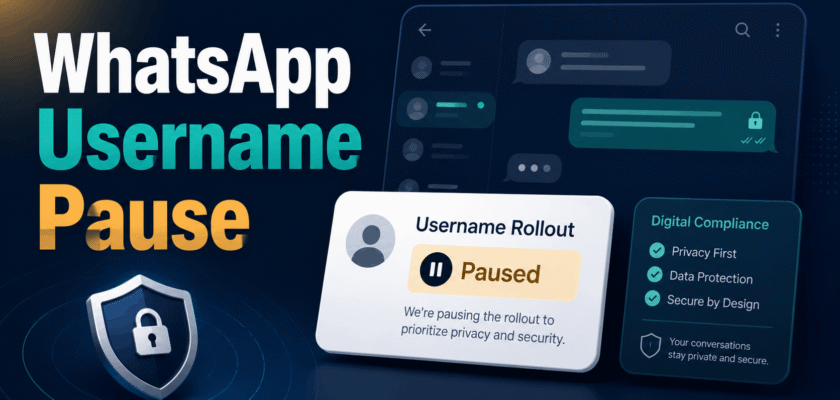
| ✅ Quick AnswerIndia asked Meta to pause the WhatsApp username rollout in India.The government wants details on fraud controls and user safety.The feature could protect phone numbers, but it may also raise impersonation risks.So, the issue is not only privacy. It is also trust and compliance. |
The government notice to WhatsApp username feature 2026 has turned a privacy update into a major policy test for India.
Meta wants users to chat without sharing phone numbers.
However, India wants the company to prove that fraud risks are under control.
Therefore, the username rollout pause is not a simple app update story.
It is now a wider debate on privacy, safety, and platform accountability.
Government Notice to WhatsApp Username Feature 2026: What Happened
On July 1, 2026, India asked Meta to hold the WhatsApp username rollout in India.
Reuters reported that the government sought a reply within three days.
The letter raised concerns about fraud, phishing, and impersonation.
It also asked WhatsApp to justify why the feature is needed.
As a result, the rollout faces a consultation pause in India.
Why WhatsApp Usernames Look Useful
At first, the idea looks user-friendly.
Many people dislike sharing phone numbers with strangers.
A username can reduce that pressure.
For example, a creator can share a handle instead of a private number.
Also, a small business can keep one public identity across apps.
So, the privacy benefit is real.
Why India Raised Fraud Concerns
Still, the government worry is also clear.
A username can hide a real number from the first contact.
That may help privacy, but it can also help bad actors.
Scammers may copy names of banks, officers, brands, or public figures.
Then, users may trust a fake account too fast.
That risk matters in India because digital fraud has become more aggressive.
| ⚠️ Main Risk Areas✓ Fake government or bank-like usernames.✓ Scam chats that hide the sender’s phone number.✓ Digital arrest style fraud using official-sounding names.✓ Business impersonation and customer support traps. |
What WhatsApp Says About Safety
WhatsApp has described usernames as optional and privacy-focused.
Reports say the feature will not create a public search directory.
That means users must know the exact username to start a chat.
WhatsApp also plans safeguards for high-profile names.
It may block repeated guessing attempts and limit unwanted contact.
In addition, a username key can add another layer of control.
Even so, India wants proof before the wider launch.
Digital Communications Regulations Compliance India
The government notice to WhatsApp username feature 2026 fits a larger regulatory pattern.
India now expects big platforms to test safety before launch.
The IT Rules also place due diligence duties on intermediaries.
So, Meta must show clear steps for user protection.
This may include abuse reporting, fake-name checks, and scam response workflows.
Also, the company may need stronger coordination with Indian cyber agencies.
Impact on Normal WhatsApp Users
For users, nothing should change immediately if the rollout stays paused.
Phone-number chat will continue as usual.
However, users should stay alert when any username feature appears.
A genuine handle does not always mean a genuine person.
Therefore, users should verify money requests, job offers, and bank messages.
✓ Do not trust a username only because it looks official.
✓ Check a business through its website or verified support page.
✓ Never share OTPs, PINs, or banking screenshots in chat.
✓ Report suspicious accounts inside the app quickly.
Impact on Businesses and Creators
The pause may slow handle planning for creators and brands.
Yet, it can also protect them from impersonation.
Many brands need clean digital identity systems.
So, reserved handles and verification controls will matter.
Businesses should prepare a simple username policy now.
They should also educate customers before publishing any new handle.
What Meta Must Prove Now
Meta must explain the feature in simple compliance terms.
First, it should show how high-risk names get protected.
Next, it should show how scams get flagged early.
Also, it should explain how users can block strangers fast.
Finally, it should explain how Indian complaints will get handled.
If these answers look strong, the rollout may restart later.
| ✅ Platform Safety Checklist✓ Reserve names of banks, public bodies, and major brands.✓ Block username scraping and guessing attacks.✓ Show clear account context before first contact.✓ Add fast scam reporting and account review tools.✓ Educate users before usernames go live. |
Single Click Blog View
This story shows a new rule for consumer tech.
Privacy features must now pass a safety test too.
A username can help users protect phone numbers.
But trust tools must arrive at the same time.
Therefore, the best rollout is not the fastest one.
The best rollout is the one users can understand and safely use.
Conclusion: Government Notice to WhatsApp Username Feature 2026
The government notice to WhatsApp username feature 2026 is more than a pause order.
It shows how India may review privacy features that can also change fraud risk.
For WhatsApp, the next step is clear.
It must prove that usernames can protect privacy without making scams easier.
For users, the lesson is simple.
Privacy is useful, but verification is still essential.
FAQs
What is the government notice to WhatsApp username feature 2026?
It is India’s reported direction to Meta to pause the username rollout and explain safety controls.
Will WhatsApp usernames replace phone numbers?
No. Reports say the feature is optional and meant to reduce phone number exposure.
Why is India worried about WhatsApp usernames?
India is worried about fraud, phishing, impersonation, and fake official-looking handles.
Can users search for any WhatsApp username?
Reports say there will be no public username directory. Users must know the exact handle.
Is the WhatsApp username feature bad?
Not necessarily. It can improve privacy, but it needs strong safety tools.


