
Human-Centric AI Vision: Why India Is Framing AI as Access
Human-centric AI vision is now central to India’s tech story. At VivaTech 2026 in Paris, Prime Minister Narendra Modi presented AI as a tool that must serve people, not replace public purpose.
His speech used a simple idea. Technology creates progress only when it is democratized. This means access should reach small firms, students, citizens and public systems, not only large companies.
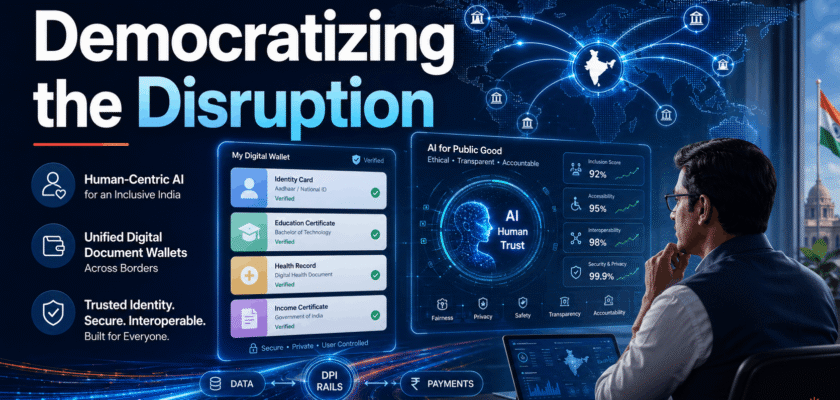
The message also connected AI with India’s digital public infrastructure. UPI, DigiLocker and other public tools were shown as examples of large-scale technology that can work for daily life.
Therefore, the new disruption is not only about faster models. It is about trusted rails that help people use digital proof, payments and services across borders.
| KEY TAKEAWAYIndia is positioning AI as a public-good layer. The strongest argument is that digital identity, payments and document wallets can make AI more useful, safer and easier to verify. |
Human-Centric AI Vision and the VivaTech 2026 Signal
VivaTech 2026 became a global stage for India’s AI and DPI pitch. Official PMO text says India sees AI as All Inclusive and focused on people.
The same address pointed to UPI usage in France and called DigiLocker one of the world’s largest digital document wallets. It said 700 million users can access authentic documents from original sources.
This matters because AI systems need trusted inputs. A digital wallet can reduce fake documents, slow verification and paper-heavy workflows. In turn, AI tools can help route, read and verify documents faster.
What DigiLocker Adds to the AI Stack
DigiLocker is not an AI model. It is a document trust layer. The official DigiLocker site says it gives citizens access to authentic digital documents inside a secure cloud-based platform.
That role is important. AI can summarize a resume, read a certificate or process an application. However, it still needs proof that the document is real.
A trusted digital wallet can provide that proof. As a result, AI moves from guesswork to verified workflow support.
Why Cross-Border Digital Document Wallets Matter
✓ Students can share verified degrees with foreign institutions.
✓ Workers can verify licenses, IDs and certificates faster.
✓ Travelers can reduce repeated paper uploads for services.
✓ Employers can check documents with less manual work.
✓ Governments can reduce fraud in benefits and permits.
✓ Platforms can build safer onboarding flows.
✓ Citizens can control sharing with clearer consent steps.
The Difference Between DPI and a Private App
A private app can solve one market problem. Digital public infrastructure can solve a shared trust problem.
DPI works best when it is open, secure and built for scale. It can let many private and public services connect to the same rails.
This is why India keeps presenting UPI and DigiLocker as public-good infrastructure. The value is not only the app. The value is the network effect around it.
| DPI LENSA document wallet becomes more powerful when colleges, hospitals, employers, banks and public agencies can verify documents from the same trusted source. |
How AI Can Support a Unified Document Wallet
AI can help users find documents faster. It can also detect missing fields, translate basic instructions and route a file to the right service.
However, AI should not become the final authority for every decision. Sensitive use cases need human review, audit trails and appeal options.
A human-centric model keeps AI as an assistant. It helps speed up work, but people keep control over consent, verification and final decisions.
Use Cases That Could Grow First
✓ University admissions for verified mark sheets and degrees.
✓ International hiring for skill certificates and licenses.
✓ Travel services that need identity and permit proof.
✓ Fintech onboarding where KYC must be trusted.
✓ Health record access where consent must be clear.
✓ Vehicle and driving document checks across service platforms.
✓ Public benefit delivery with lower paper dependency.
Risks That Must Be Controlled
⚠ Data sharing without clear consent can harm trust.
⚠ Cross-border standards can differ by country.
⚠ AI errors can misread documents or names.
⚠ Cybersecurity must be strong at every integration point.
⚠ Exclusion can happen if people lack phones or internet access.
⚠ Private platforms may ask for more data than needed.
⚠ Legal recognition must be clear before global use.
Why Human-Centric Design Must Stay Central
A digital wallet can be powerful, but it must stay simple. Users should know what they are sharing, with whom, and for how long.
Human-centric design also means support for many languages. It means offline help. It also means clear recovery steps if a user loses access.
If digital systems are too complex, they can exclude the people they promise to help. Therefore, simplicity is not a design extra. It is a public-trust requirement.
How India Can Turn DigiLocker Into a Global Trust Model
India can expand the model through standards, partnerships and bilateral pilots. Education, travel and skilled-worker mobility are practical starting points.
First, document formats need common rules. Next, countries need trust agreements. Finally, citizens need control over consent and revocation.
This path will not be instant. Still, the VivaTech 2026 message shows a clear ambition. India wants its DPI model to travel beyond domestic use.
Organic Search Summary for Readers
Human-centric AI vision is shaping India’s global technology pitch. It links AI with public-good infrastructure, not only private disruption.
DigiLocker shows how a digital document wallet can reduce paper, speed verification and support trusted workflows.
The next step is cross-border trust. If standards, privacy and legal recognition improve, digital wallets could support students, workers, travelers and businesses at global scale.
Conclusion
Democratizing the disruption means making AI useful for ordinary people. India’s VivaTech 2026 message connects that idea with DPI, UPI and DigiLocker.
The strongest opportunity is not one more app. It is a trusted digital rail where documents, payments and AI workflows can work together.
Yet the promise must stay human-centric. Privacy, consent, security and inclusion should remain at the center. Without them, digital power can quickly become digital pressure.
Frequently Asked Questions
Q. What is a human-centric AI vision?
It is an AI approach that puts people, access, safety, consent and public benefit before pure automation.
Q. Why is DigiLocker important for AI?
DigiLocker can provide trusted digital documents. AI can then process verified data with less fraud risk.
Q. Is DigiLocker already a global document wallet?
It is mainly an Indian digital document wallet. Cross-border use needs legal, technical and policy agreements.
Q. What did PM Modi say at VivaTech 2026?
Official remarks framed AI as inclusive and highlighted India’s digital public goods, including UPI and DigiLocker.
Q. What is the biggest risk?
The biggest risks are privacy misuse, weak consent, cyberattacks, legal mismatch and exclusion of users without easy digital access.


