
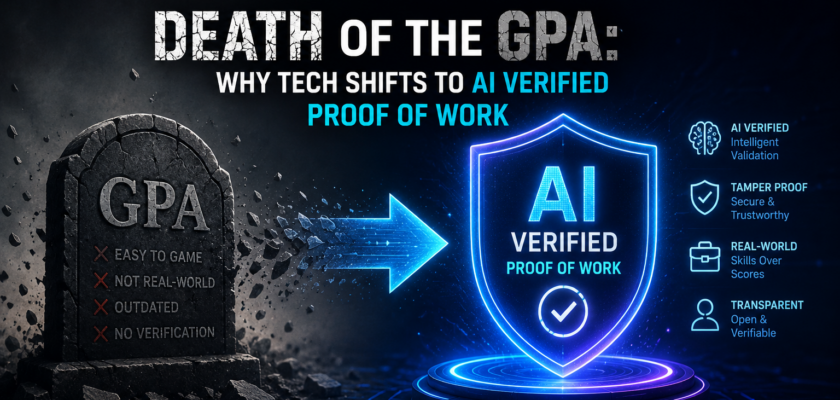
The Death of the GPA: Why Top Tech Firms Are Switching to AI-Verified Proof-of-Work.
For decades, the Grade Point Average (GPA) was the holy grail of early-career technical recruitment. When elite enterprise tech firms or high-growth startups screened thousands of university applications, a flawless 3.9 or 4.0 GPA served as a vital proxy shortcut for intelligence, long-term discipline, and baseline execution.
But as we advance through May 2026, the traditional academic transcript has lost its authority as a reliable signal.
A landmark Berkeley working paper and recent labor market reports have revealed a profound systemic shift: the explosive integration of generative LLMs into higher education has accelerated massive grade inflation. In courses highly exposed to AI tools, the distribution of “A” grades has ballooned by a staggering 13 percentage points, making top marks incredibly easy to obtain and frustratingly difficult for recruiters to evaluate.
In a world where generic portfolios can be falsified by prompts and homework is easily solved by bots, the traditional credential pipeline has collapsed into absolute noise. To survive this era of credential bankruptcy, elite tech firms are aggressively building a new framework: AI-Verified Proof-of-Work Tech Hiring 2026.
Instead of trusting rubber-stamped college grades, tech companies are utilizing advanced, tamper-proof verification engines to judge candidates entirely on immutable, real-time code execution, live problem-solving telemetry, and authentic project histories.
1. The Flaw of the Modern Transcript: Grade Inflation & Bot Noise
The rapid decline of the GPA is no longer an academic debate; it is a critical operational liability for hiring teams. Traditional screening methods are failing under the pressure of two major disruptive forces:
- The Dilution of Excellence: Because conversational AI tools can write immaculate essays, solve complex algorithms, and clear standardized math tests instantly, average academic performance has been artificially inflated. When a quarter of all applicants present a 3.5 GPA or higher, raising the grade filter doesn’t solve the problem—it simply pushes recruiters into a crowded bucket filled with unvetted candidates.
- The “Perfect Portfolio” Trap: Skills-based hiring initially felt like progress, but it has run into a massive structural hole. In 2026, entry-level candidates can effortlessly generate beautiful front-end designs, build standard GitHub repositories, or draft “clean” code samples using background agents in under five seconds. Traditional portfolios now show what a bot can generate, not what a human can think.
2. The Proof-of-Work Architecture: How AI Verification Restores Trust
To completely bypass this digital proof crisis, forward-looking tech companies are establishing high-trust, interactive vetting pipelines. AI-Verified Proof-of-Work shifts the recruitment focus away from what a candidate claims to what they can actively prove under authentic, observable conditions.
                  [ Traditional Sifting Funnel ]
       (AI-Generated Resumes ──► Inflated GPAs ──► High Risk)
                                  │
                                  ▼
               [ AI-Verified Proof-of-Work Pipeline ]
       (Real-Time Code Tracking ──► Proactive Defense ──► High Trust)
                                  │
         ┌────────────────────────┴────────────────────────┐
         ▼                                                 ▼
┌─────────────────────────────────┐               ┌─────────────────────────────────┐
│   Keystroke & Biometric Paths   │               │   Dynamic Environmental Shifts  │
│ • Real-time typing velocity     │               │ • LLM injects unexpected bugs   │
│ • Copy-paste event tracking     │               │ • Tests adaptive optimization   │
│ • Detects external LLM tapping  │               │ • Uncovers real thinking models │
└─────────────────────────────────┘               └─────────────────────────────────┘
A. Biometric Telemetry and Keystroke Analysis
When a candidate enters a modern technical evaluation, the system doesn’t just check the final answer. The evaluation engine tracks real-time keystroke dynamics, typing velocity intervals, and copy-paste events. If a candidate attempts to pipe an interview question into a hidden secondary screen or an external LLM assistant, the verification engine catches the sudden, unnatural input pattern instantly, flagging the session for a security breach.
B. Dynamic “Chaos Engineering” Environments
To test an engineer’s true capability, verification engines abandon static, predictable test banks. As a candidate writes a program, an automated simulation agent actively introduces unexpected environment bugs, drops server latency variables, or forces an unexpected change in project specifications midway through the challenge. This tests an individual’s real-time critical thinking, system debugging skills, and technical adaptability—qualities that a pre-written prompt can never accurately simulate.
3. Strategic Matrix: Traditional GPA Screening vs. AI-Verified Proof-of-Work
| Recruitment Layer | Legacy GPA & Credential Screening | AI-Verified Proof-of-Work (2026) |
| Primary Signal | Institutional grades & university prestige | Cryptographically verified live technical execution |
| Vulnerability | High (Highly exposed to grade inflation & bot assists) | Ultra-Low (Tamper-proof, dynamic real-time environments) |
| Evaluation Focus | Memorization, attendance, and standardized compliance | System logic, debugging agility, and soft skills |
| Sifting Velocity | Slow (Manually auditing thousands of blurred transcripts) | Instantaneous (Automated, high-trust skill categorization) |
| Hiring Profile | High risk of onboarding low-performance coders | Minimized Risk (Onboards verified individual contributors) |
4. Driving Onboarding Yield: Chasing the Sovereign Contributor
The industry shift toward AI-Verified Proof-of-Work Tech Hiring 2026 models is heavily accelerated by a shifting corporate landscape. As tech layoffs cross the 1.2 lakh mark this year, companies are aggressively restructuring their engineering departments. They are clearing out intermediate management layers and focusing their capital on experienced, senior individual contributors who possess deep AI fluency.
In this streamlined environment, one highly skilled engineer leveraging autonomous agents can execute the workload of an entire traditional engineering squad.
Because the stakes are so high, a single bad hire can completely stall an agile product cycle. Tech firms are utilizing proof-of-work infrastructure to target developers who can manage background AI agents, review code with absolute precision, and bring complex systems together seamlessly.
The evaluation metrics have naturally evolved: recruiters no longer care if you can memorize a basic algorithm; they want to see your live thinking process, how you weigh technical trade-offs, and how cleanly you communicate your logic under pressure.
Conclusion
The era of using the college GPA as an easy shortcut for talent evaluation is officially over. The widespread adoption of generative technology has broken our traditional trust models, forcing the corporate world to abandon plastic credentials in favor of verifiable real-world outputs.
AI-Verified Proof-of-Work represents a massive win for the global tech ecosystem. It levels the playing field, ensuring that motivated, self-taught builders with low GPAs but exceptional practical skills can easily bypass legacy institutional gatekeepers. At the same time, it protects elite enterprises from resource waste and security vulnerabilities.
To build an AI-proof career in this new era, stop obsessing over textbook perfection. Build real products, contribute to open-source systems, optimize your live execution, and let your verified code speak for itself.


