
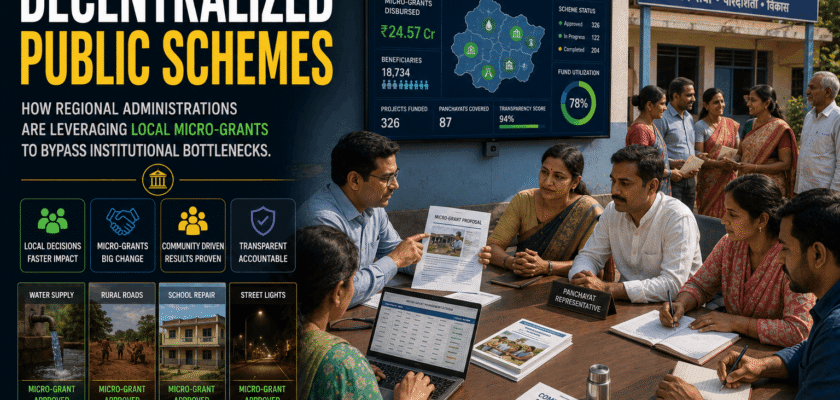
Decentralized Public Schemes: Why Local Micro-Grants Are Becoming Politically Important
Decentralized public schemes are becoming important because large government programs often move slowly through approvals, paperwork, departmental layers, and one-size-fits-all rules. Citizens, however, usually need small and practical fixes: a broken drain repaired, a community water point upgraded, a school lab improved, a local health camp organized, or a women-led enterprise supported quickly.
This is where local micro-grants can change public delivery. A micro-grant is a small, targeted fund given to a local body, community group, school, ward committee, panchayat, civil society group, or neighbourhood initiative for a specific problem. The amount may be small compared with big infrastructure budgets, but the speed and local fit can be powerful.
In 2026, the idea matters even more because regional administrations are under pressure to deliver visible results without waiting for slow institutional pipelines. The Ministry of Panchayati Raj has reported that Finance Commission grants for rural local bodies for 2026-31 include a very large allocation, with basic and tied grants supporting panchayats. At the same time, public discussions around local governance show that tied funds and weak autonomy can restrict local decision-making. These two realities explain why decentralization and micro-grants are now central governance questions.
What Are Decentralized Public Schemes?
Decentralized public schemes are government or public-development programs where decision-making, planning, and execution are moved closer to local communities. Instead of every small decision being controlled from a central office, local administrations get more power to identify needs and use funds.
These schemes may work through panchayats, municipalities, ward committees, district administrations, local NGOs, self-help groups, community organizations, and school or health committees.
- The goal is local problem-solving.
- The process is faster than waiting for a large department.
- The spending is usually small but targeted.
- The accountability should stay close to citizens.
- The outcome is easier to inspect on the ground.
In simple words, decentralization means the people closest to the problem get more power to solve it.
Why Local Micro-Grants Matter
Local micro-grants matter because many public problems are too small for big schemes but too important for citizens to ignore. A village road repair, a school drinking-water filter, a sanitation awareness drive, a local startup training camp, or a ward-level waste collection improvement may not need a massive project file. It needs quick approval, local ownership, and transparent spending.
Micro-grants help because they reduce the gap between problem identification and action. They can also support community participation because local people understand the issue and can monitor progress directly.
- They support small but visible civic improvements.
- They reduce dependence on slow departmental approvals.
- They let local bodies test ideas before scaling.
- They can include women, youth, farmers, students, and small entrepreneurs.
- They make local governance more responsive.
The Institutional Bottleneck Problem
Institutional bottlenecks happen when public schemes get stuck inside approval chains, rigid guidelines, funding delays, staff shortages, or poor coordination between departments. These bottlenecks do not always come from corruption. Sometimes they come from over-centralized design and weak local capacity.
A local leader may know that the urgent need is a streetlight, but the available fund may be tied to another category. A panchayat may receive money but lack technical staff to prepare project documents. A municipal body may have a good idea but fail to prepare a bankable proposal for competitive funding. This creates the classic governance problem: money exists, need exists, but execution is delayed.
Local micro-grants can bypass some of this delay by giving small, rule-based, quick-release funds for locally approved priorities.
Why Tied Funds Create Local Frustration
Tied funds are grants that must be spent only on fixed categories such as water, sanitation, or specific infrastructure. Tied funds are useful when governments want to protect essential priorities. But they can become frustrating when local needs are different.
For example, a village may already have decent water coverage but urgently need road repair. If most available money is tied to water and sanitation, the local body may not be able to solve the visible problem citizens care about. This is why flexibility is important.
A healthy public finance model should balance two things: national priorities and local flexibility. Micro-grants can provide that flexible layer.
How Regional Administrations Use Micro-Grants
Regional administrations can use local micro-grants in many ways. The best model is simple: define eligible project types, set a small funding limit, create a transparent approval process, require public disclosure, and verify outcomes.
- Ward-level civic repair grants
- Panchayat innovation grants
- School improvement micro-grants
- Women self-help group livelihood grants
- Youth skill and startup grants
- Local climate resilience grants
- Community health awareness grants
- Small urban safety improvement grants
- Village digital service grants
- Neighbourhood waste-management grants
This approach can make governance feel closer, faster, and more practical.
Global Micro-Grant Lessons
The micro-grant model is not only an Indian idea. UNDP and GEF Small Grants Programme calls in 2026 show how small grants can support community organizations, NGOs, research institutions, women, youth, indigenous communities, and vulnerable groups for local sustainable development. In Ghana, for example, the GEF-SGP call mentioned awards up to US$30,000 for civil society and community-based groups working on environmental priorities.
These examples show that small grants can be powerful when they are linked to local action, community monitoring, and clear project goals. The principle is the same across countries: small money can solve real problems when local actors own the work.
India’s Local Governance Context
India has a large local governance structure through gram panchayats, block panchayats, district panchayats, urban local bodies, and state departments. Finance Commission grants are a major funding channel for local bodies. The Ministry of Panchayati Raj reported details for 2026-31 rural local body grants, with basic and tied grants as key components.
This matters because India does not lack local needs. The challenge is matching funds, authority, skills, and accountability at the correct level. Local micro-grants can act as a bridge between big schemes and small needs.
For India, the model should not replace major public schemes. It should complement them.
Decentralized Public Schemes and Political Trust
Decentralized public schemes can increase political trust because citizens judge government by daily experience. People may not read budget documents, but they notice whether streetlights work, drains are cleaned, schools improve, and health camps happen on time.
When small problems are solved quickly, citizens feel the administration is listening. When small issues stay unresolved for years, even large announcements lose credibility.
That is why micro-grants are politically powerful. They create visible delivery.
Micro-Grants for Panchayats
Panchayats can use micro-grants to solve local problems that do not require large capital projects. This can include school repairs, community toilets, water-point maintenance, local digital boards, drainage improvements, village cleanliness drives, women’s livelihood equipment, and small climate-resilience projects.
However, panchayat micro-grants need guardrails. Local bodies should publish project names, budgets, timelines, vendor details, photos, and completion status. Citizens should be able to see where the money went.
Micro-Grants for Urban Local Bodies
Urban local bodies can use micro-grants for ward-level issues. A ward councillor or local committee may support small street repairs, safe pedestrian crossings, waste bins, public benches, community libraries, local sports areas, or safety lighting.
Urban governance often suffers because big projects take attention while small civic issues remain pending. A ward-level micro-grant model can give cities a faster repair and innovation tool.
Micro-Grants for Women and Youth
Micro-grants can also support women and youth-led development. Self-help groups, student groups, skill centres, local entrepreneurs, and youth clubs can use small grants to test ideas.
- Women-led food processing units
- Local tailoring and digital service centres
- Youth sports and anti-drug campaigns
- Student climate clubs
- Girls’ digital literacy projects
- Community nutrition awareness
- Local tourism guide training
- Rural maker labs
- Street vendor support tools
- Micro-enterprise pilots
This gives politics a development face. Instead of only promising jobs, administrations can support small local enterprise creation.
Micro-Grants for Climate and Environment
Local climate problems need local solutions. Heatwaves, flooding, waste, water stress, and air pollution often show up differently in every village and ward. A central plan cannot identify every drain blockage, unsafe water point, or heat-risk zone.
Climate micro-grants can support tree shade projects, rainwater harvesting repairs, local composting, school climate clubs, flood-warning boards, water quality testing, and heat shelters.
This aligns with the global small-grants principle: communities can protect ecosystems and improve resilience when funding reaches them directly.
Digital Transparency Is Essential
Micro-grants can fail if transparency is weak. Small grants are easier to misuse when records are unclear. So every micro-grant program should use simple digital disclosure.
- Project title
- Location
- Approved amount
- Responsible person
- Start date
- Completion deadline
- Before and after photos
- Payment status
- Public feedback option
- Audit status
The system does not need to be complicated. A simple public dashboard can improve trust.
Why Micro-Grants Need Social Audit
Social audit means citizens can verify whether the work was actually done. This is important because local development funds must remain accountable.
A social audit can include public meetings, notice boards, photo evidence, beneficiary lists, local inspection, and feedback forms. For small projects, social audit can be faster than large bureaucratic inspection.
The best micro-grant model combines trust with verification.
Risks of Local Micro-Grants
Local micro-grants are useful, but they are not risk-free. If poorly designed, they can become political favour tools, duplicate existing schemes, fund low-quality work, or create local capture by powerful groups.
- Political bias in selection
- Fake community groups
- Weak documentation
- Low-quality work
- Duplicate funding
- No maintenance plan
- No audit trail
- Capture by local elites
- Fragmented spending
- No measurable impact
That is why clear rules and public disclosure are important.
How to Design a Strong Micro-Grant Scheme
A strong micro-grant scheme should be simple enough for local participation but strict enough to prevent misuse.
- Set a clear maximum grant size
- Define eligible project categories
- Use local needs assessment
- Require community contribution where possible
- Publish all approved projects
- Use milestone-based payments
- Add photo and geo-tag proof
- Conduct random audits
- Reserve funds for women/youth-led ideas
- Evaluate impact before scaling
This makes the scheme practical, transparent, and politically defensible.
Why Micro-Grants Should Not Replace Big Schemes
Micro-grants are not a replacement for roads, hospitals, public transport, irrigation networks, or large housing programs. Big infrastructure still needs major budgets and technical planning.
Micro-grants should fill the gap between citizen needs and large schemes. They are best for small repairs, pilots, awareness programs, local innovations, and community-led improvements.
The correct model is not micro-grants versus big schemes. It is micro-grants plus big schemes.
What Citizens Should Demand
Citizens should demand transparency and participation. A local micro-grant program works only when people know how to apply, how selection happens, and how spending is tracked.
- Public application window
- Clear eligibility rules
- Open project list
- Ward or panchayat meeting
- Simple complaint option
- Photo proof of work
- Citizen feedback before final payment
- Annual public report
When citizens can see the process, trust improves.
What Regional Administrations Should Do Next
Regional administrations should use micro-grants as a delivery accelerator. They should identify bottleneck areas where small funds can produce fast, visible improvements.
Priority areas can include sanitation, local roads, school facilities, women-led livelihood pilots, digital literacy, waste management, health awareness, local tourism, climate adaptation, and youth innovation.
The key is not only releasing money. The key is building a repeatable system that is fast, fair, and auditable.
Final Verdict
Decentralized public schemes are becoming important because citizens want faster, more local, and more visible governance. Large schemes remain essential, but they often move slowly through institutional bottlenecks. Local micro-grants can fill the missing middle.
When designed well, micro-grants can help panchayats, municipalities, community groups, women, youth, and local innovators solve small but meaningful problems quickly. They can also increase political trust because citizens see direct action in their own neighbourhoods.
But the model needs transparency, social audit, digital disclosure, and clear eligibility rules. Without these, micro-grants can become fragmented or politically captured.
In simple words, decentralized public schemes work best when local people get power, small funds move fast, and every rupee is visible to the public.


