
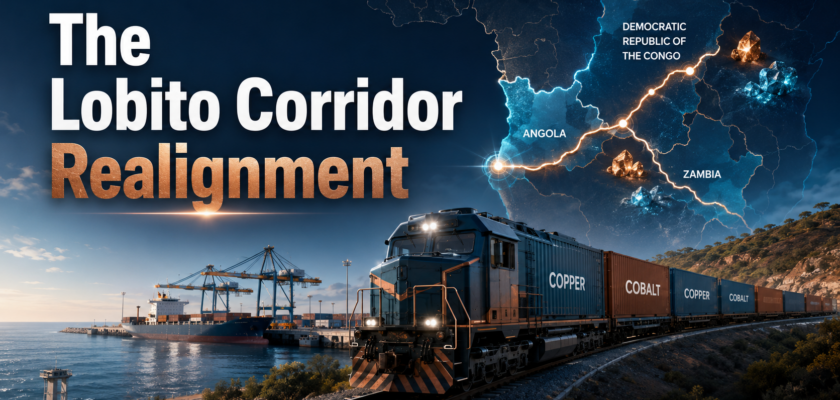
Lobito corridor copper transit updates 2026 are now bigger than rail news.
They show a new race for cleaner, faster, and safer mineral movement.
The corridor links Angola, the Democratic Republic of the Congo, and Zambia.
It connects copper and cobalt zones to the Atlantic Port of Lobito.
That makes it a serious route for Western buyers, battery firms, and policy planners.
So, this is not only a train story. It is a supply-chain story.
It is also a geopolitical story with real market impact.
Why Lobito corridor copper transit updates 2026 matter now
The Lobito Corridor is gaining attention because mineral routes are changing fast.
For years, many Central African exports moved through longer eastern or southern routes.
Now, the Atlantic route is becoming more useful for global buyers.
The reason is simple. Speed and predictability matter.
When copper or cobalt gets stuck, battery plants feel the delay.
When shipping costs rise, traders lose margin.
Therefore, a shorter rail path can become a strategic advantage.
| �� Quick TakeThe Lobito Corridor is becoming a mineral logistics shield. It may lower transit risk, but only if governance, customs, rail capacity, and border coordination improve together. |
What the Lobito Corridor actually connects
The corridor begins near the Atlantic coast of Angola.
Then it runs inland through the Benguela rail system.
From there, it links toward mineral-heavy areas in the DRC and Zambia.
These regions are important because they hold key transition minerals.
Copper supports grids, wiring, electric vehicles, and data centers.
Cobalt supports battery supply chains and industrial storage systems.
Also, lithium and nickel are part of the wider regional mineral debate.
This is why global industrial shipping security channels now include rail, ports, border posts, and customs data.
The new “defense” idea: protect the route, not just the mine
Old mineral policy focused mainly on mines.
However, 2026 has made one thing clear.
A mineral is only useful when it reaches the buyer on time.
So, governments and investors now look at the full path.
They study rail links, port capacity, road backup, customs systems, and cargo tracking.
This is why the word “defense” fits the corridor.
It means defending the flow of essential goods from disruption.
It also means reducing overdependence on one route, one port, or one buyer network.
Why Western hubs are watching this route
The United States and Europe want more resilient mineral supply chains.
They also want supply lines with clearer rules and better transparency.
The Lobito route helps that goal because it opens an Atlantic-facing option.
That matters for buyers in Europe and North America.
It may reduce pressure on older routes that already face congestion and political risk.
At the same time, African governments want more than raw export traffic.
They want jobs, local processing, logistics income, and stronger regional trade.
That balance will decide whether the corridor becomes a development project or just another extraction lane.
Critical minerals are driving the policy shift
Many readers search for critical rare earth supply chain treaties with this topic.
That phrase is useful for SEO, but it needs a clear note.
The Lobito story is mainly about copper, cobalt, and related transition minerals.
These are critical minerals, not all rare earth minerals.
Still, the policy logic is similar.
Countries want stable access to materials that power batteries, grids, and clean industry.
They also want trusted routes for defense production, cloud infrastructure, and advanced manufacturing.
Customs reform could be as important as rail
A railway can move fast, but paperwork can slow everything down.
That is why customs reform is now part of the Lobito conversation.
Better border systems can reduce waiting time.
Clear rules can also lower surprise costs for exporters.
In 2026, the DRC launched a Lobito Corridor Programme focused on trade systems.
That includes customs procedures, regulatory coordination, and institutional capacity.
These soft reforms can make the corridor more bankable.
They can also make cargo movement easier to audit.
The rail corridor still has hard problems
The Lobito Corridor has strong promise, but it is not risk-free.
Rail capacity must grow in a steady way.
Border agencies must coordinate across three countries.
Financing must remain transparent.
Local communities must see real benefits.
Also, environmental and human rights standards must stay visible.
Without these steps, the corridor could face delays and public resistance.
That is why governance is not a side issue. It is the core issue.
How traders may read the 2026 realignment
For commodity traders, the route adds optionality.
Optionality means exporters can avoid relying on only one path.
When one port gets crowded, another route can protect schedules.
When regional instability rises, a more diversified network can reduce shock.
This can support better delivery planning for copper and cobalt buyers.
However, traders will still watch costs, insurance, loading speed, and rail reliability.
They will also watch whether freight volumes grow beyond early milestones.
What this means for Africa
The best version of this project is not only about Western supply security.
It should also support African value creation.
That means local suppliers should get contracts.
Workers should get skills and safer jobs.
Small businesses near the route should benefit from better movement.
Farmers should get access to wider markets.
And mineral producers should see more options for domestic processing.
If that happens, the corridor can become a development engine.
Investor signals to watch next
The next phase will depend on a few clear signals.
- ✅ Rail traffic must keep rising without repeated stoppages.
- ✅ Zambia-linked road and rail upgrades must move from promise to execution.
- ✅ Customs reform should reduce border friction.
- ✅ Financing must stay transparent and easy to track.
- ✅ Local value addition should grow with the corridor.
- ✅ ESG and community safeguards should remain measurable.
The simple takeaway
Lobito corridor copper transit updates 2026 show a bigger shift in global trade.
Mineral security is no longer only about who owns the mine.
It is also about who can move the mineral safely, quickly, and fairly.
The Lobito Corridor gives Angola, DRC, and Zambia a stronger Atlantic option.
It also gives Western hubs a new way to diversify supply chains.
Still, success is not automatic.
The corridor must prove that it can carry freight, reduce delays, and create local value.
If it does, Lobito may become one of the most important mineral routes of this decade.


