
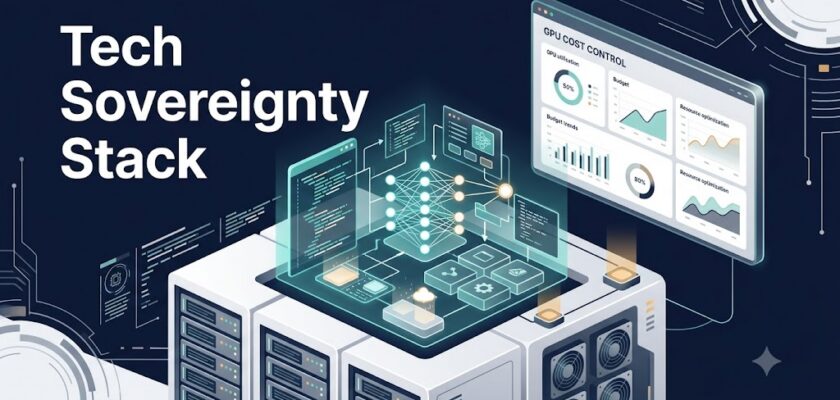
Achieving Technological Sovereignty: How Global Enterprise Networks Leverage Open-Source Architectures to Bypass GPU Hegemony
International Technology Congress ITC 2026 is putting one clear idea in front of global enterprises. AI power is no longer only about bigger models. It is also about who controls the software stack, data flow, and compute bill.
For years, many firms treated AI as a cloud service. That was easy at first. However, the cost of large-scale inference is now a boardroom issue.
So, more teams are asking a new question. Can open-source architectures reduce GPU lock-in without slowing AI work?
| ✅ Quick AnswerOpen-source AI does not remove the need for GPUs.However, it can reduce vendor lock-in.It can also improve portability across cloud, edge, and private data centers.That is why sovereign AI software deployment systems now matter. |
International Technology Congress ITC 2026: Why This Story Matters
International Technology Congress ITC 2026 is scheduled for 8-10 September in the Moscow Region. Reports say more than 5,000 delegates from over 40 countries may attend.
The event also links technology policy with industrial exports. More than 300 organizations are expected to show solutions.
Most importantly, sessions are expected to cover technological sovereignty. They will also discuss open architectures and open-source software.
That makes this event useful for enterprise readers. It shows where AI infrastructure debate is moving next.
Why GPU Hegemony Became a Boardroom Risk
Modern AI still depends heavily on GPUs. Training, fine-tuning, and inference all need strong compute.
The OECD says GPUs are currently the most used chips for AI tasks in data centers. It also notes that the AI GPU market is highly concentrated.
This concentration creates three business risks.
First, hardware may become expensive or hard to access. Second, the software layer may lock teams into one ecosystem. Third, cloud bills may become harder to predict.
Therefore, enterprises are not only buying more GPUs. They are also trying to use every GPU more wisely.
What Open-Source Architectures Change
Open-source architectures give companies more control over how AI runs.
A team can use open models, open serving tools, open standards, and portable containers. Then it can move workloads between cloud, private data centers, and edge locations.
This shift does not mean every company should build its own giant model.
Instead, it means companies can own more of the operating layer. They can tune models for local needs. They can also audit data flows more clearly.
The Linux Foundation has linked open source with sovereign AI because it supports transparency, security, customization, vendor independence, and cost control.
How Enterprises Reduce Data Center Cloud Compute Overheads
Cost control starts with model choice.
Not every task needs the biggest model. Many support, search, coding, and internal workflow tasks can run on smaller models.
Next, teams can use optimized inference engines. Tools such as vLLM-style serving, batching, caching, quantization, and routing can increase output per GPU.
Then, teams can separate workloads by risk.
Sensitive jobs may run in a private or sovereign zone. Lower-risk jobs may run on public cloud. Edge tasks may run closer to users.
As a result, the enterprise gets a mixed compute plan. It pays premium rates only when the work truly needs them.
The Portugal Example Shows the Direction
The open-source sovereignty shift is already visible in Europe.
Reuters reported that Portugal launched its first open-source AI model, Amalia, on July 1, 2026. The model supports public institutions, companies, universities, and researchers.
The project also uses high-performance computing access. This matters because sovereign AI needs both software control and real compute access.
For enterprises, the lesson is simple. Open source can support local innovation, but it still needs a serious infrastructure plan.
Where The Risk Still Lives
Open source is not magic.
Teams still need strong security checks. They must review model licenses, training data limits, and update cycles.
They also need skilled engineers. A poorly managed open stack can create new risks.
Therefore, the best strategy is not “cloud versus open source.” It is a smart blend.
Use open systems where control matters. Use managed services where speed matters. Keep clear rules for both.
Practical Enterprise Checklist
✅ Map every AI workload by data sensitivity.
✅ Choose smaller models for simple tasks first.
✅ Use open standards for containers and deployment.
✅ Track GPU usage before buying more capacity.
✅ Add AI gateways for policy and cost control.
✅ Keep audit logs for model, prompt, and output paths.
✅ Review licensing before production use.
✅ Train internal teams on open-source AI operations.
Final Takeaway: International Technology Congress ITC 2026
International Technology Congress ITC 2026 shows a bigger shift in enterprise AI.
Companies are moving from rented intelligence to controlled intelligence. They want models, data, and compute to work on their terms.
Open-source architectures help this shift. They reduce lock-in. They support sovereign AI software deployment systems. They can also lower cloud compute overheads when used with discipline.
Still, the goal is not to bypass every GPU. The real goal is to bypass dependency on one narrow path.
That is the new meaning of technological sovereignty.


