
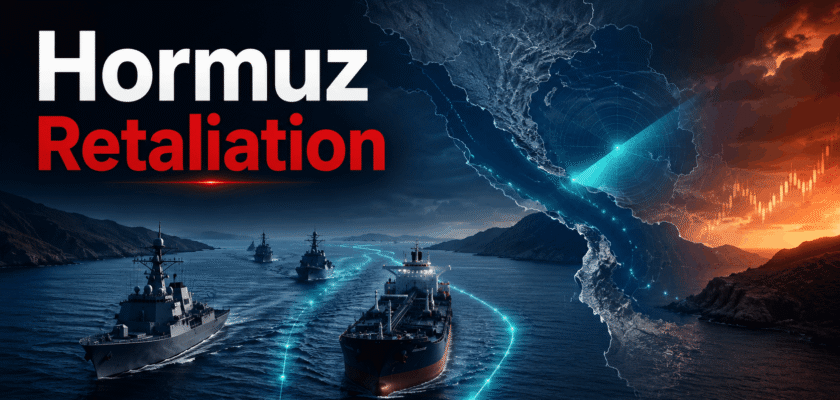
US airstrikes on Iranian targets June July 2026: what changed now
US airstrikes on Iranian targets June July 2026 have pushed West Asia back into a dangerous zone.
The latest escalation centers on the Strait of Hormuz.
Reports say three commercial vessels were attacked near the vital shipping lane.
After that, the US military carried out a new strike wave.
US Central Command said the operation hit over 80 targets.
These included radars, air defense systems, and small IRGC boats.
As a result, traders and diplomats are watching the region again.
Why the Strait of Hormuz matters so much
The Strait of Hormuz is not just another sea route.
It is one of the world’s most sensitive energy corridors.
Oil, LNG, and commercial cargo move through this narrow passage.
So, even a short disruption can affect global prices.
This is why Strait of Hormuz maritime shipping lane security updates matter daily.
A vessel attack here can quickly become an energy-market signal.
It can also become a military signal for rival powers.
What the US says about the retaliation
The US has framed the strikes as a response to attacks on commercial shipping.
Officials said the action was meant to impose costs.
They also said it was aimed at protecting crews in an international waterway.
The target list was wide but still focused on military capacity.
Reported targets included coastal radar and anti-ship systems.
More than 60 small boats linked to the IRGC were also struck.
That detail matters because small boats are often used to pressure passing vessels.
Iran’s reaction and the risk of a wider conflict
Iran has rejected the US action and called it aggression.
Iranian officials also warned of a strong response.
That keeps the situation unstable.
The danger is not only one strike or one counterstrike.
The bigger danger is a cycle of action and reaction.
If that cycle grows, nearby Gulf states may face pressure too.
Therefore, the next 48 to 72 hours could shape the market mood.
How shipping risk moved from local issue to global concern
Shipping risk becomes global when insurance, route planning, and fuel cost change together.
A tanker owner may wait before entering the lane.
An insurer may raise the war-risk premium.
A buyer may search for a safer cargo source.
Then, the cost moves from the sea lane to the final market.
This is why maritime security is now a trade story.
It is also an inflation story for import-heavy economies.
The three pressure points to watch
First, watch whether commercial ships keep moving safely.
Second, watch whether oil and LNG cargoes face delays.
Third, watch whether fresh military alerts spread to nearby bases.
These points can show if the crisis is cooling or widening.
Global energy index response to regional conflict
The global energy index response to regional conflict can be fast.
In this case, oil prices moved higher after the latest escalation.
That reaction was not only about one damaged vessel.
It was about fear of a larger supply shock.
Markets price risk before the full damage is known.
So, headlines from Hormuz can move energy stocks, currencies, and freight costs.
If the route stays open, panic may cool quickly.
However, if attacks continue, the risk premium can return.
Why oil sanctions also matter in this story
The US also moved on Iranian oil permissions.
That step added another layer to the conflict.
Military pressure affects security.
Sanctions pressure affects revenue and supply.
Together, they can make negotiations harder.
They can also make oil traders more nervous.
So, the Hormuz story is not only about missiles.
It is also about money, exports, and leverage.
What this means for India and Asia
Asia watches Hormuz very closely.
Large Asian economies depend on Gulf energy flows.
India, China, Japan, and South Korea can feel price pressure quickly.
For India, crude oil costs affect fuel, freight, and inflation expectations.
A longer crisis may also affect aviation fuel and shipping rates.
That is why Indian readers should track both energy prices and maritime advisories.
Even if supply continues, uncertainty can raise costs.
How investors may read this volatility
Investors usually react in layers.
First, they watch crude oil prices.
Next, they watch energy stocks and shipping companies.
Then, they look at airlines, paint companies, logistics firms, and currency moves.
A short shock may only create temporary volatility.
A long shock can affect margins across many sectors.
That is why the market response should not be judged from one candle.
The trend over several sessions matters more.
The diplomatic test after the strikes
The hardest question is whether diplomacy can still hold.
A fragile understanding can survive one breach.
But repeated ship attacks and retaliatory strikes weaken trust.
The US wants freedom of navigation.
Iran wants control and leverage in the strait.
Gulf states want safety for tankers and LNG cargoes.
These goals are not easy to balance.
So, diplomacy now has less room for error.
What readers should track next
Readers should track official maritime alerts first.
They should also watch Brent crude, WTI crude, and LNG headlines.
Next, they should watch statements from the US, Iran, Qatar, Oman, and Gulf security agencies.
Finally, they should watch whether shipping lanes remain open without new attacks.
If vessels move normally, markets may calm.
If more vessels are hit, the story can become much larger.
That is the key difference now.
Final thoughts on US airstrikes on Iranian targets June July 2026
US airstrikes on Iranian targets June July 2026 are now a major geopolitical trigger.
The strike wave shows how quickly a shipping incident can become a regional crisis.
It also shows why Hormuz remains central to global energy security.
For readers, the main point is simple.
Watch the ships, not only the speeches.
If commercial traffic remains safe, the shock may ease.
But if attacks continue, volatility can spread across energy, trade, and diplomacy.
That is why this Hormuz retaliation deserves close attention.
| ✅ Key Takeaways✓ The crisis began with fresh attacks on commercial vessels near Hormuz.✓ The US response reportedly hit over 80 Iranian targets.✓ Shipping safety is now tied directly to oil and LNG market confidence.✓ Asia, including India, remains highly exposed to Hormuz energy flows.✓ This is a fast-moving story, so official updates should be checked before publishing. |


