
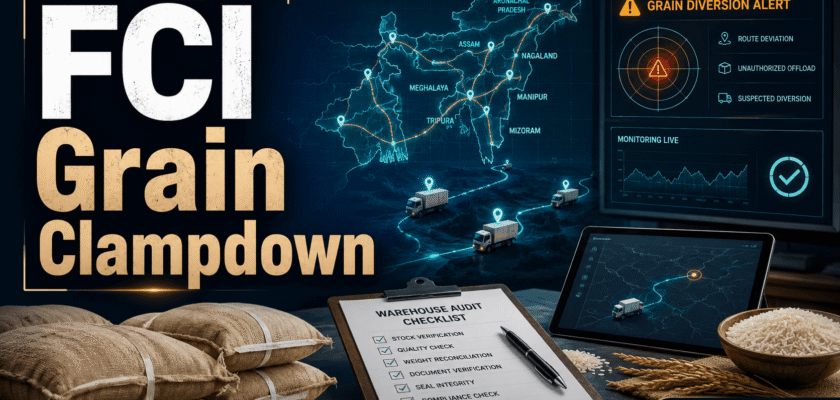
Supply Chain Leakage Clampdown: How FCI’s Mega Suspension Wave Over North-East Grain Diversion Restructures Bulk Food Distribution
| ✅ Publish-Safe News NoteThis article uses alleged/probe language. Suspensions are not convictions. Final liability depends on official inquiry findings. |
Food Corporation of India senior official suspensions 2026 have turned a food logistics probe into a bigger supply-chain warning for India. The issue is not only about one rice sale. It is also about how bulk grain moves, who signs the release, and how each truck is tracked after it leaves a depot.
The reported North-East grain diversion case shows why India needs cleaner food movement data. It also shows why public distribution routes must be protected from manual gaps, weak approvals, and unclear end-use checks.
Food Corporation of India senior official suspensions 2026: what happened?
According to reported details, five senior Food Corporation of India officials were suspended after alleged irregularities in the sale of rice meant for public distribution in North-Eastern states.
The case reportedly involves rice sale to NERAMAC under the Open Market Sale Scheme (Domestic). The issue under review is whether rice was issued without the right auction route and then allegedly diverted away from its intended public purpose.
Also, NERAMAC had earlier suspended two officials linked to the same matter. Therefore, the probe is now larger than one office file. It reaches procurement, depot release, route tracking, buyer checks, and end-use proof.
| ✅ Key Fact Box✓ Five senior FCI officials were reported suspended. ✓ One suspended officer was Executive Director rank. ✓ The matter relates to alleged rice diversion for North-East public distribution. ✓ NERAMAC officials were also suspended earlier. ✓ The case is still a probe, not a final conviction. |
Why this matters for bulk food distribution
Food grain distribution is one of India’s most sensitive supply chains. A small leak can affect ration availability, state-level planning, and trust in welfare delivery.
FCI handles purchase, storage, movement, distribution, and sale of foodgrains on behalf of the government. Because of this role, any alleged diversion can raise questions across the full bulk-food chain.
For North-East states, the risk is even sharper. Terrain, rail dependency, road gaps, and long transit routes already make food movement complex. Therefore, every release order needs clear tracking from depot to final destination.
Where leakage can enter the chain
Leakage does not always start at the last shop. It can begin much earlier, especially when bulk rice changes hands between depots, buyers, transporters, and agencies.
- Weak buyer verification before depot release.
- Manual release orders with poor digital trail.
- Truck movement without live route visibility.
- Missing destination godown confirmation.
- Stock issue outside the stated policy route.
- Delayed audit alerts after grain has already moved.
That is why the FCI suspension case is important for the food sector. It gives a clear signal that paper-based trust is not enough for modern grain logistics.
How FCI’s wider safeguards are changing
The wider response is already visible. Recent reports say FCI has tightened safeguards for subsidised rice supplied to distilleries under the ethanol programme. Distilleries may face criminal action if released rice is misused or diverted.
The new operational guidance also stresses vehicle details, destination godowns, authorised representatives, and first-in-first-out stock issue. These are not small paperwork changes. They are basic controls for bulk food traceability.
The software gap in public grain logistics
India does not only need more audits. It needs faster alerts before leakage becomes a loss. Bulk food grain logistics tracking software can help by joining depot, vehicle, buyer, route, warehouse, and receipt data in one screen.
For example, a dashboard should flag a rice dispatch if the buyer is not allowed under the policy route. It should also alert officials if the vehicle stops too long, changes route, or reaches a different warehouse.
A smarter tracking stack should include
- QR-coded release orders for every bulk movement.
- GPS-linked truck movement from depot to godown.
- Digital buyer KYC and authorisation checks.
- E-auction or policy route validation before issue.
- Geo-tagged warehouse receipt confirmation.
- Auto alerts for route diversion and delayed unloading.
- Role-based officer approval logs for every stock release.
Why the North-East route needs special care
North-East food routes often need more resilience than standard routes. Weather, distance, hill roads, border-state complexity, and logistics cost can delay deliveries.
So, a one-size-fits-all audit model may not work. Authorities need special region-level dashboards for stock availability, transit time, depot pressure, and route risk.
Also, recipient agencies should confirm end-use faster. This can reduce the gap between stock issue and stock arrival. That gap is where diversion risk can grow.
| ✅ Practical Reform BoxFor bulk food distribution, the best reform is simple: no release without digital proof, no route without live tracking, and no closure without destination confirmation. |
Impact on private bulk food buyers
This case also sends a message to private buyers and institutional users. Any buyer using subsidised or public-system grain must maintain clean records.
That includes buyer identity, truck registration, end-use declaration, invoice trail, warehouse proof, and consumption records. If the grain is for a specific purpose, the end-use must match the release order.
Therefore, food processors, distilleries, warehouses, and transport partners should review their compliance systems now. A missing document can create a serious risk later.
What food businesses can learn
Cloud kitchens and small food brands may not deal with FCI rice directly. Still, they can learn from this case. Food supply chains fail when records, routes, and responsibility are split across too many hands.
- Keep supplier bills and batch records in one folder.
- Track delivery partners and warehouse partners clearly.
- Use digital stock logs for high-volume ingredients.
- Avoid informal bulk buying with unclear source documents.
- Check vendor GST, FSSAI, and transport records often.
Conclusion
Food Corporation of India senior official suspensions 2026 show why India’s food logistics system needs sharper digital controls. The North-East grain diversion probe is not just a disciplinary story. It is a warning about weak links in bulk food movement.
Going forward, every depot release should carry digital proof. Every truck should be traceable. Every buyer should be verified. And every destination should close the loop with a clear receipt.
If this happens, India can reduce leakage and protect public food security. More importantly, it can make bulk food distribution faster, cleaner, and more trusted.


