


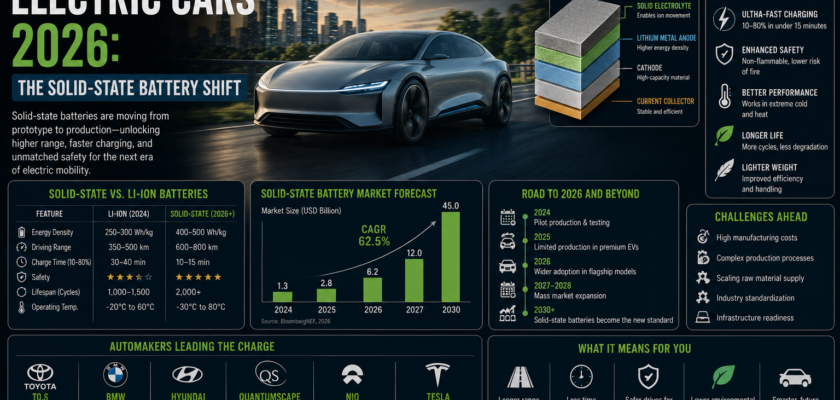
The Solid-State Battery Shift: Why Mainstream Automakers Are Phasing Out Lithium-Ion by 2028.
The electric vehicle (EV) sector is fast approaching an insurmountable physical wall. For over a decade, liquid-electrolyte lithium-ion battery chemistry served as the undisputed champion of the EV revolution, single-handedly powering the transition from compliance cars to mainstream crossovers. Yet, as we push through May 2026, the automotive engineering landscape openly acknowledges that standard lithium-ion packs have been optimized to their theoretical maximum limits. Automakers can no longer wring significant range extension or charging speed advancements out of liquid cells without making vehicles unacceptably heavy, bulky, and structurally volatile.
The industry’s collective gaze has definitively shifted to what lies beyond. We have officially entered the preparatory phase of the next great automotive evolution: the wholesale transition to solid-state architecture.
By completely swapping out the flammable, unstable liquid electrolyte found in today’s cars and replacing it with a dense ceramic, polymer, or sulfide-based solid medium, next-generation platforms are unlocking performance parameters once deemed impossible.
With major automotive groups locking in their factory conversions, the solid-state battery production timeline dictates that while 2026 serves as the year of final extreme validation, 2028 will mark the commercial tipping point where legacy liquid batteries begin their permanent phase-out in premium segments.
1. The Volumetric Leap: Why Liquid Batteries are Fading
The core issue forcing the decline of lithium-ion technology is its fundamentally limited energy density. Traditional liquid cells generally top out below a energy capacity threshold of 300 Wh/kg. Because liquid electrolytes require thick physical separators to keep the anode and cathode from touching and short-circuiting, a massive portion of the battery pack’s volume is dead weight that stores absolutely no electricity.
                     [ The Battery Structural Leap ]
                                    │
         ┌──────────────────────────┴──────────────────────────┐
         ▼                                                     ▼
┌─────────────────────────────────┐               ┌─────────────────────────────────┐
│  Legacy Liquid Lithium-Ion      │               │  Next-Gen All-Solid-State       │
│ ❌ Flammable Liquid Electrolyte  │               │ ✅ Non-Flammable Ceramic/Sulfide │
│ ❌ Volatile Thermal Runaway Risk │               │ ✅ Intrinsic Structural Safety   │
│ ❌ Thick, Volumetric Separators  │               │ ✅ Dense Bipolar Cell Stacking   │
│ ❌ Maxes Out Below 300 Wh/kg    │               │ ✅ Exceeds 400 to 500 Wh/kg     │
└─────────────────────────────────┘               └─────────────────────────────────┘
         │                                                     │
         └──────────────────────────┬──────────────────────────┘
                                    ▼
                      [ The Driveway Performance ]
         (1,200+ Kilometer Range Realized ──► 10-Minute Rapid Top-Ups)
Solid-state cells dismantle this restriction entirely. By removing the liquid solution, engineers can utilize an ultra-thin solid electrolyte layer that doubles as the separator, enabling cells to be stacked directly on top of one another in a dense, bipolar arrangement.
Furthermore, this solid barrier allows the integration of pure lithium-metal anodes instead of traditional graphite, driving energy densities skyrocketing to 400 Wh/kg and even 500 Wh/kg in validated pilot runs.
For the everyday driver, this translates to a radical real-world upgrades: next-gen electric cars 2026 prototypes are demonstrating structural capacity footprints capable of delivering over 1,200 kilometers of range on a single charge, all while taking up significantly less physical space within the car’s skateboard chassis.
2. The Production Roadmap: Moving from Niche Pilots to 2028 Mass Rollouts
The global transition from chemistry labs to actual dealer lots is progressing through a meticulously scheduled, highly capital-intensive multi-phase manufacturing roadmap.
Phase 1: The Semi-Solid Bridge (2024–2026)
The industry is currently navigating the commercialization of semi-solid state variants. These hybrid packs utilize a tiny fraction of liquid wetting gel to bridge the gap between electrodes, achieving a practical mid-step energy density of roughly 300 to 360 Wh/kg. High-end production vehicles are already using these semi-solid cells to deliver over 900 kilometers of real-world endurance.
Phase 2: High-End Batch Demonstration (2027–2028)
The true paradigm shift begins as the calendar turns toward 2027 and 2028. Leading automotive names—including Toyota, BYD, and CATL—have officially locked in regulatory approvals and initial small-series production schedules for all-solid-state variants.
  [ Advanced Pilot Production ] ───► [ Initial High-End Commercialization ] ───► [ Mainstream Mass Scale ]
       • 2024-2026 Verification           • 2027-2028 Premium Launches             • 2030+ Cost Parity
       • Extreme Climate Tests            • Halo Coupes & Luxury Sedans            • Global Factory Overhauls
These highly sophisticated, zero-liquid packs will debut initially inside elite halo sports coupes and premium luxury SUVs. During this critical 2028 window, manufacturers expect to compress production costs significantly, targeting an infrastructure optimization point of $70 per kWh to bring solid-state economics on par with legacy liquid alternatives.
3. Strategic Matrix: Liquid Lithium-Ion vs. All-Solid-State Cells
| Performance Metric | Traditional Liquid Lithium-Ion Packs | Next-Gen All-Solid-State Systems (2026–2028) |
| Volumetric Energy Density | Baseline (Generally under 260–300 Wh/kg) | Exceptional (Targeting 400 to 500+ Wh/kg) |
| DC Fast-Charging Bounds | 20 to 45 minutes (Limited by heat/plating constraints) | Ultra-Fast (Supports 5C; 10% to 80% in 10 minutes) |
| Intrinsic Safety Profile | High risk of flammable thermal runaway if punctured | Absolute; solid electrolyte completely resists fires |
| Cold Weather Performance | Substantial degradation; up to 30% range drops | Highly resilient; keeps 85% efficiency at -30°C |
| Risk Characterization | High vulnerability to long-term degradation curves | Minimized Risk; zero capacity loss over 15 years |
4. Eradicating Thermal Runaway: The Intrinsic Safety Shield
Beyond the undeniable marketing allure of hyper-extended ranges and sub-10-minute fast charging, the most profound driver behind the solid-state revolution is the complete eradication of fire risk.
In a traditional vehicle accident, if a liquid lithium-ion cell experiences structural punctures or internal short-circuits, it triggers an uncontrollable chemical reaction known as thermal runaway. The volatile liquid electrolyte instantly catches fire, burning at extreme temperatures that are notoriously difficult for emergency crews to extinguish.
Solid-state battery tech completely removes this safety vulnerability. Because solid ceramic or sulfide substrates are naturally non-flammable and structurally stable, they have effortlessly sailed through the most brutal military-grade safety evaluations—including extreme nail-penetration tests, high-impact crush scenarios, and intense thermal chamber exposures without showing a single trace of flame or smoke.
This unshakeable internal safety profile means automakers can completely remove heavy, complicated cooling liquid lines, structural blast plates, and heavy thermal firewalls from the battery enclosure. By trimming this engineering dead weight out of the vehicle, car brands can further maximize aerodynamic efficiency and cabin interior comfort—proving that the ultimate path to true EV adoption lies in making cars inherently safe from the inside out.
Conclusion
The undeniable momentum mapping across the global automotive pipeline proves that the countdown to the post-lithium era has officially begun. The long-standing framework of accepting long charging delays, winter range drops, and thermal volatility as the necessary costs of driving an electric vehicle is rapidly crumbling.
By clearing away the slow, fragile, and volatile chemistry of liquid-based batteries and replacing them with transparent, rock-solid engineering matrices, mainstream automakers are establishing an uncompromised path to long-term transport sustainability.
The old abacus maze of calculating whether an EV has enough remaining capacity to survive a freezing road trip is nearing its end. As high-volume solid-state manufacturing gigafactories steadily go live ahead of the 2028 commercial breakout, they deliver an undeniable realization to the broader energy landscape: the future of clean transport doesn’t belong to those who make larger, heavier batteries, but to those who leverage advanced materials to make batteries structurally smarter, intrinsically safer, and infinitely more efficient.


