
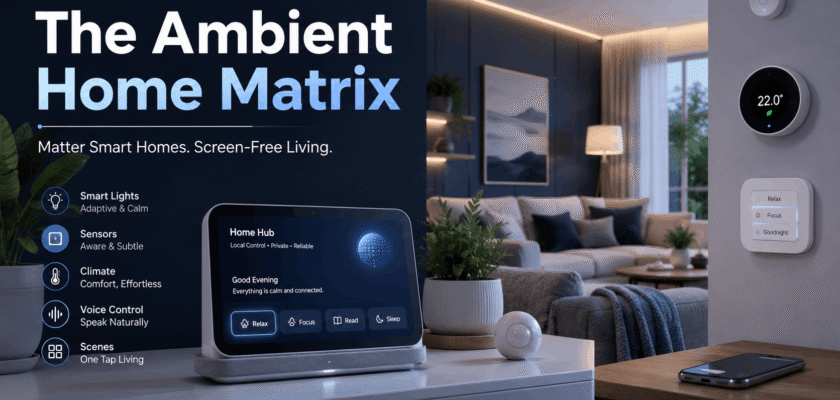
Ambient Home Matrix: Why Homes Are Going Screen-Free
Ambient home matrix is a new smart-home idea.
It means the home works quietly around you.
Also, it reduces screen checks.
Instead of opening apps, scenes run by context.
For example, lights can shift at sunset.
Then, fans can slow after bedtime.
Therefore, the home feels smart but calm.
Why Matter Makes This Shift Easier
Matter gives smart devices one common language.
It is an IP-based standard for connected homes.
Also, it supports local control as a core idea.
So, devices can work across major ecosystems.
That matters for minimalist homes.
Because one system can avoid many apps.
Important Matter 2.0 Reality Check
The title uses Matter 2.0 as a future phrase.
However, official releases show Matter 1.6 now.
Matter 1.6 adds better setup tools.
It also adds Joint Fabric support.
As a result, one home network can serve more platforms.
Still, platform support may take time.
So, buyers should check device updates first.
What Screen-Free Smart Living Means
Screen-free living does not reject technology.
Instead, it hides routine control.
You still use apps for setup.
After that, the home should need fewer taps.
This is helpful after long workdays.
Also, it can reduce attention fatigue.
Simple Screen-Free Examples
✓ Lights dim when the evening scene starts.
✓ A sensor turns on hallway lights.
✓ A button starts focus mode.
✓ A local hub runs bedtime mode.
✓ A thermostat follows a simple schedule.
✓ Voice control works for basic tasks.
Why Local Control Matters
Local control can make a home faster.
Also, it can work during internet issues.
Cloud control can still be useful.
However, every simple action should not need cloud travel.
Therefore, local scenes are better for daily comfort.
They are also better for privacy-aware homes.
| KEY TAKEAWAYThe best smart home feels quiet.It helps without asking for attention.That is the real value. |
The Role of Thread and Wi-Fi
Matter can run over several networks.
Thread helps low-power devices talk together.
Wi-Fi helps higher-power devices stay connected.
Meanwhile, Ethernet can support stable hubs.
Together, these layers build a stronger home.
Still, not every device needs every protocol.
How Joint Fabric Helps Families
Many homes use more than one platform.
One person may use Apple Home.
Another may use Google Home.
A third may use Alexa.
Joint Fabric aims to reduce that split.
In simple words, one device setup can serve more systems.
Therefore, family control may become easier.
How to Build an Ambient Home Matrix
Start with one daily pain point.
Do not automate the whole house first.
Instead, pick one room.
Then, choose one simple routine.
After that, test it for one week.
If it feels calm, expand slowly.
Best First Rooms
✓ Bedroom for sleep scenes.
✓ Kitchen for hands-free lighting.
✓ Study room for focus mode.
✓ Hallway for motion lights.
✓ Living room for evening scenes.
Best Devices for Low-Screen Control
A few devices are enough at first.
Start with a Matter hub.
Then, add smart lights.
Next, add sensors.
After that, add a smart button.
Finally, add climate control if needed.
Simple Device Stack
✓ Matter controller.
✓ Thread border router.
✓ Smart bulb or switch.
✓ Motion sensor.
✓ Door sensor.
✓ Scene button.
✓ Smart plug.
✓ Thermostat or fan control.
Reducing Screen Fatigue at Home
Screen fatigue often comes from small checks.
One tap becomes ten taps.
Then, a calm home becomes another dashboard.
Therefore, remove weak automations.
Keep only helpful scenes.
Also, keep app icons away from the home screen.
A Simple Daily Blueprint
Morning mode should be gentle.
For example, lights can rise slowly.
Then, work mode can reduce alerts.
After lunch, fresh-air mode can start.
Next, evening mode can warm the lights.
Finally, bedtime mode can shut screens down.
Privacy Rules for Smart Homes
Smart homes need trust.
So, check data settings first.
Use strong passwords.
Also, update device firmware.
Keep guest access limited.
Most importantly, avoid unknown brands for key locks.
Common Setup Mistakes
⚠ Buying devices before checking compatibility.
⚠ Using too many apps.
⚠ Automating every small action.
⚠ Ignoring local control options.
⚠ Skipping firmware updates.
⚠ Keeping noisy phone alerts on.
⚠ Using weak Wi-Fi coverage.
Best Automation Rules
Good rules should feel invisible.
They should also be easy to stop.
For example, a button should override a scene.
Also, guests should understand basic controls.
So, keep every rule simple.
If a rule causes stress, delete it.
Organic Search Summary
Ambient home matrix is about calm automation.
It uses Matter, Thread and local control.
Also, it reduces screen checks at home.
However, Matter 2.0 is not official yet.
So, buyers should plan around current Matter releases.
This keeps the setup real and useful.
Conclusion
The ambient home matrix is a lifestyle shift.
It makes smart homes feel quieter.
Also, it protects attention.
Matter can help by improving device teamwork.
Still, users should avoid over-automation.
A calm home should serve people, not screens.
Frequently Asked Questions
Q. What is the ambient home matrix?
It is a smart-home setup that runs quietly with fewer screens.
Q. Is Matter 2.0 officially released?
No confirmed official Matter 2.0 release was found.
Q. What is the latest Matter update?
CSA announced Matter 1.6 in June 2026.
Q. Can Matter reduce app clutter?
Yes, because it helps devices work across ecosystems.
Q. What should I automate first?
Start with lights, sensors and one simple room scene.
Q. Does local control improve privacy?
It can help, but device settings still matter.
Q. Should every home become fully automated?
No. Automate only what reduces effort.


