
| ⚠️ Fact-Safe Publishing Note This article explains a commissioned tracking terminal and mission-support system.It does not claim that the crewed launch date is final.The Cocos terminal is described as a support point for telemetry, tracking, and command.Any future launch schedule should be checked again before publishing live updates. |
Gaganyaan space tracking terminal Cocos Islands 2026 is more than a small space-tech update. It shows how India and Australia are turning geography into mission safety for India’s human spaceflight programme.
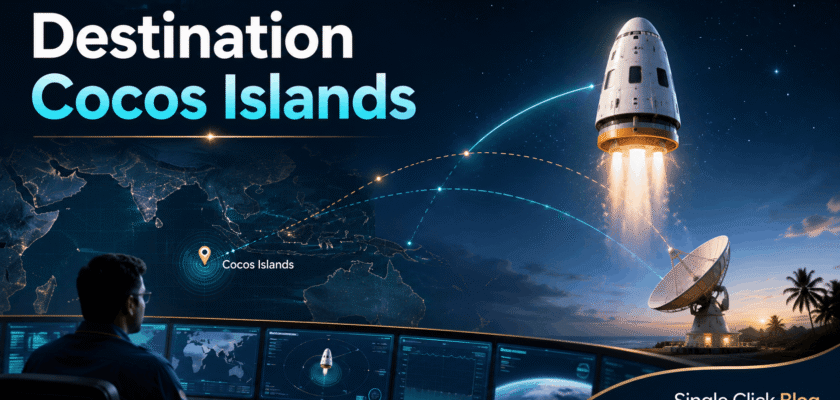
The new support point sits on the Cocos (Keeling) Islands. That location gives mission teams a useful view over the Indian Ocean region. As a result, the terminal can help track the spacecraft when clean ground contact matters most.
| ✅ Key Takeaway Australia has commissioned temporary telemetry terminals in the Cocos (Keeling) Islands for Gaganyaan support.The system can help track all four planned Gaganyaan missions mentioned by Australian authorities.ISRO describes Gaganyaan as a mission to send three crew members to a 400 km orbit for three days.The India-Australia civil space partnership is moving from policy language to working mission infrastructure. |
Why Gaganyaan Space Tracking Terminal Cocos Islands 2026 Matters
Gaganyaan space tracking terminal Cocos Islands 2026 matters because human spaceflight depends on constant awareness. A spacecraft is not only launched and watched from one place. It moves fast. It crosses visibility windows. It needs reliable ground support.
For a crewed mission, every signal has value. Telemetry can show system health. Tracking can confirm position. Command links can support planned actions and contingency workflows.
Therefore, the Cocos terminal is not just a foreign location. It is a safety layer in the wider Gaganyaan network.
What The Cocos Islands Terminal Actually Does
The terminal is linked to telemetry, tracking, and command support. In simple words, it helps mission teams hear from the spacecraft, locate it, and maintain mission contact during key flight windows.
| Telemetry | Receives health and performance data from the spacecraft. |
| Tracking | Helps confirm where the spacecraft is during its orbital path. |
| Command Support | Supports planned mission instructions during available contact windows. |
| Mission Safety | Adds another ground-support layer for human spaceflight operations. |
This is important because Gaganyaan is not a normal satellite mission. It is a human spaceflight demonstration. So reliability, redundancy, and fast response matter more than usual.
India Australia Civil Space Sector Agreements Move Into Action
India Australia civil space sector agreements have been building for years. The 2012 civil space cooperation framework was updated through a 2021 amendment. That update gave both space agencies a stronger route for specific cooperation activities.
Now, that cooperation is visible on the ground. Australia’s space agency says it worked with government agencies and Nova Systems to establish temporary telemetry terminals in the Cocos Islands.
This matters for both countries. India gets a valuable tracking location. Australia proves its role as a serious Indo-Pacific space partner. Also, Australian space firms get closer to mission-support supply chains.
| ✅ Why This Is Strategic The Cocos Islands sit in a useful Indian Ocean position.Australia has wide sky access and large tracking-support advantages.India needs reliable ground infrastructure for human spaceflight confidence.The partnership links space science, advanced manufacturing, defence-adjacent technology, and mission operations. |
How It Directs The Gaganyaan Human Flight Path
The phrase “directs the flight path” should not be read as manual driving from Australia. Instead, the Cocos site helps mission teams observe, verify, and support the spacecraft during flight.
This support can become vital when the spacecraft moves over zones where Indian ground stations may not have direct contact. Extra tracking coverage can reduce blind spots.
In human spaceflight, blind spots are not comfortable. Engineers want continuous data. Doctors want crew-condition confidence. Controllers want a clean mission picture.
That is why Gaganyaan space tracking terminal Cocos Islands 2026 is a strong technology story. It is about safe systems, not only national pride.
ISRO Human Spaceflight Program Launch Timeline: What To Know
ISRO has described Gaganyaan as a programme to demonstrate human spaceflight capability in low Earth orbit. The goal is to send three crew members to around 400 km orbit for a three-day mission and bring them back safely.
However, launch timelines can change. That is normal for human spaceflight. Before a crewed mission, uncrewed tests, parachute checks, launch vehicle reviews, life support validation, crew escape systems, and recovery planning all need strong confidence.
So readers should treat the Cocos terminal as mission readiness infrastructure. It supports the launch timeline, but it does not replace ISRO’s final readiness call.
| ✅ Simple Reader Guide Do not confuse a tracking terminal with a launch site.Cocos Islands will support tracking, not launch the mission.Gaganyaan remains an ISRO-led human spaceflight programme.Australia’s role adds geography, tracking, and mission-support depth. |
Why Cocos Islands Are So Useful For Space Tracking
The Cocos (Keeling) Islands are an Australian external territory in the Indian Ocean. For space tracking, their location can be useful because spacecraft paths do not care about national borders.
A mission needs ground stations placed across the right arc. If one region cannot see the spacecraft, another station may help keep the data chain alive.
That is why countries often use global ground networks. Human spaceflight makes this even more important. The margin for delay becomes smaller, and mission teams prefer more visibility.
What This Means For India’s Space Technology Stack
For India, the biggest message is scale. Gaganyaan is building a full human-spaceflight stack. It needs a human-rated launch vehicle, crew module, service module, life support, training, recovery systems, and ground support.
The Cocos tracking terminal supports that ground layer. It also signals that India’s space programme is becoming more networked with trusted international partners.
At the same time, this does not reduce India’s indigenous role. ISRO remains the lead mission agency. Australia is supporting a specific operational need.
Business Impact: Why Space Tracking Is Also An Industry Story
This update is also important for the space economy. Ground stations need hardware, software, secure networks, field operations, power systems, maintenance teams, and compliance support.
Therefore, one mission-support terminal can create wider signals for suppliers. It can also help Australian and Indian companies work together on future space services.
For startups, the lesson is clear. Space is not only rockets. Tracking, communications, safety analytics, simulation, cyber protection, logistics, and recovery support are also valuable markets.
Conclusion: Destination Cocos Islands Is A Safety Signal
Gaganyaan space tracking terminal Cocos Islands 2026 shows how modern space missions are built through networks. The rocket may launch from India, but safe human spaceflight needs wider support.
The Cocos terminal adds a useful tracking layer. It also turns India Australia civil space sector agreements into visible action. Most importantly, it keeps the focus on crew safety, mission data, and controlled operations.For readers, the message is simple. Gaganyaan is not just one launch. It is a national technology stack. And the Cocos Islands terminal is now one important node in that stack.


