
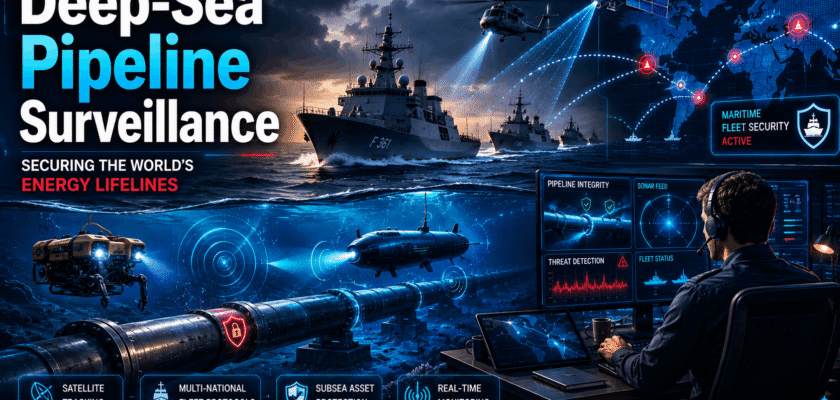
Deep-Sea Pipeline Surveillance: Why It Matters Now
Deep-sea pipeline surveillance has moved from a technical energy issue to a global security priority. Subsea pipelines, power cables and telecom links now sit at the centre of national resilience. When these systems fail, the impact can reach homes, ports, markets and military planners.
Recent disruptions around the Baltic Sea have made governments more alert. As a result, NATO, the European Union and regional states are investing in stronger maritime monitoring, faster reporting and better coordination with industry operators.
However, the challenge is difficult. Undersea infrastructure is long, hidden and often located outside normal public view. A single energy link may cross several legal zones, shipping lanes and seabed conditions.
Therefore, the new security model is layered. It combines naval patrols, aircraft, drones, satellites, seabed sensors, shipping-data analysis and private operator alerts.
| KEY TAKEAWAYDeep-sea pipeline surveillance is no longer only about finding leaks. It is about detecting suspicious activity, protecting energy security and creating a faster response system before damage spreads. |
Deep-Sea Pipeline Surveillance and the Baltic Warning Signal
The Baltic Sea has become a clear warning zone for undersea infrastructure risk. Reuters reported in January 2026 that Finland, the European Commission and Baltic Sea states were working on a maritime surveillance centre to protect critical undersea infrastructure in the Gulf of Finland.
That report also noted that the region had been on high alert after power, telecom and gas pipeline disruptions since Russia’s 2022 invasion of Ukraine. In addition, NATO increased its Baltic Sea presence with frigates, aircraft and naval drones.
Meanwhile, NATO’s Baltic Sentry mission was launched in January 2025 to improve critical infrastructure security. NATO described the effort as a way to integrate national surveillance assets and strengthen deterrence.
What Multi-National Fleet Security Looks Like
Multi-national fleet security does not mean one ship guarding every kilometre of pipeline. Instead, it means several countries sharing the burden of awareness, patrol and response.
Naval forces may watch high-risk corridors. Maritime patrol aircraft can cover wider areas. Drones can inspect suspicious zones. Coast guards can handle law-enforcement steps closer to shore. At the same time, private operators can feed technical alerts into national systems.
Because these assets belong to different authorities, the command model must be clear. The best protocol defines who watches, who verifies, who responds and who informs the pipeline operator.
The Main Layers of Subsea Energy Link Protection
✓ Surface patrols to track vessels near sensitive routes.
✓ Maritime patrol aircraft to cover large sea areas quickly.
✓ Uncrewed surface and underwater systems for closer inspection.
✓ Satellite and radar monitoring for route-level awareness.
✓ AIS tracking to identify unusual ship movement or gaps.
✓ Seabed sensors to detect vibration, pressure change or acoustic signals.
✓ Operator control rooms to flag pressure drops or leak warnings.
✓ Shared incident rooms to connect military, coast guard and industry teams.
| SECURITY LAYER BOXThe strongest system is not one sensor or one patrol ship. It is a linked network where technical alarms, vessel tracking and maritime response teams work together. |
Why Pipelines Are Harder to Protect Than Ports
Ports have fixed gates, cameras and security zones. Pipelines are different. They run across long seabed routes where visibility is limited.
Moreover, undersea pipelines can pass through international waters, exclusive economic zones and national waters. This makes legal response more complex.
Another challenge is attribution. A pipeline problem may come from an accident, equipment failure, anchor drag, environmental stress or deliberate interference. Because of this, investigators need data from several sources before making public claims.
How Drones and Sensors Change the Game
Uncrewed systems are now central to deep-sea pipeline surveillance. They can reduce risk for human crews and inspect areas that are hard to reach.
Underwater drones can check pipeline sections, seabed scars and anchor marks. Surface drones can monitor routes for longer periods. Meanwhile, sensors can watch for vibration, pressure and acoustic changes.
However, drones are not a complete answer. They need strong data links, maintenance, legal permissions and trained teams. Still, they help create a faster inspection loop.
The Role of Industry Operators
Pipeline operators know the technical heartbeat of their assets. They monitor pressure, flow, leak indicators and maintenance records.
Because of that, industry data is vital. NATO’s Critical Undersea Infrastructure Network has included industry stakeholders, civilian authorities and military experts to deepen cooperation.
Still, companies cannot replace state security forces. The better model is partnership. Operators provide technical alerts, while governments provide maritime authority, intelligence and response capacity.
What Suspicious Activity May Look Like
⚠ Vessels slowing or circling near known infrastructure routes.
⚠ Ships switching off location signals in sensitive waters.
⚠ Repeated crossings over a pipeline corridor.
⚠ Anchor activity close to cable or pipeline zones.
⚠ Unusual drone, submersible or survey activity.
⚠ Technical pressure alerts that match nearby vessel movement.
⚠ Coordinated activity around several infrastructure points.
Legal and Political Friction
Deep-sea pipeline surveillance also creates political friction. States want stronger security, but they must respect maritime law, commercial shipping rights and international boundaries.
The European Policy Centre argued in 2025 that repeated acts of sabotage against undersea infrastructure call for coordinated and collective response. It also said the EU should support a stronger interpretation of maritime law to safeguard cables and pipelines.
This shows the policy problem clearly. Surveillance must be stronger, but it must also be lawful, evidence-based and coordinated.
Why Energy Markets Are Watching
Subsea energy links are not only engineering assets. They can affect gas supply, electricity flows and investor confidence.
If a pipeline is damaged, traders may price extra risk into energy markets. Insurance costs can rise. Governments may also need emergency energy planning.
Therefore, better surveillance can reduce uncertainty. It cannot stop every incident, but it can make response faster and more credible.
What Countries Should Improve Next
✓ Map critical subsea routes and update risk zones regularly.
✓ Share non-sensitive vessel and infrastructure risk data across agencies.
✓ Create clear response rules for territorial waters and exclusive economic zones.
✓ Run joint exercises with navies, coast guards and private operators.
✓ Use drones and sensors for routine checks, not only emergencies.
✓ Build evidence chains so investigations can stand up politically and legally.
✓ Invest in redundancy so one damaged link does not create a wider crisis.
Organic Search Summary for Readers
Deep-sea pipeline surveillance matters because modern energy security depends on hidden infrastructure. Pipelines and cables are hard to guard, yet they are essential for daily life.
The newest security model is multi-national and layered. It uses patrol ships, aircraft, drones, sensors, shipping data and industry control rooms.
Most importantly, surveillance is not only about watching the sea. It is about turning signals into fast, lawful and coordinated action.
Conclusion
Deep-sea pipeline surveillance has become a defining issue in global politics. The Baltic Sea experience shows how quickly subsea infrastructure can become a security concern.
NATO’s Baltic Sentry, regional monitoring centres and industry cooperation all point in the same direction. Governments now want earlier warnings, better evidence and faster response.
However, the task is complex. Pipelines are long, hidden and legally sensitive. That is why the future of subsea energy security will depend on smart coordination, not only stronger patrols.
Frequently Asked Questions
Q. What is deep-sea pipeline surveillance?
Deep-sea pipeline surveillance is the monitoring of subsea pipelines using patrols, drones, sensors, satellites, shipping data and operator alerts.
Q. Why are subsea energy links important?
They move energy across regions and support power, heating, industry and national resilience.
Q. What is NATO Baltic Sentry?
Baltic Sentry is a NATO mission launched in January 2025 to strengthen critical undersea infrastructure security in the Baltic Sea region.
Q. Can drones fully protect pipelines?
No. Drones help inspect and monitor, but they must work with patrols, sensors, legal authority and response teams.
Q. Why is the Baltic Sea important for this topic?
The region has seen multiple power, telecom and pipeline disruptions, making it a major test case for undersea infrastructure protection.


